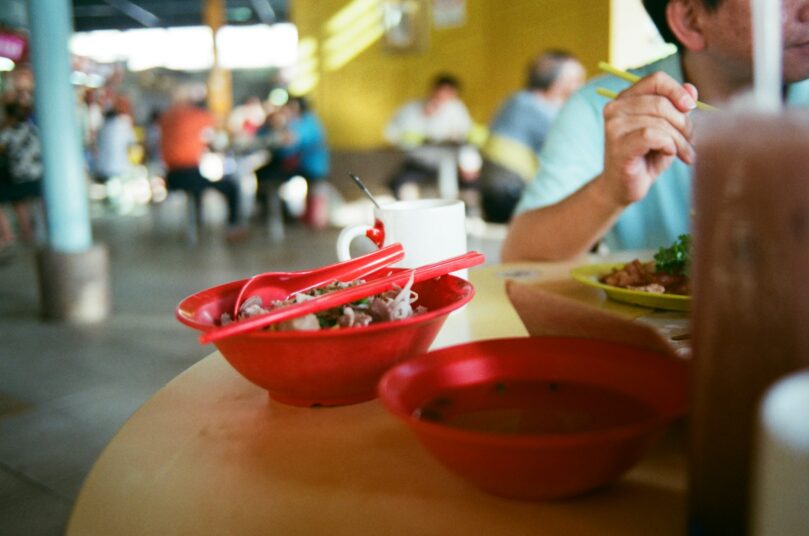
In this podcast episode, I chat with a fellow Singaporean, Adlena Wong, whom I got to know on LinkedIn, proving that LinkedIn does work in connecting people with shared interests. It wasn’t just because Adlena was a fellow Singaporean that got me curious, but it was her candid reflections on LinkedIn that either resonated with my experiences or provided a counterpoint to what I experienced. Plus her food business and signature bak chor mee (minced meat noodles) meal prep kit certainly appealed to the Singaporean craving for heritage comfort food.
An important theme that came up in our conversation was “side hustle”, a term people use to describe a business or project you run in your spare time, but often seen as less important than your main job. For Adlena, her food entrepreneurship journey was not just a side hustle and mattered in ways that regular employment did not offer.
It made me reflect on my foray into podcasting, a side hustle of sorts, but certainly an important aspect of my personal development and desire to connect more deeply with the topics and themes I’ve been writing about for years – crossing borders, feeling different, and discovering how being and belonging is an ongoing dance.
I’ve written about the portfolio career as something that happened to me over time, and how reflection helped me understand its deeper implications. Sometimes talking about our career as a portfolio of experiences and skills can liberate us from the shaky career ladder of progression and paychecks. I’m not suggesting that the moment we fail the career-ladder stress test, we simply become a portfolio of whatever has happened to date. I am suggesting that we use a different lens to appreciate how our skills, talents and experiences have shaped us and led us up and down and across the career game board. And even more than that, explore different ways to think and talk about our careers.
If you’re someone who has crossed borders and cultures, what does your portfolio look like?
Or to use a food metaphor, what do your main course, side dishes, desserts and specials look like?
Watch or Listen to the Episode
Watch on YouTube: https://youtu.be/eAjLLa3Lw-4
Listen on Spotify: https://open.spotify.com/episode/4t4hQVdUVejoGMtk6TI66X?si=YcPehUm5RoW1odIp6XC7eg
Meet the Guest: From Communications Career to Food Entrepreneur
Adlena Wong is the founder of Super Shiok Eats, a Singaporean food business in Auckland, New Zealand, and a part-time internal communications lead at a public sector organisation there. She moved from Singapore to New Zealand roughly eight years ago, arriving just before the COVID-19 pandemic, and is a communications professional and mother of two daughters.
Why “Side Hustle” Undersells the Work of Building Something New
A “side hustle” undersells committed work because the label measures effort by job title and hours, not by the intensity of care behind it. Adlena makes this case for Super Shiok Eats: the business grew out of necessity rather than a formal career plan, but the effort, energy, and dedication she pours into it disqualifies it from being casual.
Someone can be a casual worker in title terms while still bringing full dedication — and that level of commitment, not the formality of the role, is what actually defines “real” work.
For Adlena, her day job as an internal comms lead is what pays the bills. Super Shiok Eats, on the other hand, is where she sees no ceiling on what’s possible — a distinction worth naming for anyone weighing a “day job” against a passion project they’re reluctant to call minor.
How to Turn a Difficult Season Into a New Direction
Turning a difficult season into a new direction often starts with using enforced disruption to finally test an idea you’d already been holding onto. Adlena had completed her food safety certification about a year after arriving in New Zealand — a long-held ambition to eventually start a food business — and when COVID-19 lockdown hit, she needed a personal outlet beyond childcare and supporting her husband’s work-from-home routine, so she began cooking and selling food beyond her immediate family and friends.
What started as something that felt “silly” to launch mid-pandemic turned out to be well-timed: with international travel closed off, homesick members of the diaspora in New Zealand became customers, telling Adlena that her food — including her bak chor mee (minced meat noodles) — helped them feel less homesick and reconnected them to specific memories of home. It’s a reminder that constrained, disruptive periods can sometimes create the exact conditions — time, need, and a captive community — that a new direction requires.
What Your First Jobs Abroad Might Actually Look Like
Your first jobs abroad might look nothing like your prior career, and that’s normal. Before returning to communications work, Adlena took on several unrelated roles while settling into her new environment:
- Paper delivery run — found through a local Facebook community group; a way to exercise and learn her new neighbourhood while fitting around school drop-off and pick-up.
- Teacher aide — grew out of volunteering at her eldest daughter’s school, and gave her insight into how the local schooling system works from the inside.
- Daycare helper — a further extension of her hands-on involvement in her children’s early education environment.
- Contract communications role — a six-month maternity cover at an insurance company, which led to her current position as an internal communications lead.
The pattern is a useful one for anyone starting over: taking work that’s unrelated to your prior career, but that fits your immediate circumstances, can be a legitimate bridge back to your field rather than a detour from it.
What an Isolating Start Can Teach You About Family Resilience
An isolating start can force a family to rely on itself in ways that build resilience faster than a wider support network would allow. Adlena describes arriving in a new country and going into lockdown shortly after as a “double whammy” — new to the place and then isolated within it — but in hindsight frames it as a positive turning point: two years of relative self-reliance strengthened her family unit in a way she believes would have been harder to achieve back home, where extended family and social obligations would have competed for attention.
Why Workplace Culture Feels So Different After an International Move
Workplace culture feels different after an international move mainly because of pace and trust — two things rarely named outright but felt daily. Asked to pinpoint the biggest difference she’s experienced, Adlena points to pace: having to slow down significantly compared to the fast, efficiency-driven environment she was used to. She frames this as an open question rather than a settled judgement — she isn’t sure whether it’s harder for migrants to slow down, or harder for locals to speed up.
A second lens raised in conversation: the level of interpersonal trust in workplaces and communities, where relationships and an assumption of good faith carry significant weight. Adlena reframes her home country’s more rules-heavy environment not necessarily as low trust, but as a “nanny state” habit of being taken care of — contrasted with a more laissez-faire “she’ll be right” culture in her new country. For anyone navigating culture shock at work, this kind of reframing — treating friction as difference rather than deficiency — can make the adjustment easier to sit with.
How to Hold Onto Your Identity While Building a Life Somewhere New
Holding onto your identity while building a life somewhere new means separating home from life rather than forcing yourself to choose one. Adlena identifies clearly with her country of origin — she holds its passport, speaks with its accent, and runs a business built around its food — while drawing that clear distinction:
Home is always where you’re from. Life is where you are.
She describes this as her version of “work-life balance” applied to geography — home remains thousands of kilometres away, but her present, day-to-day life is firmly in her new country. Family ties, especially with her mother and her husband’s family, still anchor “home” to where she came from. This kind of dual framing — rather than forcing a single answer to “where are you from” or “where is home” — is a useful model for anyone who feels pressure to fully “belong” to only one place.
Why a Career Change Abroad Can Unlock Confidence You Didn’t Have at Home
A career change abroad can unlock confidence because starting where nobody knows your professional reputation removes the pressure to stay on a single, predictable track. Adlena credits exactly this — the relative anonymity of starting over in a new country — with giving her the confidence to pivot away from a traditional, upward-only career path, in contrast to her home country, where she believes she’d most likely still be climbing toward a formal, single-track leadership title.
Despite founding and growing her own business, she has deliberately stayed hands-on with the fundamentals of her craft — writing, research, email campaigns, photography, and event organisation — rather than moving entirely into oversight. She credits this hands-on approach with giving her the practical skills (branding, marketing, communication) that made her business possible. For anyone facing a career change, this suggests that skills built in one context can transfer directly into building something of your own, even in an unrelated industry.
What People Moving Abroad Often Miss Most About Home
What people miss most about home after moving abroad is often small and practical, not grand or cultural. For Adlena, it’s public transport — an efficient, affordable, reliable transit system, contrasted with the cost trade-offs she now weighs in her new country, like choosing between a costlier bus fare and parking — a reminder that everyday conveniences, once taken for granted, are often what’s felt most acutely once they’re gone.
How to Know Which Advice to Trust When You’re Weighing a Move Overseas
The advice worth trusting when weighing a move overseas usually comes from people who made a similar trade-off recently, not from generic reassurance that a move is simply “right” or “wrong.” Adlena leans on the perspective of peers who moved around the same time as her, rather than earlier generations of migrants whose circumstances differ, and the advice she returns to is about trade-offs: things she might not have had at home — such as owning two cars or living in a landed property with a garden — are part of what she’s gained by moving, weighed against what she’s given up.
The One Thing to Remember Before You Move Overseas
No matter what happens, you can always come home. That’s Adlena’s answer when asked what she’d tell her pre-move self — and the same reassurance she hopes to pass on to her own daughters if their life circumstances ever become difficult: home remains a place to return to, regardless of outcome.
Q&A Highlights
Where is home for you?
“I think it would still be Singapore. I spent most of my life being born and raised there, and family is still there — our parents are all back home. That tie still being there makes it hard to break, just because we are in a different country.”
What’s the one thing you miss about Singapore?
“Public transport — good, efficient, reliable public transport that doesn’t cost you an arm and a leg and make you question your life decisions, like: Should I pay $10 to take a bus or take the car and pay $7 for my parking?”
If you could tell your pre-move self one thing, what would it be?
“No matter what happens, you can always come home. If it doesn’t work out, if life gets too hard, come home. That’s what home is.”
About Dr Sherrie Lee
Dr Sherrie Lee is a career coach and educator for international professionals, ICF certified in positive psychology coaching. She is a Professional Member of CDANZ, where she hosts the Character Strengths Special Interest Group, and writes and speaks regularly on international careers, character strengths, and cross-cultural belonging.
Learn more at thediasporicacademic.com, book a free 20-minute discovery call, connect on LinkedIn, or subscribe to the monthly newsletter International Career Journey on Substack.
Subscribe to the podcast International Career Journey on your platform of choice: 🎥 Subscribe on YouTube 🎙️Subscribe on Spotify