Close
Paper boat on top of a globe symbolising international career journey
Image by Joachim Schnürle from Pixabay

My International Career Journey: Everything Everywhere All At Once

A Year of Professional Development, Character Strengths, and Portfolio Strategy

At the start of 2025, I’d set out to go deep and hone my craft as an international career coach. I committed to professional development, reaching a wider audience with my character strengths workshop. Along that journey, I also experienced planned happenstance – being presented with opportunities when I least expected it, and taking a leap of faith and saying yes.

When I look back at what I’ve done, I find myself taking a pause, a deep breath, and savouring the moment. Imagining I was looking at an art work on the wall, I see Jackson Pollock’s Convergence where “the process of dripping, pouring, and splattering provided him with a combination of chance and control.” 

Jackson Pollock's Convergence painting - vibrant abstract expressionist artwork demonstrating the balance of chance and control in creative process, metaphor for international career development journey
Jackson Pollock’s “Convergence” (1952)

Chance and control. Having a direction of travel but not knowing exactly if it will and how it will work out. Making plans and adjusting them as other things pop up. Keeping my focus on what I want: To make a bigger and deeper impact on international professionals in their career journey.

Professional Development is Non-negotiable

I’ve learnt time and time again that there’s always more to learn, even if you feel you’re at the peak of your career or on top of your game. In fact, if we accept that people and society are dynamic and ever-changing, then it follows that we will need to keep learning, refining, and sharpening our toolkit and skill set.

This year was marked by extensive professional development in career practice. When I get serious about something, I don’t just read a book about it. I could be biased since I have learning as a top strength. And truth be told, sometimes I overuse this strength to my detriment – signing up for way more webinars than I can practically attend or reasonably focus my attention on. But I’m learning the lesson of ‘less is more’ and ‘fewer but deeper’.

A rang of tools and parts symbolising the career toolkit international professionals need to continuously replenish and refine.
Image by Евгений from Pixabay

For international professionals and migrants navigating career transitions, this commitment to continuous learning becomes even more critical.

New Zealand vs Singapore: Two Approaches to Professional Development 

It’s also interesting to note the contrasting attitudes toward professional development between New Zealand (where I live) and Singapore (where I’m from). In New Zealand, professional development is individual-driven, incentivised (or disincentivised) by the organisation’s commitment to it in terms of time and money, as well as the value they perceive it has on the day-to-day operations and organisational needs. In Singapore, at least in the government and education sectors, professional development goes hand in hand with performance evaluation and career advancement. In fact, the Singapore government has a nation-wide blueprint of workforce development for different sectors and career stages, often heavily subsidised, clearly encouraging businesses and organisations to keep their employees up to date and future-ready.

In various New Zealand workplaces, I often find myself the most enthusiastic about professional development among my peers, and also the most disappointed when there is no formal career progression pathway, or when I realise the pathway is part of the ‘hidden curriculum’. Over time, I’ve learnt to be the boss of my own professional development, and in fact, that is often the message I get from managers and HR folk – you decide what you need and ask for it. If the stars (and budget align), you get it!

I believe there is a lot more New Zealand organisations can do to make staff professional development more structured, strategic and a win-win incentive for productivity and innovation. However, I’ve also learnt to embrace an entrepreneurial mindset to designing my professional development and ultimately my career portfolio. And this year was a bumper crop of professional development, more than I actually initially planned for.

Being the Boss of My Own Development

I committed to raising my practice to the highest industry standards. While anyone can call themselves a coach or career advisor, I wanted to provide quality assurance of my work. This year, I completed the 130-hour Facilitating Career Development course, a prerequisite for earning the globally recognised Certified Career Services Provider credential from the National Career Development Association. The programme bridged theory and practice and addressed cultural and ethical dimensions of career practice. Certification required passing an exam and ongoing professional development. To deepen my coaching skills, I’m also close to finishing an ICF-accredited Positive Psychology Coaching programme which has been a truly transformative experience.

Coffee mug next to laptop with screen showing webinar participants.
Photo by Chris Montgomery on Unsplash

Another professional development highlight was an on-demand webinar series called Practice, Practice, Practice co-organised by the Career Development Association of New Zealand (CDANZ) and the Career Development Association of Australia. The series reminded me of the importance of career theory in practice and how ongoing professional development involves the humility of peer supervision and learning from others’ practice. For me, this balance of knowledge acquisition and learning through and from community is the gold standard of professional development. Thinking about the differences between Singapore and New Zealand, Singapore tends to favour knowledge acquisition more than peer learning while New Zealand more readily adopts a community of practice approach. Over and above these two approaches, critical reflection is key to pulling the different threads of professional development into a meaningful learning experience that can have a positive influence on practice. Less is more. Fewer but deeper.

Character Strengths in Career Development

The VIA character strengths framework has become my go-to tool for career coaching and self-awareness development. These 24 character strengths make up the best aspects about our personality.

Developed by researchers in positive psychology, the VIA character strengths framework proposes that everyone possesses all 24 character strengths in varying degrees, so each individual has a unique personal profile. Each character strength falls under one of these six broad virtue categories, which are universal across cultures and nations. The framework uses simple but thoughtful language to describe each strength, applicable across a variety of contexts, and the survey is free to access.

Why VIA Character Strengths?

Because the VIA framework is underpinned by robust research, easy to understand, has wide application and is freely accessible, the VIA survey of character strengths has become my top choice for developing self-awareness – one of the foundations of developing your own career. I’ve written on the topic of character strengths in career development and have spoken about it on two podcasts. One of the podcasts came about in the most serendipitous fashion – I was scrolling through my LinkedIn feed and came across a call for guests on a podcast program to talk about assessments in coaching. The VIA survey immediately came to mind and after a couple of emails and a thoroughly enjoyable recording session, I’m really proud to have shared my heart about character strengths and how doing the survey and pouring over my personal profile has personally transformed my career perspective at a time of job redundancy. For international professionals facing career uncertainty or workplace transitions, understanding your character strengths can provide an anchor of self-knowledge in times of change.

You can’t hide a light under a bowl. Apart from running monthly workshops on character strengths at the university where I work as a career consultant, I’ve run a few webinars on the topic, including a session for the 2025 Higher Education Summit that came about in yet another serendipitous manner. Once again it was my LinkedIn feed that led me to a post on the summit. After reading about the background, the call for contributions and one of the themes of emotions, well-being and inner development, it became clear to me: this was an opportunity to share my character strengths workshop to a global audience! Strength in action: Spirituality.
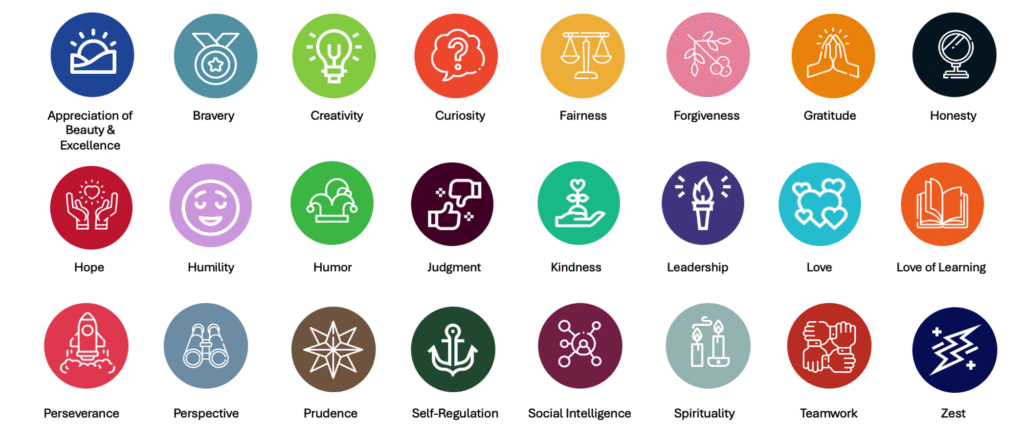
24 icons representing the 24 VIA character strengths designed by Dr Sherrie Lee
24 Character Strengths Chart © 2025 Dr Sherrie Lee

Taking Character Strengths Global

I took a leap of faith and put together a proposal for the webinar, not knowing much else about the summit or the people who would attend. The proposal was accepted, I prepped for the webinar and up till the last few minutes before the start time, I had no idea how many would turn up. We ended up with a cosy group of eight people from different European countries and backgrounds, and had a precious time of open sharing and discussion of how we can apply character strengths in scary times. Connecting with higher education students and professionals from another continent also helped me to fulfil my dream of expanding my impact on international professionals. Strength in action: Zest.

Building Community: The CDANZ Special Interest Group

However, what I am most proud of is establishing the CDANZ Special Interest Group on Character Strengths. Sharing best practices and learning together with a professional community requires not only time commitment but also active participation. I started with a simple belief that good things cannot be kept hidden and ran a character strengths webinar for CDANZ members with a call for interest in a special interest group (SIG). We had enough numbers to confidently launch the SIG and the three meetings we’ve had to date have helped to create a warm and inclusive group who are generous with sharing and deeply reflective. The smooth running of these online meetings would not have been possible without the assistance of a colleague who helped with refining meeting activities and reflection exercises, as well as providing technical support during meetings. There were times when I wondered if all these hours of prep and admin was going to result in any significant gain. But when I think back to the various aha moments and learning reflections at the SIG meetings, I realise the intrinsic value of talking about strengths in a safe and supportive environment. It is ultimately a service to my professional community in the belief that learning comes through reflection, and transformation through application. Strength in action: Gratitude.

International Career Portfolio Rebalance

An important part of my own international career development this year was reviewing my portfolio career strategy and how I could make a bigger impact. Strategy for me is not a one-day meeting to work out what’s important and what to discard, but more like a meandering experiment until I find my answer. I don’t recommend this approach for everyone but with Spritiuality as my top character strength, followed closely by Creativity and Zest, I knew I couldn’t help but connect with people, try out new ideas, and with a full tank of energy. 

Sure I overused these strengths on many occasions, but I also learned to recover in equal measure through silence and rest. There are ways to bring these strengths into optimal use but I honestly much rather overuse them and find ways to compensate at later times. And over time I’m sure I’ll recalibrate the balancing act. But for now, I’m very much driven by the motto: Carpe diem, seize the day, make your lives extraordinary.

Finding My Themes Through Writing

Through the process of more regular blogging and starting a monthly newsletter International Career Journey (on LinkedIn and Substack), I’ve clarified what my portfolio career stands for. I’ve gravitated towards these core themes for international professionals:

  • Navigating cross-cultural workplaces and transitions
  • Future proofing your career by building portfolio careers
  • Self-awareness through character strengths and critical reflection

These themes aren’t just what I write about. They’re the foundation of how I’m building my own portfolio career.

Adding Portfolio Skills through my Instagram Experiment 

Part of rebalancing my career portfolio meant adding new skills and experimenting with different mediums. I’ve been experimenting with creating content for my Instagram account. I wanted to learn more about media content creation and how easy – or difficult – it would be to learn and to implement on a regular basis. The learning curve was steep! They say reels are the primary tool to drive engagement, and I’m still learning about what makes a good 3-second hook.

Apart from self-taught lessons on trending audio, reel length and hooks, I also learned about the fleeting nature of attention, how the medium is the message, and admittedly, a personal sense of helplessness in never being able to keep up with the latest trends and algorithms in instagram worthy engagement. But this is part of portfolio career building: trying new things, discovering what fits, and letting go of what doesn’t. I’ve learnt to stop competing and comparing and focus on creating moments of insight with a bit of fun and flair.

From Experiment to Clarity: Portfolio as Process

And where has this meandering experiment taken me?

From working to ‘impossible’ deadlines (and meeting them anyway) to a place of pause and reflection.

From scattered activities to intentional choices.

This year taught me that portfolio career strategy isn’t about having everything figured out. It’s about staying true to your core purpose while remaining open to unexpected opportunities. The professional development courses, character strengths workshops, newsletter writing, Instagram experiments – each was both planned and spontaneous, controlled and chance-driven.

I don’t need to have absolute certainty of what my portfolio looks like. What matters is the clarity of purpose that guides every decision: To expand my influence and impact on helping international professionals thrive on their career journey, whichever stage and place they may be.

The portfolio isn’t fixed. It’s a living, evolving composition, constantly being rebalanced as new opportunities emerge and priorities shift.

As I bring up the image of Jackson Pollock’s Convergence once again, I stand in awe of the masterpiece that is a result of chance and control. 

An image of Jackson Pollock's Convergence (1952)

For anyone on their own international career journey, I hope these reflections on professional development, character strengths, and portfolio career building offer both inspiration and practical pathways forward

Carpe diem, seize the day, make your lives extraordinary.

Frequently Asked Questions About International Career Development

Q: What are VIA character strengths and how do they help with career development?

The VIA (Values in Action) character strengths are 24 universal qualities that represent the best aspects of our personality, developed by researchers in positive psychology. They help with career development by providing a foundation of self-awareness. This helps you understand what energises you, how you naturally approach challenges, and where you might be overusing or underusing certain strengths. For international professionals, understanding your character strengths becomes especially valuable during career transitions, as they remain constant even when your environment, role, or workplace culture changes.

Q: How is professional development different between New Zealand and Singapore?

The key difference lies in structure and responsibility. In Singapore, particularly in government and education sectors, professional development is systematically integrated with performance evaluation and career advancement, with nationwide workforce development blueprints and significant subsidies. In New Zealand, professional development tends to be more individual-driven. You’re expected to identify your own needs and advocate for them, with organisational support varying widely. This means international professionals in New Zealand need to adopt an entrepreneurial mindset toward their own development, actively designing their learning pathway rather than following a prescribed route.

Q: What is a portfolio career and is it right for international professionals?

A portfolio career involves combining multiple roles, projects, or income streams rather than relying on a single traditional job. It might include consulting work, part-time employment, freelance projects, and passion ventures all at once. For international professionals, a portfolio career offers flexibility to leverage diverse skills across different contexts, build resilience against job market uncertainty, and create opportunities that traditional employment might not offer. This is especially valuable when navigating visa restrictions, credential recognition challenges, or wanting to maintain connections across multiple countries.

Q: How can character strengths help during workplace transitions?

Character strengths provide an anchor of self-knowledge during times of change. When you’re navigating a new workplace culture, adjusting to different management styles, or facing job uncertainty, your character strengths remain constant. They help you identify what you naturally bring to any situation, recognize when you’re in flow versus when you’re struggling, and make strategic decisions about roles and opportunities that align with your authentic self. This is particularly powerful for international professionals who may be adapting to unfamiliar workplace norms or rebuilding their professional identity in a new country.

Q: What does ‘planned happenstance’ mean in career development?

Planned happenstance is the idea that careers develop through a combination of intentional action and being open to unexpected opportunities. Rather than rigidly following a predetermined career plan, you create possibilities by staying curious, persistent, flexible, optimistic, and willing to take risks. In my own journey this year, planned happenstance showed up when I responded to opportunities I found scrolling through LinkedIn, such as the podcast invitation and the Higher Education Summit, without knowing exactly where they would lead, but trusting they aligned with my broader goal of reaching international professionals. Here’s another article I wrote about planned happenstance: Planned Happenstance – How to Make your Own Career Luck

Q: How do I start building self-awareness for career development?

Start with free, research-backed tools like the VIA character strengths survey (viacharacter.org). Take time to reflect on your results, not just your top strengths, but also your lower-ranked ones and what that pattern tells you about yourself. Combine this with regular critical reflection on your work experiences: What energises you? What drains you? When do you feel most authentic? Consider working with a career coach who can help you explore these patterns and translate self-awareness into actionable career strategies.

Q: What skills are most important for international professionals to develop?

Beyond technical skills in your field, focus on cross-cultural communication and adaptability, the ability to translate your experience across different contexts, resilience and flexibility in the face of uncertainty, networking across cultures and platforms, and continuous learning mindset. These meta-skills help you navigate different workplace cultures, explain your value to employers unfamiliar with your background, and stay agile as workplace expectations evolve.

Q: How can I expand my impact as an international professional?

Consider creating content that shares your unique perspective whether through blogging, newsletters, social media, or speaking opportunities. Join or establish special interest groups in your professional community. Facilitate workshops or webinars on topics you’re passionate about. Look for ways to connect with international audiences through platforms like LinkedIn. The key is finding your authentic voice and the themes that matter most to you, then consistently showing up to share your insights and learn from others’ experiences.

Work With Me

Throughout this post, I’ve shared my journey with professional development, character strengths, and building a portfolio career as an international professional. Now I want to support you in your international career journey.

I’m Dr Sherrie Lee, an international career coach with certifications as a Certified Career Services Provider (CCSP) and ICF-accredited Positive Psychology Coaching. I specialise in helping international professionals, migrants, and academics navigate cross-cultural workplaces, career transitions, and building careers that truly fit.

Based in Wellington, New Zealand, I work with clients globally through one-on-one coaching, workshops, and speaking engagements.

Ready to take the next step in your international career journey?

Whether you’re navigating a career transition, exploring a portfolio career strategy, or seeking clarity on your professional direction, let’s have a conversation.

Book a free 20-minute discovery call to discuss where you are, where you want to go, and how I can help you get there.

Carpe diem, seize the day, make your life extraordinary. And remember, you don’t have to do it alone.


Portfolio careers are increasingly important in a disruptive labour market.
Image by Markus Winkler from Pixabay

The Portfolio Career I Didn’t Know I Was Building

The world feels more uncertain than it was before. Yet I’ve never felt more sure about the kind of career I want. 

That’s not to say I know exactly what role I’ll land in five years or which skills I’ll need to master next. Job titles and roles matter—they help you understand required capabilities and map stepping stones forward. I’ve used this approach many times, and it’s served me well.

But I’m entering a new phase of career thinking. Rather than chase the next job with its narrow definitions and built-in limitations, I want to cultivate my own unique suite of skills and expertise that leads to interesting, challenging opportunities.

Enter the portfolio career.

The Era of Portfolio Careers Has Arrived

We’ve long thought of careers as ladders to climb—promotions, better pay, prestigious titles. That paradigm is all but outdated.

The OECD confirms what many already know: 21st-century career paths have become increasingly fluid. Workers change jobs, employers, and entire careers more frequently than past generations. Average job tenure has declined across OECD countries. U.S. data shows baby boomers held nearly 13 jobs over their working lives, with surveys suggesting half of all workers undergo a complete career change during their lifetime.

“The successful career of the future is not a ladder to climb. It’s a portfolio to curate.” — April Rinne, futurist

Rapid technological change and labour market disruption mean we must adapt continuously, develop new skills, and sometimes change careers entirely. Unlike a job that can be lost, your portfolio career—the collection of skills, experiences, and capabilities you’ve built—is yours forever.

Portfolio careers are especially relevant for international professionals who have crossed borders, rebuilt careers in new countries, learnt whole new cultures, and navigated challenges of visas, identity, and belonging.

This isn’t a trendy concept. It describes what we’ve been doing all along—whether for advancement or survival—even when we didn’t have language to name it.

So how can we better appreciate our own portfolio careers?

Taking inspiration from Agile methodology, I suggest doing a career retrospective: a structured reflection on your journey to date, examining all your roles (paid and unpaid, including volunteering), and discovering themes and threads.

My Career Retrospective: 25 Roles in 25 Years

When I list everything I’ve done from my first gig out of high school to now, I count 25+ roles spanning 25+ years.

My laundry list includes: piano teacher, lifestyle writer, dance company manager, English teacher, conflict management trainer, business communications lecturer, researcher, student association president, business development manager, principal advisor to a deputy secretary, social media manager, board member, worship leader, and university career consultant.

One could call it chaotic. To a recruiter, it might seem like a bewildering collection of disparate roles, leaving them wondering what kind of career chameleon they’re dealing with.

But how about poetic? From a young age, I’ve been driven by curiosity and purpose, following personal interests rather than conventional pathways. Each role represents a desire to pursue passion, help people, or contribute to something bigger than myself.

Photo by Ian Schneider on Unsplash

The Early Years: Passion vs. Pragmatism

The coolest role I had at university was arts and film reviewer for an e-zine set up by enterprising students starting their web hosting business. The gig didn’t pay, but spending evenings watching theatre, dance productions, and countless films for free was payment enough. Critiquing performances and narratives was the highest form of self-actualisation for an arts student majoring in English.

After graduation, I worked in the dot-com sector as it was about to bubble-burst, moved to arts management, then teaching. I constantly felt tension between passion and pragmatism in my home country of Singapore. My peers were well ahead in their established careers while I worried about my CV, which screamed “job-hopper” from day one.

The Settling Down Phase: Getting “Real”

When I was ready to settle down and start a family, I was determined to hang up my footloose approach and get serious about a “real job.” I interviewed for a conflict management trainer role that felt very much in my element. I was video recorded doing a mock training session which felt natural, thanks to past teaching gigs and high school drama productions.

Then came the chat with the big boss. She was concerned about my CV: “Can you actually stay in this job?” I played my adulting card—all truth, no fluff. She later told me: “If it wasn’t for your video, we wouldn’t have given your CV a second look.”

Life stage and family responsibilities changed everything. I was looking for stability and professional growth, which I found in training and education roles. I spent 10 years sharpening my trainer’s toolkit, honing my teaching craft, delving into pedagogies, and completing my Master of Arts in Teaching. There was great satisfaction doing meaningful work through my skills and talents, yet a restlessness tugged at my sensibilities.

The Big Leap: PhD and Migration

That restlessness led to another life-changing transition. Inspired by theories and research I’d spent long hours writing about for my Master’s, I wanted to go further. I decided I wanted to do a PhD in Education with dreams of becoming an academic. I also wanted my family to experience something new, for my children to enjoy their childhood, and to take this calculated risk before we got too comfortable.

We moved to New Zealand where I started a new role as a PhD candidate and threw myself wholeheartedly into academia and research.

Image by Gerd Altmann from Pixabay

Making Sense of the Pattern

How could I make sense of all these roles?

Analysing them using Holland Codes (RIASEC personality types) revealed this: I have a Social-Enterprising-Artistic (SEA) profile. Social is clearly dominant, Enterprising a strong secondary, and Artistic significant. Conventional and Investigative are moderate, while Realistic is non-existent.

Whilst people usually take the profile test to explore related jobs, this reverse analysis helped me appreciate something profound: The SEA profile isn’t just about job preferences or job fit. It reveals my desire to combine social, enterprising, and artistic elements in my work. Or put another way: to be someone who influences and develops people, spearheads projects, and offers creative and original insights.

The portfolio I built was invisible to me for years because I measured it against conventional markers of progress and prestige, even whilst trying to explore alternative directions.

Seven Years of Change, Challenge, and Completion

This realisation emerged recently whilst reflecting on my original migration plans and PhD dreams. Serendipitously, it’s been seven years since completing my PhD.

Seven years. That’s how long it took from completing my PhD in Education at the University of Waikato to finding my way back to a university setting, but in a role I never imagined when I submitted my thesis.

Seven years often represents a period of completion, transformation, and cycles. When I walked across that graduation stage, I carried dreams of an academic career: publications, teaching positions, research grants. That was the primary motivator for moving countries and uprooting my family. The academic career seemed like a natural progression from teaching in higher education, and a worthy, family-proud career I would add.

Photo by MD Duran on Unsplash

The pathway I envisioned was clear and conventional. What I got instead was seven years of non-academic roles where I swapped my academic identity for a professional one that felt strange at first but grew in skills, knowledge, and networks over time. It was difficult to admit I’d “failed” to become an academic. I used to joke that I was a “recovering academic” when I first started my professional role.

But looking at those seven years through an emotional lens, I also recall the roller coaster: rejection and reinvention, success and shattered plans. The search for academic jobs felt hopeful but grew hopeless through successive rejections. Then came a career consultant role for new migrants that was supposed to be temporary but led to pragmatic considerations of stable income. A pivot into government work took me further from my academic identity, yet the professional environment was exciting and rewarding. Just when I thought I’d made impressive strides, involuntary redundancy forced me to consider returning to Singapore, questioning whether migration itself had been a mistake.

The roller coaster graph of those seven years ends on a high with my current role as university career consultant. Climbing from rock bottom to this high point was no magic wand, quick career hack, or pure dumb luck. I was forced to consider all options, dig deep, and get uncomfortable with worst-case scenarios. The Social-Enterprising-Artistic aspects of my career personality jostled for attention. I felt drawn to roles that gave me the most energy and hope.

At any point during those seven years, if you’d asked about my career, I would have simply answered with facts, stating the job I had or that I was looking for one.

But here’s what hindsight reveals: I was building a portfolio career all along. I just couldn’t see it because it’s very hard to avoid measuring yourself against conventional markers of progress and prestige, even when you’re consciously trying to explore alternative directions.

When Your PhD Feels Like a Cruel Joke

PhD students often indulge in cruel optimism – the doctoral aspiration for academic life despite depressing realities of limited opportunities and precarious pathways. I was truly an optimist, feeling ultra-motivated to publish, attend conferences, and do everything possible to increase my academic capital and beat the odds.

My PhD research focused on peer brokering practices amongst international learners, specifically how students navigate culturally relevant connections and networks to succeed in unfamiliar academic environments. I understood, intellectually and personally, what it meant to be an outsider trying to find my way. I’d lived it as a Singaporean Chinese in New Zealand: trying to explain who I was culturally and ethnically to a largely disinterested audience, working hard and speaking out to prove naysayers wrong, always seeking connections and networks that understood my work and identity.

Cruel optimism ran its course. Urgent pragmatism loomed large in the rearview mirror.

The cruel part wasn’t just the reality of the academic job market and short-term contracts, but that being migrant, Asian, Chinese, unconventional, and assertive was a mixed bag of traits that didn’t quite fit the people, place, and perspective where I was situated.

With my PhD degree done and dusted, it was a full-time paid job that would keep my migrant dreams alive, not a half-baked notion of someday getting an academic position. Because that’s what migration demands. You can’t afford idealism when you need to prove economic value whilst still establishing your foothold in a new country.

The Invisible Portfolio I Was Actually Building

They say hindsight is 20/20. Commenting on the past seems easy when you know the outcome. But that clarity is only useful if it’s meaningful and teaches lessons for the future.

What do my aha moments tell me about myself, my career, and my future?

Phase 1: Getting a Foot in the Door (The Accidental Job)

When I took the career consultant role working with new migrants, it felt like survival mode. Ditching the academic dream for a job. A foot in the door to the public sector. Something to pay bills whilst figuring out what came next.

What it looked like then: A compromise. Moving away from academia and research. Leaving behind the identity I’d worked so hard to build.

What I can see now: This role built new knowledge structures of the public sector and provided the very foundation of my career practice today. I was developing:

  • Deep empathy through shared experience: I wasn’t just helping migrants; I was one. I understood the disorientation, the pressure to prove yourself, the exhaustion of constant cultural translation.
  • The art of brokering in practice: My research had been about peer brokering. Now I was doing it professionally by connecting people to resources, translating between cultural contexts, helping others navigate unfamiliar systems.
  • Client-centred coaching skills: Every conversation required listening beneath the surface, understanding what people weren’t saying, recognising cultural dimensions of career aspirations.
  • Knowledge of settlement systems: I was learning the landscape of migration support, policy, and barriers—knowledge that grew my systems thinking and analysis skills.

This wasn’t just a job. It was an apprenticeship in policy implementation and cross-cultural career development that no academic position could have provided.

Phase 2: Embracing a New Professional Mindset (Switching Track)

The pathway into government jobs took me even further from what I thought I wanted. Policy. Stakeholder management. Bureaucratic processes. This wasn’t education. This wasn’t research. This was a completely different professional culture.

What it looked like then: I was losing my academic identity. Becoming someone else. Forced in a different direction.

What I can see now: I was gaining dual citizenship in academic and professional cultures—an attribute I didn’t think much of before but has provided unique credibility to different audiences. I developed:

  • Policy thinking: Understanding how systems work, how decisions get made, how to navigate institutional structures
  • Stakeholder management across differences: Working with diverse groups, building consensus, translating between organisational languages
  • Public sector networks: Connections across government agencies, exposure to how settlement and education policy machinery actually operates
  • Institutional navigation skills: The patience to work within complex systems, the strategic thinking to influence them

I was learning my identity didn’t have to be either/or. I could hold both academic researcher and government professional. I could maintain my “north star” of international education whilst being pragmatic about where I worked. In fact, that north star helped me land a job at Education New Zealand as business development manager.

However, holding two identities also taught me that working in government was less about asserting personal authoritative expertise and more about implementing policies of the government of the day, regardless of opinion or perspective.

Image by Gerd Altmann from Pixabay

Phase 3: Contributing to Causes and Networks (Keeping My Passion Alive)

Throughout my government years, I never stopped watching for opportunities related to my research interests: international students, migration, cross-cultural engagement, supporting ethnic communities. 

I initiated Lunar New Year celebrations at my workplace. I was an active member of the Pan-Asian Public Sector Network. I applied successfully to be a board member of English Language Partners (New Zealand’s largest provider of English language training to migrants and former refugees). I maintained connections with academic friends and professional associations, and wrote about my passion topics on my blog.

What it looked like then: Scattered focus. Trying to be someone I couldn’t really be anymore. Not knowing where passion projects were leading—maybe a dead end.

What I can see now: This was planned happenstance in action, the career theory by John Krumboltz about creating and transforming unplanned events into opportunities. I was engaging in:

  • Strategic networking: Building bridges between sectors, creating weak ties that Mark Granovetter’s research showed would be more valuable than strong ties
  • Domain expertise maintenance: Supporting and advocating for cross-cultural engagement and inclusion even whilst working in completely different areas, ensuring I could speak both languages when opportunities arose
  • Persistence without rigidity: Having direction without being so attached to specific outcomes that I missed other possibilities

I also wonder if keeping passion alive with these extracurricular activities was the extra fuel that kept me motivated in my day job, especially when work demands zapped all optimistic energy from my tank.

Career transitions aren’t just about skills and opportunities. They’re about identity, belonging, and the courage to rebuild yourself when your plans fall apart.

Phase 4: Losing My Job and Feeling Like a Loser (Hitting Rock Bottom)

When the notice of redundancy came, I felt I was free-falling. No government job. Few alternatives. A good track record and previous connections seemed to count for little when everyone else had those things too.

It felt like reliving the cruel optimism of pursuing a PhD but worse. I had overcome, I had succeeded, and now I’d fallen off what looked like the highest rung, with no substitute in sight. Was someone punishing me for thinking I could make it this far?

Urgent pragmatism reared its fat, ugly head. Should I stay or should I go? Should I return to Singapore? Had my PhD and all these years establishing my New Zealand career been for nothing?

What it looked like then: Failure. Career stagnation. The end of my New Zealand story.

What I can see now: This forced pause helped me pull together my portfolio career elements. Now both content and process are key components of my training and coaching practice. I gained:

  • Clarity about values: When considering leaving a country, you discover what actually matters. I had to articulate why I wanted to stay, what New Zealand meant to me, what kind of work would be meaningful.
  • Resilience through radical uncertainty: I learnt to sit with not knowing. To hold multiple possibilities without immediately needing resolution. To be reminded that man proposes, but God disposes, and that God ultimately directs my steps and determines my outcomes.
  • Introspection as a practice: The ability to examine my assumptions, challenge my own narratives, and ask hard questions became a skill I could offer others.
  • Normalising ‘return’ without shame: Many international professionals face this crossroads. I learnt that considering all options, including returning home, isn’t failure. Despite the social stigma of a failed migration story (common in many Asian cultures), I consider it a blessing to be able to have the option of returning home when others may not have such a choice. It’s a choice worthy of consideration that holds potential benefit.

This period taught me something important about career transition: 

It’s not just about transferrable skills and opportunities. It’s about identity, belonging, and the courage to rebuild when plans fall apart.

During this time, I took steps to explore what I’d been interested in for ages, what was part and parcel of an academic’s job, what I’d done professionally as corporate trainer and lecturer, and engaged in when mentoring junior staff and organising onboarding programmes: training and coaching.

I started looking into professional development programmes, getting credentialled for past experience and skills, volunteering my training and coaching services to not-for-profits. The more I did it, the more alive I felt. I was once again in my element!

Attaining professional membership with the Career Development Association of New Zealand was a milestone of gigantic proportions. It validated this: that my PhD in Education and previous teaching, coaching, and career development experience had not been in vain. In fact, all of it was highly valuable for the work of a careers practitioner.

Phase 5: University Career Consultant (Full Circle Integration)

After more than 20 job applications and rejections, whilst exploring and experimenting with training and coaching, a job ad caught my attention: Career Consultant, Victoria University of Wellington. This was a role I’d been practising for months, work I’d done before, in an environment I was highly attracted to. I interviewed successfully for the role, and when I started, it felt absolutely right from day one.

It wasn’t the academic role I’d once clamoured for, but I was working in an educational and intellectual environment promoting student success and supporting equity groups like international and refugee-background students. Not only was I doing meaningful work with direct impact, I genuinely felt welcomed, included, and valued for my knowledge and contributions. Turns out my PhD and all those publications and conferences had built a reputation I didn’t know existed!

What it looked like then: Finally arriving. Coming home.

What I can see now: This role was only possible because of everything that came before. I didn’t return to the university. I arrived as someone completely different.

I brought:

  • Lived experience of migration that allows me to truly understand international students
  • Government systems knowledge that helps me navigate institutional contexts
  • Cross-cultural coaching expertise developed through working in multicultural Singapore and with new migrants in New Zealand
  • Research credentials that give me credibility in an academic environment
  • Brokering skills I can now teach explicitly, drawing on both my PhD research and professional practice

The portfolio I built wasn’t the one I planned. It was more meaningful, more multifaceted, and more transferable than I could have imagined.

Hindsight is 20/20, but only if you’re willing to look back and name what you’ve built. Only if you’re willing to let go of the portfolio you planned and embrace the one you actually have.

The Portfolio Career You Have Is Often Not the One You Planned

When I look back at those seven years between PhD and university career consultant, I don’t see wasted time anymore. I see a portfolio that emerged through lived experience, adaptive responses, and willingness to learn from unexpected places.

The portfolio I built was invisible to me for years because I only saw what was important for my current job and immediate future. I thought success meant getting the job you trained for, getting promoted, getting more money.

But the career retrospective helped me see that where I am today isn’t just a result of accumulated skills, knowledge, and experience. My career personality profile of Social-Enterprising-Artistic was seeded during university, evolved over different life stages, and very much fuelled the career choices and life decisions I’ve made.

Image by Vilius Kukanauskas from Pixabay

Here’s the paradox I’ve come to understand: even as I consciously tried to chart a different course, I found myself unconsciously measuring progress against traditional markers like job titles, seniority levels, institutional prestige. It’s incredibly difficult to fully let go of these ingrained metrics, even when intellectually you know they don’t capture the full picture of career growth. The tension between exploring new directions and seeking validation through conventional markers was constant. Only in retrospect can I see that the real progress was happening in the very moments I thought I was “falling behind.”

Hindsight is 20/20, but only if you’re willing to look back and name what you’ve built. Only if you’re willing to let go of the portfolio you planned and embrace the one you actually have.

An Invitation to Be Intentional

What hidden portfolio have you been building?

Look back at your career path, especially the parts that felt like failures or detours.

  • What were you actually learning?
  • What skills were you developing that you’ve never named?
  • What connections were you making that seemed peripheral but turned out essential?

The career you have is often different from the one you planned. But different doesn’t mean lesser. It may be richer than you thought, more resilient than you realise, and truly unique and yours to own.


Dr Sherrie Lee is a career coach for cross-cultural and mid-career transitions. She helps international professionals build networks and thrive in new work cultures. Her lived experience as a migrant, research on knowledge brokering, and active professional networks give her a unique perspective on staying resilient and future-ready amid career uncertainty and disruption. Connect with her at thediasporicacademic.com

Who Am I? Finding Identity as an International Professional

“You’ll never please everyone. So who are you really choosing to be?”

After living away from my home country for more than 10 years, I still struggle to answer one simple question: who am I?

It’s not that I lack a label. I call myself an ‘international professional’ – a term that sounds respectable enough. ‘International’ suggests movement across borders. ‘Professional’ implies accumulated knowledge and expertise. But this convenient shorthand still falls short of capturing who I really am.

As a career coach working with international professionals, I see this struggle everywhere. In networking events. In job interviews. In LinkedIn profiles that somehow all sound the same. We’ve learned to package ourselves neatly into expected categories – the ambitious expat, the global nomad, the third culture kid. But these labels often feel hollow because they don’t capture our actual experiences or what truly drives us.

The truth is, being able to articulate who you are matters. Potential employers want to understand your story. Collaborators need to know what you bring beyond credentials. Your professional network connects with you because of shared values and experiences, not just shared industries.

Yet so often, we default to stereotypes or generic descriptions that don’t distinguish us from anyone else.

Image by Gerd Altmann from Pixabay

The Challenge of Self-Definition

So how do you break free from generic labels and articulate who you really are?

I’ve considered the usual options, and none quite work.

Why Common Labels Don’t Fit

Citizen of the world? Too easy, too cheap, and hollow in every practical sense. You are really only a citizen of one country, maybe two if that’s allowed. Citizenship carries the heavy responsibility of representation, belonging, and defending the country’s honour. How can I possibly do that for the world when it is hard enough to do it justice for my own country?

Personal demographics? I could list my age, gender, ethnicity, and my multiple roles as mother, wife, worker and community volunteer. But I don’t feel like exposing my personal life to a wide faceless readership. There’s little chance of meaningful dialogue in the internet sphere of partial fleeting attention.

Professional credentials? I could dig deep into what I do and the value I bring. After all, isn’t that what we do on LinkedIn? We position ourselves as an authority on X, with sure-fire strategies for Y, and crystal ball gazing into the future of Z. But I hear the dissenting voice: oh no, not another cringy self-promotional humble brag!

Confessional authenticity? Maybe I ditch being professional and go confessional. I could reveal my deepest fears, my latest desires, my 2025 bucket list. Would this be the authentic voice that people want to hear? Or just a higher level of cringe for the naysayers?

AI-generated image of an elderly father and young son riding a donkey.

The Father, Son, and Donkey Parable

I’m reminded of the story of the father, his son, and a donkey. They tried every way to travel well, but couldn’t win.

At first, the father rode while the son walked. Bystanders chided the father for letting his young son walk. Then the son rode while the father walked. Now the criticism targeted the son for letting his elderly father walk. Then both rode the donkey together. But the outcry was about cruelty – how could they make the donkey bear the weight of two people? Finally, father and son carried the donkey on their backs. All they heard was laughter and derision.

The moral? You will never please all audiences. So do what you believe is sensible and within your own moral conscience, instead of responding to every possible criticism.

My Story: A Different Kind of International

Applying this moral, who am I beyond the label of ‘international professional’?

I’ll answer with a story.

Growing Up in Singapore

I am from Singapore. I grew up in systems based on meritocracy and competition, shaped by cultural notions of generational respect and family pride.

My peers and I were always trying to go ‘international’ – for culture, education, and lifestyle. But it was a ‘western’ kind of international, with specific countries in mind, ranked in order of preference. This particular form of being international was prestigious, desirable, and an investment for future advancement.

As the internet opened up the world in new ways – connecting us to information, opportunities, and people beyond our borders – going international shifted from dream to possibility. We could see what was out there. We could imagine ourselves in those places. The world felt within reach in a way it hadn’t for previous generations.

But while international-oriented people zigged, I zagged. I wasn’t craving a specific kind of international label or a fast-tracked pathway to success. I wanted to explore ideas that mattered to me and find my own kind of international.

My First International Experience: Canada

My first experience of being international was as an exchange student at Simon Fraser University in Burnaby, just outside Vancouver.

It was also my first experience of snow. It was supposed to be magical. It turned out to be a slushy, sneaker-soaked disappointment I will never forget.

But thank goodness that experience didn’t define my international journey. My dormitory was truly international – local Canadians, international and exchange students from various Asian and European countries. I had eye-opening interactions for my 21-year-old self who had lived a fairly sheltered life in conservative Singapore.

The moments I remembered: Being told off by my Swiss dorm mate for having the radio on too loud at 7 am. (I was playing classical music at what I thought was a reasonable low volume.) Being clueless about putting a paper plate in the oven and nearly burning down the kitchen. Observing a standoff between my Chinese dorm mate cleaning a fish in the shared kitchen sink and the Swiss making remarks in accented English which my Chinese friend either didn’t catch or couldn’t care less about.

I remember squeezing into a car driven by Chinese Jeff who had a broken side window taped up with cardboard. Canadian Bob wasn’t wearing a seatbelt. I kept asking annoying questions: Is this okay? Is it legal? Am I allowed to sit in the middle? All the way to the cinema to watch Good Will Hunting.

I really lapped up the ‘go for it’ attitude of the Canada I experienced then. It was liberating to just try things out and not worry about what others would think. Being international felt like I could be free to explore who I wanted to be!

The Mountain Climb That Changed Everything

The deepest memory I have was going on a mountain climb at the start of Spring.

Weather was great, they said. Won’t you come along? Winter and slushy snow were things of the past. I was no fitness buff but had gotten used to walking around the nearby hills. So I thought, sure, what’s not to like about a mountain climb with friends?

On the day of the hike, I came prepared in my own way. Jeans and track shoes. Umbrella, water bottle, beanie and gloves in backpack.

Of course, everyone else wore appropriate hiking gear. I was the only one in jeans. What did I know about proper hiking clothes? Not much really.

My ignorance became my downfall just a couple of hours in. It was getting difficult to move in jeans. Then it started to rain. Out came my umbrella, which became more burden than help when navigating rocky terrain. I was slowing down as others leaped ahead. Then it started to snow. I could barely make out where the rest of the group was.

My beanie and gloves came in handy at least. But my track shoes were thoroughly soaked and my feet were icy cold. Two guys stayed with me to make sure I kept moving – one behind me, one ahead. The snow was getting heavier. There was no way but up.

I felt like a total fool for thinking the Canadian gung-ho spirit was all I needed for a mountain hike. I felt I was going to die. I was tired, unfit, and miserable about the weather, my incompetence, and totally overwhelmed by the challenge.

But I had two cheerleaders, one from behind and one in front. I somehow managed to inch my way up to the top.

The rest of the group was there, waiting for me. We even took a photo of our victory pose.

Author’s photo: Grouse Mountain, Vancouver (date withheld)

What Being International Really Means

That was the defining experience for me about being international. Exploring a new country and culture. Being unprepared but doing it anyway. Having cross-cultural friendships through shared and meaningful experiences.

It was a brief four months. Over time I’ve lost touch with all these wonderful friends. But those experiences sealed in me this desire to be international and the very real notion that what doesn’t kill you will only make you stronger.

This wasn’t just a memorable trip. It was my inciting incident – the moment that shaped my values, my approach to challenges, and what I look for in my professional life. It taught me that being international isn’t about prestige or following a prescribed path. It’s about the willingness to be uncomfortable, to rely on others, and to push through when you feel unprepared.

My Answer: Identity Through Story

So who am I?

An international professional who is motivated by the ability to explore freely and be part of a multi-cultural environment of shared and meaningful experiences.

I had to say that through a story. A sentence or two would just be a string of context-less words.

When people ask me now – in interviews, at conferences, in coaching conversations – I don’t just list my credentials. I tell them about standing in the snow on that mountain, feeling utterly out of my depth, and making it to the top anyway. That story tells them more about who I am and how I work than any resume bullet point ever could.

Image by Colin Behrens from Pixabay

Your Turn: What’s Your Defining Moment?

As international professionals, we all have these moments. The experiences that shape who we are and why we do what we do. But many of us have never taken the time to identify them or articulate why they matter.

So here’s my challenge to you:

Think back to your own inciting incident. What was the defining moment or experience that shaped who you are as an international professional? Not the expected milestones – your first degree, your first job, your first promotion. But the moment that revealed something fundamental about your values, your resilience, or what truly motivates you.

Maybe it was a moment of cultural misunderstanding that taught you empathy. A professional setback that redirected your path. A conversation that changed how you saw yourself. An unexpected friendship that expanded your worldview.

Take time to reflect on it. What made it significant? What did you learn about yourself? How does it connect to who you are today and what you’re trying to build in your career?

Then practice articulating it. Not as a rehearsed elevator pitch, but as a genuine story that helps others understand what drives you. This is how you move beyond generic labels and stereotypes. This is how you show people who you really are.

Because here’s what I’ve learned through years of coaching international professionals: The ones who can articulate their story with clarity and authenticity are the ones who build meaningful careers and connections. They’re the ones who find opportunities that truly fit them, rather than just chasing what looks prestigious.

But now that you know my backstory, I can leave you with just a few more words:

Carpe diem. Seize the day. Make your lives extraordinary. Be your own kind of international.


Dr Sherrie Lee is a Certified Career Services Provider™ and career coach specialising in cross-cultural career transitions. With a PhD in Education focusing on cultural networking practices and over 10 years of facilitation, training and coaching experience, she helps international professionals build authentic networks and thrive in new work cultures. Learn more about Dr Sherrie Lee and book a free no-obligation 20-min call to find out how career coaching can help you.

Lost in Translation? How to Network Across Cultures Without Losing Yourself

A migrant professional’s honest guide to building authentic connections that actually work


“Hi, I have a PhD in Education, what do you do?”

I still cringe remembering that introduction. There I was, all fired up and ready to make an impression at a professional networking event in New Zealand, and I managed to sound both arrogant and awkward in one breath. The polite smile on the other person’s face said it all.

If you’ve ever stood at a networking event clutching your drink for dear life, watching others exchanging enthused nods and laughter while you wonder who you’re supposed to become to fit in here, you’re not alone. The truth is, networking as an international professional isn’t just about overcoming the usual social anxieties—it’s about navigating an entirely new cultural code while trying to stay true to who you are.

The Networking Translation Trap: When Good Advice Goes Wrong

We’ve all heard it: “It’s not what you know but who you know.” For migrant professionals, this advice often comes with a bewildering follow-up: “Just start networking!” But networking how? With whom? And should you really be sliding into CEOs’ LinkedIn DMs with AI-generated messages saying you’re “open to work”?

While networking online seems easy enough and convenient, it is the in-person networking in real life that helps to build relationships and trust. Just like ‘easy apply’ on LinkedIn is usually too good to be true, so is the notion that one can get jobs simply through LinkedIn connections and smooth messages.

I’ve been there—both as the overeager newcomer firing off connection requests and as the wallflower studying my food with laser focus, especially when I was the only person of colour in the room. I’ve caught myself freezing when asked to ‘work the room,’ and I’ve observed fellow international professionals do the same—our usual confidence evaporating in a sea of unfamiliar social cues.

The problem isn’t that we don’t understand networking’s importance. The problem is that most networking advice assumes we all speak the same cultural language.

The Observation Phase: My Accidental Discovery

After enough awkward introductions (including my PhD disaster), I accidentally stumbled onto something that changed everything. Instead of trying to network at every event, I started treating some gatherings as pure observation missions.

I’d go with a friend, position myself strategically near conversations, and simply watch. How did people approach each other? What topics seemed to energise discussions? When did conversations naturally transition from small talk to professional topics? How long did people spend with each person before moving on? (Finally, putting my ethnographic skills from my PhD research to practical use!)

What I discovered was fascinating: successful networking looked completely different than I’d imagined. It wasn’t about being the most charismatic person in the room or having the perfect elevator pitch. It was about understanding the unspoken rhythm of professional social interaction in this particular cultural context—and more importantly, learning to move within that rhythm while staying true to yourself.

It all started to make sense when I realised that networking in this new cultural context wasn’t about having the perfect introduction—it was about mastering the art of thoughtful presence. I learned that you could stand at the periphery of a conversation, show genuine interest through your body language and attentive gaze, and often someone would naturally gesture you in with a smile and ‘Please, join us.’ That invitation felt magical because it was earned through authentic engagement, not forced through aggressive networking tactics.

Small Talk Isn’t Small: The New Zealand Lesson

In my early networking attempts, I tried to skip straight to “professional” conversation. Big mistake. In New Zealand’s cultural context, I learned that small talk isn’t just polite filler—it’s the foundation that everything else is built on.

Those conversations about weekend plans, the weather, or local events aren’t wasted time. They’re trust-building exercises. They signal that you’re approachable, that you see the other person as a whole human being, not just a potential career contact.

But here’s what took me longer to realise: you can absolutely talk about being new to the country, your cultural observations, or your experiences adapting to New Zealand work culture. These aren’t networking weaknesses—they’re conversation nuggets that make you memorable and relatable.

And for someone who has little interest and knowledge in sports, culture was my next best topic!

The Cultural Calibration: Finding Your Authentic Networking Style

The breakthrough came when I stopped trying to network “like a New Zealander” and started networking like myself but with cultural awareness. I developed what I now call “cultural calibration”: adapting your approach without abandoning your authentic self.

This meant:

  • Observing first: Understanding the local networking rhythm before jumping in
  • Practicing at low-stakes events: Testing my approach at casual gatherings before important professional events
  • Embracing my story: Using my migrant experience as conversation starters rather than hiding it
  • Building genuine curiosity: Focusing on learning about others rather than impressing them

The Relationship-First Reality Check

Here’s what all those LinkedIn networking “hacks” miss: networking is fundamentally about relationships, not transactions. You can’t skip to the transactional end and expect results (unless you’re truly a one-of-a-kind people have been waiting for all their lives).

And if you haven’t already realised it, networking is most effective when it begins long before a job is needed, not at the point of desperation!

Different cultures have different relationship-building timelines. Some business cultures move quickly from introduction to collaboration. Others require longer relationship investment before professional opportunities emerge. As international professionals, we need to read these cultural cues while building authentic connections.

Your Cross-Cultural Networking Toolkit

The key to networking success across cultures lies in strategic preparation, authentic engagement, and thoughtful follow-through. Here’s my three-phase approach for attending in-person networking events:

Before the Event: Research attendees and prepare cultural talking points that make you memorable for the right reasons.

During the Event: Balance observation with action—arrive early, set realistic goals (2-3 meaningful conversations), and remember that genuine curiosity translates across all cultures.

After the Event: Follow up within 48 hours with personalised messages that reference specific conversation points.

Small Talk That Actually Works

Remember, small talk is the foundation of trust-building in most cultures. Safe conversation starters include weather, local events, hobbies, and your positive observations about adapting to the local culture. Your international background isn’t something to hide—people are genuinely curious about your journey and cultural insights.

Avoid heavy topics like politics, religion, or salary details. Instead, focus on sharing interesting (not overwhelming) details about your professional path or cultural discoveries.

💡 Want the complete toolkit with specific conversation scripts, follow-up templates, cultural adaptation strategies, and confidence-building exercises?

From Outsider to Insider: The Long Game

Networking isn’t a one-event solution—it’s a long-term relationship-building strategy that varies dramatically across cultures and connections. While some cultures favor quick professional connections, others require extended relationship investment before any career conversations begin. Similarly, some professional relationships spark immediately over shared goals or complementary expertise, while others develop slowly as you establish credibility and trust in your new environment. What matters isn’t the timeline—it’s the authenticity of the connection.

Here’s the human reality of the networking long game: you’re building relationships with real people, not LinkedIn profiles or AI-generated personas. Real people get overwhelmed, miss messages, and sometimes life simply gets in the way of timely responses. When your thoughtful follow-up goes unanswered, don’t spiral into rejection stories. Practice assuming positive intent—they’re likely just juggling their own challenges. There are countless other meaningful connections waiting to be made, so channel your energy toward those rather than overanalysing radio silence.

The professionals who thrive in cross-cultural networking aren’t the most outgoing or the most culturally assimilated. They’re the ones who show up consistently, contribute their unique perspectives authentically, and understand that networking is about building community, not collecting contacts.

Your cultural background isn’t something to overcome, it’s your networking superpower. In a world craving authentic connections, the professional who bridges cultures while staying true to themselves doesn’t just network successfully—they become the connection others seek out.

🌍 Ready for more cross-cultural career insights?

Join international professionals who get my monthly newsletter on navigating career success across cultures.

Subscribe on LinkedIn

Subscribe on Substack

Let’s Put These Strategies into Action

You don’t need to get lost in translation to build a powerful professional network. The most successful international professionals I know aren’t cultural chameleons—they’re authentic bridges who help others understand different perspectives while building genuine relationships.

Your networking journey isn’t about becoming someone else. It’s about learning to present your authentic self with cultural intelligence and strategic intention. The accent, the different perspective, the unique career path—these aren’t obstacles to overcome. They’re advantages that make you memorable in all the right ways.

The key is developing the confidence to show up as yourself while respecting the cultural context you’re operating in.

Ready to master authentic networking that accelerates your career without compromising who you are?

As a career coach who’s navigated this journey myself—from awkward PhD introductions to building meaningful professional networks across cultures—I understand the unique challenges international professionals face. My coaching combines cultural intelligence with practical networking strategies that honor your authentic self while achieving your career goals.

I’ve helped professionals from over 20 countries develop networking confidence that opens doors and creates opportunities. Whether you’re struggling with cultural adaptation, battling networking anxiety, or simply want to build more strategic professional relationships, I provide personalised strategies that work for your unique background and goals.

Learn more about me and book a free no-obligation 20-min call to find out how career coaching can help you.

Dr Sherrie Lee is a Certified Career Services Provider™ and career coach specialising in cross-cultural career transitions. With a PhD in Education focusing on cultural networking practices and over 10 years of facilitation, training and coaching experience, she helps international professionals build authentic networks and thrive in new work cultures.

Embracing the Journey of an International Professional

🌍 Here’s my story of how I became an international professional.

My life motto: Carpe Diem

“Carpe diem. Seize the day. Make your lives extraordinary.”

The quote comes from the film Dead Poets Society, spoken by the character John Keating (played by the late Robin Williams), a teacher inspiring his students to pursue their passion and do something great. I watched the film when I was just 12 years old, ready to enter high school, and in those years of schooling and later on at university. I found myself drawn to exploration, self-discovery, and defying expectations. That spirit remains a driving force in my life and career today.

It represents more than just motivation. Carpe Diem speaks to my desire to be bold and use my talents, to be brave and make a difference, and to believe that whatever I do serves a greater purpose beyond my own needs.

My identity: A Chinese Singaporean

I was born and raised in Singapore, a multicultural city-state and former British colony, where English is the main language of education and public life. In multicultural Singapore, Chinese, Malay, Indian, Eurasian and other ethnic communities live side-by-side, and so I was part of a social fabric of cultural and linguistic diversity from an early age,

As a Chinese Singaporean, I grew up speaking English at home, school, and with friends, while also learning Chinese and Mandarin as a second language under Singapore’s bilingual policy. Our official mother tongue was assigned based on ethnicity and was a second language by default. Singapore’s bilingual policy has evolved over the years with a current focus on reviving interest and proficiency in our ethnic languages. However, among my generation, we were impressed upon the social and economic importance of mastering English, a gateway to the Western world and prosperity.

The particular ideology, policy and pragmatism of my upbringing have no doubt contributed to my strong grounding in both Western and Asian cultures. This has enabled me to navigate global spaces with confidence and cross-cultural fluency. My language and cultural identity shapes how I see the world and informs my work as an international professional and career coach committed to cross-cultural understanding. I understand what it’s like to look ‘Asian,’ sound ‘Western,’ and yet not fully belong in either category.

Image by CatsWithGlasses from Pixabay

What does it mean to be international?

My sense of being ‘international’ began during a university course on the history of the English language. I was introduced to World Englishes and the debate on who ‘owns’ English. I was struck by how much judgment people receive based on their accent, race, or skin colour, even in multicultural contexts, and the sharp division and discrimination between native and non-native English speakers.

In all my youthful defiance, I told myself: No country or accent shall determine how I use English. I shall be an international speaker of English!

This deep desire to challenge the barriers and divisions imposed by so-called pure, prestigious or better versions of English later shaped my Master of TESOL and PhD study. The debate on who owns English was re-ignited through my essay on Re-imagining the Non-Native Speaker. In my PhD research on international learners, one of my research agenda items was to dispel the deficit framing of non-native English speakers.

In corporate settings, I realised how many brilliant professionals around the world feel undermined not by lack of skill, but by cultural codes, accent bias, and the hidden hierarchies of language.

A 2013 British Council report states that English “now belongs to the world and increasingly to non-native speakers – who today far outnumber native speakers.” Indeed, the English language continues to evolve and it continues to serve as a global lingua franca, and yet old habits die hard. Our accent (and skin colour) continue to draw judgment from native and non-native English speakers alike. Just read the news about the racist backlash against Air New Zealand’s new CEO Nikhil Ravishankar.

It feels like contemporary notions of ‘inclusivity’ that celebrate and embrace differences are individual beliefs at best, and very slippery and airy concepts at worst. And I wonder if ‘international’ is a similar contemporary notion – Is it something that is celebrated and embraced? Or will it reveal its true colours when it is put to the test? And how much is one person’s experience of being international positively or negatively affected by the languages they speak, the accent of their spoken English, their passport, and the shade of their skin they were born with?

Photo by Christine Roy on Unsplash

How to thrive as an international professional

The complex realities of being international are discomforting, but I’m not here to dwell in the discomfort. Instead, I aim to raise awareness and spark conversation through writing. I’ve previously written about my experiences and tensions in looking, feeling and being different:

✍️ Living and thriving with labels: A journey towards cultural intelligence

✈️ The Diasporic Resident

🧭 How NOT to be a Migrant

The moral of my stories? Carpe diem. Seize the day. Make your lives extraordinary.

I hope discomfort gives your data. They can show us what still needs dismantling—and where we have power to influence change. So perhaps it’s time to stop scrolling or eye rolling and start thinking, feeling and doing things differently.

My coaching approach: Supporting international careers

As a career coach for international professionals, I’m here to help you, however you define yourself as ‘international’, to do these things:

🔍 Discover Your Strengths
Clarify who you are and how you want to contribute to the world.

❤️ Act With Purpose
Move beyond random applications and focus on how you add value.

🎯 Build Career Confidence
Master tools and strategies to manage manage your career on your own terms—for life!

An invitation to international professionals

If you’re navigating a career change, adapting to a new cultural environment, or exploring your identity as an international professional, this space is for you.

🌍 Learn more about my career journey here.

🔗 Subscribe on LinkedIn, or on Substack, follow along, let’s make our lives extraordinary—wherever in the world we are.

Don`t copy text!