Close
International professional using character strengths to network across cultures at a professional event

How Character Strengths Help You Network Better Across Cultures

When You Feel Like a Fish Out of Water

That is how I would describe myself in many networking moments — watching people fall into easy conversation and laughter while I find myself alone in a corner, wondering how they make it look so effortless. It happens when I am in a room full of strangers, when the topics seem out of my league, when the jargon jungle closes in around me.

But then I remember why I came: to meet new people, learn something useful, and give new connections a chance to form.

In my first few years in New Zealand, I was acutely self-conscious of the way I looked and how I sounded. My fair skin and black hair meant I was frequently assumed to be from China (I’m from Singapore), and well-meaning folk would greet me with ni hao — to which I would simply say hello in return. For context, this was Hamilton: a smallish university city with international students coming and going, and a particular brand of parochialism I found difficult to reconcile with my very urban, cosmopolitan outlook. It was humbling, and at times uncomfortable.

While I was completing my PhD, I focused on building an academic network, attending as many symposiums and conferences as I could manage. But when the academic career did not materialise, I found myself having to build a completely different network — business owners, public servants, entrepreneurs — people who did not especially care that I had a doctorate. Venturing from the safe harbour of academia, where people enjoyed discussing abstract ideas and methodological debates, into a world of money, practicality, and politics, was disorienting and, at times, disaster-prone.

Speech bubbles of different shapes and colours representing different small talk topics

What saved me, eventually, was small talk. Once I could talk to one person about the weather, the food, or what was interesting about the venue, the rest felt more possible. Rapport came first. Everything else followed.

I share this not as a cautionary tale but as context: feeling like a fish out of water in networking situations is not a personal failing. It is an experience shared by international professionals navigating unfamiliar cultural codes, by migrants rebuilding professional lives from scratch, and by introverts everywhere who find the whole enterprise exhausting before it has even begun. What helps — for all of these groups — is not a better script or a more polished elevator pitch. It is a clearer sense of who you already are, and how to bring that forward with intention.

This is where character strengths come in.


What Are Character Strengths and Why Do They Matter for Networking?

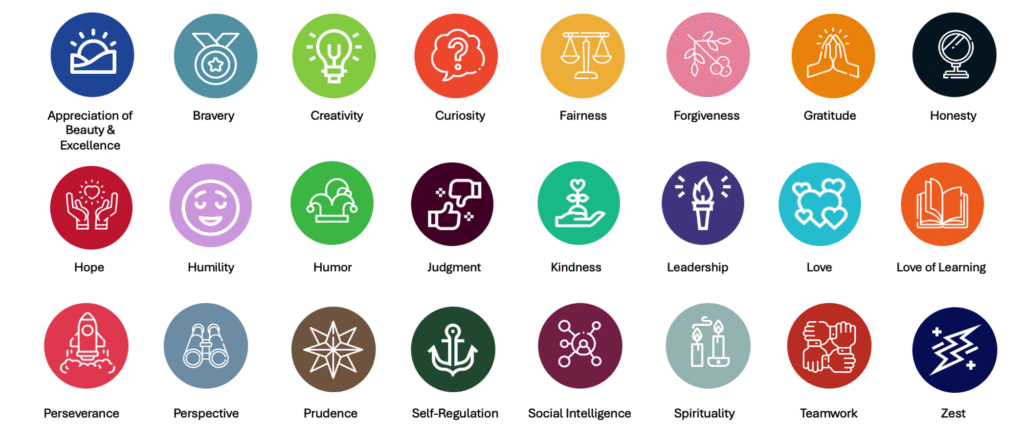
The VIA character strengths framework, developed through research in positive psychology by Christopher Peterson and Martin Seligman, identifies 24 strengths — qualities like Bravery, Curiosity, Kindness, and Zest — that represent the best of who we are. Everyone possesses all 24 strengths in varying degrees. Some sit near the top of your profile almost without your noticing, because they are so intuitive. Others require more conscious effort. All of them are genuinely good, and all of them have a positive impact on others when applied with awareness.

Taking the free VIA Survey at viacharacter.org gives you a ranked list of all 24 — your own unique character profile. And here is what I have found, both in my own networking journey and in working with international professionals and career coaching clients: when you understand your strengths, networking becomes less about performing a version of yourself you think the room wants to see, and more about bringing forward what is already there.

It is also worth thinking differently about what networking actually is. It is not a dreaded event with fancy drinks and a business card quota. It is a series of small moments — a question asked, a laugh shared, a follow-up email sent three days later. It is not the event that gets you a job. It is the small conversations that help people remember you. That shift in framing alone can take the pressure off considerably.

Below, I want to walk through four character strengths that I have found particularly useful in networking contexts — especially for those of us who feel culturally out of place, socially uncertain, or simply not built for working the room.


Bravery: How Do You Face the Fear of Walking In?

To be brave is to face your challenges rather than avoid them.

A Māori proverb or whakataukī captures this beautifully: Tūwhitia te hopo, mairangatia te angitū — feel the fear and do it anyway. But the literal translation offers something even more useful: tūwhitia te hopo means eliminate the negative; mairangatia te angitū means accentuate the positive. It is not just encouragement. It is a strategy.

Bravery in networking might look like tuning out the voice that says it will be a room full of strangers who have nothing to say to me, and replacing it with I might learn something useful from someone I have never met. That is a small but significant reframe — and it is exactly what Bravery, applied intentionally, makes possible.

Bravery also works well in combination with other strengths, particularly Creativity. If walking into a room alone feels too exposing, Creativity might suggest going with a friend and treating it as a social outing. Or setting yourself a small, manageable goal — two new connections added to your LinkedIn network by the end of the evening — rather than facing the whole room at once. Small targets, honestly pursued, are far more useful than ambitious ones abandoned at the door.

If Bravery is in your top five strengths: you likely already show up, even when it is hard. The work is in noticing that courage and giving yourself credit for it. If it is not: Bravery is a strength you can call on deliberately. Naming the fear, finding a manageable first step, and walking toward it anyway — that is Bravery in practice, regardless of where it sits in your profile.


Curiosity and Love of Learning: What Happens When You Get Curious Instead of Self-Conscious?

If Bravery gets you through the door, Curiosity and Love of Learning are what make the conversation worth having.

Curiosity is the motivating force that draws you toward new experiences and new people. Love of Learning is what happens next — the desire to hold onto and deepen what you discover. They are among the most closely related strengths in the VIA framework, and together they are, in my experience, the ideal combination for navigating an unfamiliar culture. They give you a reason to be in the room that has nothing to do with impressing anyone.

I remember hovering at the edge of a group already deep in conversation, smiling and nodding as people spoke. Mutual eye contact was my cue to offer a question. I made mental notes of what was interesting. I watched how others moved easily between groups — a friendly nice talking to you, hope to see you around and they were gone, joining another conversation entirely. In many Asian cultural contexts, leaving a conversation feels impolite. Here, it is simply how networking works. Curiosity helped me observe that without judgment, and Love of Learning helped me file it away.

Getting curious about the other person also has a liberating side effect: it takes the focus off yourself. The more I thought about networking as making friends rather than securing career opportunities, the less stressful it became. Nothing to lose. Everything to gain. And a much better opening line than Hi, I have a PhD, what do you do? — which I have, regrettably, actually said. A genuine question, a light observation about the event, or even a shared complaint about the weather will take you much further.

For international professionals specifically: your cultural unfamiliarity is not a liability here. It is material. Genuine questions about how things work in your new country — asked with real curiosity rather than performed interest — make people feel interesting and valued. That is a networking superpower many locals do not have.


Social Intelligence: How Do You Read the Room When the Rules Are Unfamiliar?

Social intelligence is the ability to be aware of and understand our own feelings and thoughts, as well as those of the people around us — and to respond in ways that are appropriate to the situation.

It is worth distinguishing it briefly from the related concept of emotional intelligence. While emotional intelligence focuses on identifying and managing your own emotions, social intelligence extends further: it includes understanding the dynamics of relationships and interactions, reading social situations accurately, and responding in ways that actually land. In a networking context, this is the difference between knowing you feel nervous and knowing what to do with that nervousness so it does not derail the conversation.

Here is a real example. I once approached a group at a networking event and asked what had brought them along that evening. The answer was brief: our company are event sponsors and we got free tickets. The group was clearly comfortable among themselves and not especially interested in conversation with a stranger. I felt foolish for a moment. Embarrassed, even.

But Social Intelligence gave me a second reading: these were likely regulars who had attended too many of these events, were there out of obligation, and had probably exhausted their networking energy hours ago. It was not about me. So I smiled, nodded graciously, and walked to the food table — partly to regroup, partly because the food was genuinely good — and looked for someone else who seemed more available for conversation. Drink in hand, I felt considerably less exposed.

That small recalibration — moving from what did I do wrong to what was actually happening in that interaction — is Social Intelligence at work. It does not eliminate awkward moments. It helps you recover from them without losing your footing.

For those who find networking socially exhausting: Social Intelligence also means knowing your own limits. Arriving early when the room is quieter, giving yourself permission to step outside for a moment, setting a time limit for the event — these are not cheating. They are self-awareness in action.


Putting It All Together: How to Use Your Strengths Before Your Next Networking Event

Whether Bravery, Curiosity, Love of Learning, and Social Intelligence appear at the top of your VIA profile or further down, they are all available to you. The question is how consciously you are drawing on them.

If these strengths are among your top five: bring them to networking moments with more intention. Notice when you are using them well, and when anxiety is quietly suppressing them. If they sit lower in your profile: here is an opportunity to develop them — to bring them to mind deliberately, practise them in lower-stakes situations, and notice what shifts.

Whatever your profile looks like, the goal of networking is not to become someone you are not. It is to bring who you already are into the room — with enough cultural awareness to calibrate how you express it, and enough self-knowledge to know what you are working with.

Start with the free VIA Survey at viacharacter.org. Fifteen minutes. Twenty-four strengths. Your own unique profile, ready to be put to work.


For Career Practitioners: Supporting Clients Who Struggle with Networking

If you work with clients who find networking uncomfortable — whether because of cultural unfamiliarity, social anxiety, introversion, or simply never having been shown how — the character strengths framework offers a practical and genuinely useful coaching lens.

Rather than beginning with tactics, begin with strengths. Ask your client what they already bring into a room. Help them name the courage it takes to show up at all. Explore with them which strengths they are suppressing out of anxiety versus which they are calibrating with cultural awareness. These are different conversations, and they lead to different outcomes.

I facilitate the CDANZ Special Interest Group on Character Strengths — a warm, reflective community of career practitioners exploring how strengths-based approaches can deepen our work with clients. Our next meeting is on Thursday 23 April 2026, 7–8pm (NZ time), and the topic is directly relevant if you support clients who find networking challenging — whether that is international professionals navigating a new cultural context, or anyone dealing with social anxiety or uncertainty about where to begin.

The meeting is open to CDANZ members and non-members alike.

Register here: https://zoom.us/meeting/register/1FIbsNPYRGS9SydcbXqb6w


Dr Sherrie Lee is a career coach for cross-cultural and mid-career transitions, based in Wellington, New Zealand. She is a Certified Career Services Provider™, leads the CDANZ Special Interest Group on Character Strengths, and works with international professionals, migrants, and academics navigating career change across cultures. Learn more at thediasporicacademic.com or book a free 20-minute discovery call.



Paper boat on top of a globe symbolising international career journey
Image by Joachim Schnürle from Pixabay

My International Career Journey: Everything Everywhere All At Once

A Year of Professional Development, Character Strengths, and Portfolio Strategy

At the start of 2025, I’d set out to go deep and hone my craft as an international career coach. I committed to professional development, reaching a wider audience with my character strengths workshop. Along that journey, I also experienced planned happenstance – being presented with opportunities when I least expected it, and taking a leap of faith and saying yes.

When I look back at what I’ve done, I find myself taking a pause, a deep breath, and savouring the moment. Imagining I was looking at an art work on the wall, I see Jackson Pollock’s Convergence where “the process of dripping, pouring, and splattering provided him with a combination of chance and control.” 

Jackson Pollock's Convergence painting - vibrant abstract expressionist artwork demonstrating the balance of chance and control in creative process, metaphor for international career development journey
Jackson Pollock’s “Convergence” (1952)

Chance and control. Having a direction of travel but not knowing exactly if it will and how it will work out. Making plans and adjusting them as other things pop up. Keeping my focus on what I want: To make a bigger and deeper impact on international professionals in their career journey.

Professional Development is Non-negotiable

I’ve learnt time and time again that there’s always more to learn, even if you feel you’re at the peak of your career or on top of your game. In fact, if we accept that people and society are dynamic and ever-changing, then it follows that we will need to keep learning, refining, and sharpening our toolkit and skill set.

This year was marked by extensive professional development in career practice. When I get serious about something, I don’t just read a book about it. I could be biased since I have learning as a top strength. And truth be told, sometimes I overuse this strength to my detriment – signing up for way more webinars than I can practically attend or reasonably focus my attention on. But I’m learning the lesson of ‘less is more’ and ‘fewer but deeper’.

A rang of tools and parts symbolising the career toolkit international professionals need to continuously replenish and refine.
Image by Евгений from Pixabay

For international professionals and migrants navigating career transitions, this commitment to continuous learning becomes even more critical.

New Zealand vs Singapore: Two Approaches to Professional Development 

It’s also interesting to note the contrasting attitudes toward professional development between New Zealand (where I live) and Singapore (where I’m from). In New Zealand, professional development is individual-driven, incentivised (or disincentivised) by the organisation’s commitment to it in terms of time and money, as well as the value they perceive it has on the day-to-day operations and organisational needs. In Singapore, at least in the government and education sectors, professional development goes hand in hand with performance evaluation and career advancement. In fact, the Singapore government has a nation-wide blueprint of workforce development for different sectors and career stages, often heavily subsidised, clearly encouraging businesses and organisations to keep their employees up to date and future-ready.

In various New Zealand workplaces, I often find myself the most enthusiastic about professional development among my peers, and also the most disappointed when there is no formal career progression pathway, or when I realise the pathway is part of the ‘hidden curriculum’. Over time, I’ve learnt to be the boss of my own professional development, and in fact, that is often the message I get from managers and HR folk – you decide what you need and ask for it. If the stars (and budget align), you get it!

I believe there is a lot more New Zealand organisations can do to make staff professional development more structured, strategic and a win-win incentive for productivity and innovation. However, I’ve also learnt to embrace an entrepreneurial mindset to designing my professional development and ultimately my career portfolio. And this year was a bumper crop of professional development, more than I actually initially planned for.

Being the Boss of My Own Development

I committed to raising my practice to the highest industry standards. While anyone can call themselves a coach or career advisor, I wanted to provide quality assurance of my work. This year, I completed the 130-hour Facilitating Career Development course, a prerequisite for earning the globally recognised Certified Career Services Provider credential from the National Career Development Association. The programme bridged theory and practice and addressed cultural and ethical dimensions of career practice. Certification required passing an exam and ongoing professional development. To deepen my coaching skills, I’m also close to finishing an ICF-accredited Positive Psychology Coaching programme which has been a truly transformative experience.

Coffee mug next to laptop with screen showing webinar participants.
Photo by Chris Montgomery on Unsplash

Another professional development highlight was an on-demand webinar series called Practice, Practice, Practice co-organised by the Career Development Association of New Zealand (CDANZ) and the Career Development Association of Australia. The series reminded me of the importance of career theory in practice and how ongoing professional development involves the humility of peer supervision and learning from others’ practice. For me, this balance of knowledge acquisition and learning through and from community is the gold standard of professional development. Thinking about the differences between Singapore and New Zealand, Singapore tends to favour knowledge acquisition more than peer learning while New Zealand more readily adopts a community of practice approach. Over and above these two approaches, critical reflection is key to pulling the different threads of professional development into a meaningful learning experience that can have a positive influence on practice. Less is more. Fewer but deeper.

Character Strengths in Career Development

The VIA character strengths framework has become my go-to tool for career coaching and self-awareness development. These 24 character strengths make up the best aspects about our personality.

Developed by researchers in positive psychology, the VIA character strengths framework proposes that everyone possesses all 24 character strengths in varying degrees, so each individual has a unique personal profile. Each character strength falls under one of these six broad virtue categories, which are universal across cultures and nations. The framework uses simple but thoughtful language to describe each strength, applicable across a variety of contexts, and the survey is free to access.

Why VIA Character Strengths?

Because the VIA framework is underpinned by robust research, easy to understand, has wide application and is freely accessible, the VIA survey of character strengths has become my top choice for developing self-awareness – one of the foundations of developing your own career. I’ve written on the topic of character strengths in career development and have spoken about it on two podcasts. One of the podcasts came about in the most serendipitous fashion – I was scrolling through my LinkedIn feed and came across a call for guests on a podcast program to talk about assessments in coaching. The VIA survey immediately came to mind and after a couple of emails and a thoroughly enjoyable recording session, I’m really proud to have shared my heart about character strengths and how doing the survey and pouring over my personal profile has personally transformed my career perspective at a time of job redundancy. For international professionals facing career uncertainty or workplace transitions, understanding your character strengths can provide an anchor of self-knowledge in times of change.

You can’t hide a light under a bowl. Apart from running monthly workshops on character strengths at the university where I work as a career consultant, I’ve run a few webinars on the topic, including a session for the 2025 Higher Education Summit that came about in yet another serendipitous manner. Once again it was my LinkedIn feed that led me to a post on the summit. After reading about the background, the call for contributions and one of the themes of emotions, well-being and inner development, it became clear to me: this was an opportunity to share my character strengths workshop to a global audience! Strength in action: Spirituality.

24 icons representing the 24 VIA character strengths designed by Dr Sherrie Lee
24 Character Strengths Chart © 2025 Dr Sherrie Lee

Taking Character Strengths Global

I took a leap of faith and put together a proposal for the webinar, not knowing much else about the summit or the people who would attend. The proposal was accepted, I prepped for the webinar and up till the last few minutes before the start time, I had no idea how many would turn up. We ended up with a cosy group of eight people from different European countries and backgrounds, and had a precious time of open sharing and discussion of how we can apply character strengths in scary times. Connecting with higher education students and professionals from another continent also helped me to fulfil my dream of expanding my impact on international professionals. Strength in action: Zest.

Building Community: The CDANZ Special Interest Group

However, what I am most proud of is establishing the CDANZ Special Interest Group on Character Strengths. Sharing best practices and learning together with a professional community requires not only time commitment but also active participation. I started with a simple belief that good things cannot be kept hidden and ran a character strengths webinar for CDANZ members with a call for interest in a special interest group (SIG). We had enough numbers to confidently launch the SIG and the three meetings we’ve had to date have helped to create a warm and inclusive group who are generous with sharing and deeply reflective. The smooth running of these online meetings would not have been possible without the assistance of a colleague who helped with refining meeting activities and reflection exercises, as well as providing technical support during meetings. There were times when I wondered if all these hours of prep and admin was going to result in any significant gain. But when I think back to the various aha moments and learning reflections at the SIG meetings, I realise the intrinsic value of talking about strengths in a safe and supportive environment. It is ultimately a service to my professional community in the belief that learning comes through reflection, and transformation through application. Strength in action: Gratitude.

International Career Portfolio Rebalance

An important part of my own international career development this year was reviewing my portfolio career strategy and how I could make a bigger impact. Strategy for me is not a one-day meeting to work out what’s important and what to discard, but more like a meandering experiment until I find my answer. I don’t recommend this approach for everyone but with Spritiuality as my top character strength, followed closely by Creativity and Zest, I knew I couldn’t help but connect with people, try out new ideas, and with a full tank of energy. 

Sure I overused these strengths on many occasions, but I also learned to recover in equal measure through silence and rest. There are ways to bring these strengths into optimal use but I honestly much rather overuse them and find ways to compensate at later times. And over time I’m sure I’ll recalibrate the balancing act. But for now, I’m very much driven by the motto: Carpe diem, seize the day, make your lives extraordinary.

Finding My Themes Through Writing

Through the process of more regular blogging and starting a monthly newsletter International Career Journey (on LinkedIn and Substack), I’ve clarified what my portfolio career stands for. I’ve gravitated towards these core themes for international professionals:

  • Navigating cross-cultural workplaces and transitions
  • Future proofing your career by building portfolio careers
  • Self-awareness through character strengths and critical reflection

These themes aren’t just what I write about. They’re the foundation of how I’m building my own portfolio career.

Adding Portfolio Skills through my Instagram Experiment 

Part of rebalancing my career portfolio meant adding new skills and experimenting with different mediums. I’ve been experimenting with creating content for my Instagram account. I wanted to learn more about media content creation and how easy – or difficult – it would be to learn and to implement on a regular basis. The learning curve was steep! They say reels are the primary tool to drive engagement, and I’m still learning about what makes a good 3-second hook.

Apart from self-taught lessons on trending audio, reel length and hooks, I also learned about the fleeting nature of attention, how the medium is the message, and admittedly, a personal sense of helplessness in never being able to keep up with the latest trends and algorithms in instagram worthy engagement. But this is part of portfolio career building: trying new things, discovering what fits, and letting go of what doesn’t. I’ve learnt to stop competing and comparing and focus on creating moments of insight with a bit of fun and flair.

From Experiment to Clarity: Portfolio as Process

And where has this meandering experiment taken me?

From working to ‘impossible’ deadlines (and meeting them anyway) to a place of pause and reflection.

From scattered activities to intentional choices.

This year taught me that portfolio career strategy isn’t about having everything figured out. It’s about staying true to your core purpose while remaining open to unexpected opportunities. The professional development courses, character strengths workshops, newsletter writing, Instagram experiments – each was both planned and spontaneous, controlled and chance-driven.

I don’t need to have absolute certainty of what my portfolio looks like. What matters is the clarity of purpose that guides every decision: To expand my influence and impact on helping international professionals thrive on their career journey, whichever stage and place they may be.

The portfolio isn’t fixed. It’s a living, evolving composition, constantly being rebalanced as new opportunities emerge and priorities shift.

As I bring up the image of Jackson Pollock’s Convergence once again, I stand in awe of the masterpiece that is a result of chance and control. 

An image of Jackson Pollock's Convergence (1952)

For anyone on their own international career journey, I hope these reflections on professional development, character strengths, and portfolio career building offer both inspiration and practical pathways forward

Carpe diem, seize the day, make your lives extraordinary.

Frequently Asked Questions About International Career Development

Q: What are VIA character strengths and how do they help with career development?

The VIA (Values in Action) character strengths are 24 universal qualities that represent the best aspects of our personality, developed by researchers in positive psychology. They help with career development by providing a foundation of self-awareness. This helps you understand what energises you, how you naturally approach challenges, and where you might be overusing or underusing certain strengths. For international professionals, understanding your character strengths becomes especially valuable during career transitions, as they remain constant even when your environment, role, or workplace culture changes.

Q: How is professional development different between New Zealand and Singapore?

The key difference lies in structure and responsibility. In Singapore, particularly in government and education sectors, professional development is systematically integrated with performance evaluation and career advancement, with nationwide workforce development blueprints and significant subsidies. In New Zealand, professional development tends to be more individual-driven. You’re expected to identify your own needs and advocate for them, with organisational support varying widely. This means international professionals in New Zealand need to adopt an entrepreneurial mindset toward their own development, actively designing their learning pathway rather than following a prescribed route.

Q: What is a portfolio career and is it right for international professionals?

A portfolio career involves combining multiple roles, projects, or income streams rather than relying on a single traditional job. It might include consulting work, part-time employment, freelance projects, and passion ventures all at once. For international professionals, a portfolio career offers flexibility to leverage diverse skills across different contexts, build resilience against job market uncertainty, and create opportunities that traditional employment might not offer. This is especially valuable when navigating visa restrictions, credential recognition challenges, or wanting to maintain connections across multiple countries.

Q: How can character strengths help during workplace transitions?

Character strengths provide an anchor of self-knowledge during times of change. When you’re navigating a new workplace culture, adjusting to different management styles, or facing job uncertainty, your character strengths remain constant. They help you identify what you naturally bring to any situation, recognize when you’re in flow versus when you’re struggling, and make strategic decisions about roles and opportunities that align with your authentic self. This is particularly powerful for international professionals who may be adapting to unfamiliar workplace norms or rebuilding their professional identity in a new country.

Q: What does ‘planned happenstance’ mean in career development?

Planned happenstance is the idea that careers develop through a combination of intentional action and being open to unexpected opportunities. Rather than rigidly following a predetermined career plan, you create possibilities by staying curious, persistent, flexible, optimistic, and willing to take risks. In my own journey this year, planned happenstance showed up when I responded to opportunities I found scrolling through LinkedIn, such as the podcast invitation and the Higher Education Summit, without knowing exactly where they would lead, but trusting they aligned with my broader goal of reaching international professionals. Here’s another article I wrote about planned happenstance: Planned Happenstance – How to Make your Own Career Luck

Q: How do I start building self-awareness for career development?

Start with free, research-backed tools like the VIA character strengths survey (viacharacter.org). Take time to reflect on your results, not just your top strengths, but also your lower-ranked ones and what that pattern tells you about yourself. Combine this with regular critical reflection on your work experiences: What energises you? What drains you? When do you feel most authentic? Consider working with a career coach who can help you explore these patterns and translate self-awareness into actionable career strategies.

Q: What skills are most important for international professionals to develop?

Beyond technical skills in your field, focus on cross-cultural communication and adaptability, the ability to translate your experience across different contexts, resilience and flexibility in the face of uncertainty, networking across cultures and platforms, and continuous learning mindset. These meta-skills help you navigate different workplace cultures, explain your value to employers unfamiliar with your background, and stay agile as workplace expectations evolve.

Q: How can I expand my impact as an international professional?

Consider creating content that shares your unique perspective whether through blogging, newsletters, social media, or speaking opportunities. Join or establish special interest groups in your professional community. Facilitate workshops or webinars on topics you’re passionate about. Look for ways to connect with international audiences through platforms like LinkedIn. The key is finding your authentic voice and the themes that matter most to you, then consistently showing up to share your insights and learn from others’ experiences.

Work With Me

Throughout this post, I’ve shared my journey with professional development, character strengths, and building a portfolio career as an international professional. Now I want to support you in your international career journey.

I’m Dr Sherrie Lee, an international career coach with certifications as a Certified Career Services Provider (CCSP) and ICF-accredited Positive Psychology Coaching. I specialise in helping international professionals, migrants, and academics navigate cross-cultural workplaces, career transitions, and building careers that truly fit.

Based in Wellington, New Zealand, I work with clients globally through one-on-one coaching, workshops, and speaking engagements.

Ready to take the next step in your international career journey?

Whether you’re navigating a career transition, exploring a portfolio career strategy, or seeking clarity on your professional direction, let’s have a conversation.

Book a free 20-minute discovery call to discuss where you are, where you want to go, and how I can help you get there.

Carpe diem, seize the day, make your life extraordinary. And remember, you don’t have to do it alone.

Character Strengths in your Career Development

Understanding who you are at your core can transform your career journey.

“Who am I?” It’s a question that sounds simple but can feel overwhelming, especially when you’re standing at the crossroads of your career. As a career coach, I’ve seen countless students and graduates get caught up in the external pressures of choosing the “right” degree or the highest-paying job, while neglecting the most important question: Who are you, and how do you want to contribute to the world?

This is where character strengths come in—and they might just be the missing piece in your career development puzzle.

Listen to the podcast based on this article: Discover Your Character Strengths for your Career Development.

Listen to the latest podcast Values in Action with Dr Sherrie Lee where I was guest on the Coaching Coast to Coast program

Continue reading the article ⬇️

What Are Character Strengths?

Character strengths are the positive traits of your personality that influence how you think, feel, and behave. Picture this: when you’re browsing the latest books at the library or showing genuine interest during networking conversations, you’re seeing your strength of Curiosity in action.

The research on character strengths began in the early 2000s during the rise of positive psychology. Led by Christopher Peterson and Martin Seligman (known as the father of Positive Psychology), this groundbreaking work resulted in the landmark textbook Character Strengths and Virtues: A Handbook and Classification and the VIA Survey which measures 24 character strengths.

These 24 strengths fall under six universal virtue categories that transcend cultures and nations:

  • Wisdom (Creativity, Curiosity, Judgment, Love of Learning, Perspective)
  • Courage (Bravery, Perseverance, Honesty, Zest)
  • Humanity (Kindness, Love, Social intelligence)
  • Justice (Fairness, Leadership, Teamwork)
  • Temperance (Forgiveness, Humility, Prudence, Self-Regulation)
  • Transcendence (Appreciation of Beauty & Excellence, Gratitude, Hope, Humor, Spirituality)
© 2025 Dr Sherrie Lee

Why Understanding Your Strengths Matters for Your Career

Let me share a personal story. When my job was made redundant and I had to consider opportunities outside the industry I’d worked in for five years, I felt like I’d been knocked off a spinning top with no way to get back on. In my search for clarity, I discovered the VIA Survey.

While I wasn’t surprised by my results—I’d done plenty of personality assessments before—something was different this time. The simple but thought-provoking descriptions of each strength gave me a fresh perspective on who I was at my core. It validated thoughts I’d had about alternative career paths and even provided language I could use in cover letters and interviews.

Today, I work as a career consultant, and I can tell you firsthand that understanding and applying your character strengths is transformative for career development.

Here’s why it matters:

  • Self-awareness is the foundation of career planning. Understanding your career direction, what you want to study, and how you want to develop professionally all starts with knowing yourself. Those are exactly the questions employers have about candidates: Who are you? Why do you want to work here?
  • It helps you align career decisions with your values. A keen awareness of what makes you YOU helps align your career choices with your personal values and motivations, allowing you to shape a meaningful career narrative.
  • It provides concrete material for job applications and interviews. Your character strengths give you specific, authentic language to use in cover letters and interview responses.

How to Discover Your Character Strengths

The most direct way to understand your character strengths is through the VIA Survey. What makes this assessment particularly valuable compared to other popular tools like the Gallup CliftonStrengths or MBTI assessment?

The VIA Survey is completely free. Unlike many career assessment tools that require payment upfront, the VIA Survey provides you with a comprehensive ranked list of all 24 character strengths at no cost. This makes it accessible to students and job seekers who might be managing tight budgets.

You get your complete strengths profile. Rather than focusing on just your top strengths (like some assessments do), the VIA Survey ranks all 24 strengths from highest to lowest. This gives you a fuller picture of your character profile and helps you understand not just what you’re strongest in, but also areas where you might want to develop.

It’s rooted in rigorous research. The VIA Survey is based on extensive scientific research in positive psychology, with validation across cultures and populations. The 24 character strengths framework has been tested and refined over two decades.

Extensive free resources available. The VIA Institute website offers a wealth of free resources that both individuals and career practitioners can use, including:

  • Detailed descriptions of each character strength
  • Research summaries and articles
  • Practical exercises for applying your strengths
  • Resources for educators and coaches
  • Workplace applications and team activities

The basic survey takes just 10-15 minutes to complete and immediately provides your personalised character strengths profile. If you want deeper insights, you can choose to purchase more detailed reports, but the free version gives you everything you need to get started on your strength-based career journey.

In my coaching practice, I also recommend reflection exercises that help you understand your values, skills, and working style. The key is to approach this as an ongoing process of self-discovery, not a one-time assessment.

Character Strengths for Career Clarity

Knowing your signature strengths can help you clarify your career path and ideas. I recently worked with a student pursuing a Bachelor of Arts in Psychology and Criminology. They knew they didn’t want to be a psychologist but weren’t sure what else was possible. 

When we reviewed their VIA results, we discovered that Love and Kindness were among their top strengths—qualities that were important to them in all aspects of life, including their future work. This insight sparked a conversation about potential roles in community services and various positions focused on helping people navigate difficult situations, including mental health challenges.

By connecting their natural strengths to career possibilities, this student found direction and purpose they hadn’t realised before with such clarity.

How Strengths Complement Your Technical Skills

Character strengths are also an important complement to your knowledge and skills. Your qualifications give you the knowledge and technical skills in your field. Your character strengths help you apply them effectively in the workplace.

For example, you might understand project management in terms of using spreadsheets, organising meetings, and tracking progress. But it’s your Social Intelligence that helps you communicate effectively with different stakeholders, your Love of Learning that helps you adapt and grow on the job, and your Perseverance that keeps you going when projects get challenging.

What Employers Are Looking For

Different roles and industries will emphasise some strengths over others. Here are some patterns I’ve observed:

  • Innovation and business development roles value cognitive strengths like Creativity and Curiosity
  • Customer-facing positions prioritise social strengths like Kindness and Teamwork
  • Analytical and detail-oriented roles benefit from Perseverance, Prudence, and Self-Regulation

But here’s the important part: your particular top strengths shouldn’t dictate what roles you pursue. You have the capacity for all 24 strengths. A good fit between your signature strengths and your work environment enhances satisfaction and performance, but it’s not the only factor for success. Your knowledge, skills, interests, and the broader job market all play important roles.

This is especially relevant given the World Economic Forum’s Future of Jobs Report prediction that we’ll have multiple careers in our lifetime. With 92 million roles being displaced and 170 million new jobs created this decade due to technological development and economic shifts, understanding and applying your strengths becomes even more crucial for navigating this dynamic and ever-changing job market.

Key Takeaway and Next Steps

As Aristotle said, “Knowing yourself is the beginning of all wisdom.”

Your top five signature strengths represent who you are at your core. Applying these strengths more often will not only help you feel better and become more resilient—it will lead you to discover more meaningful and satisfying work.

Ready to Discover Your Strengths?

If you’re curious about your character strengths, here’s how to get started:

1. Take the VIA Survey to get a ranked list of your 24 character strengths.

2. Note your top five strengths which are your signature strengths.

3. Discuss your results with trusted friends. What resonates, what surprises you, and where have you seen each other demonstrate these strengths?

4. Download my character strengths reflection worksheet to support your reflection.

5. Consider professional support. Find a career coach or attend workshops to explore how to apply your strengths in your career journey.

Remember, career development isn’t just about finding any job—it’s about finding work that aligns with who you are and allows you to contribute your unique gifts to the world. Your character strengths are your roadmap to getting there.

About the author

Dr Sherrie Lee is a career coach who specialises in helping tertiary students and international professionals discover and apply their character strengths for meaningful career development. She runs workshops and provides one-on-one coaching to support individuals in their career journeys. Sherrie is a Professional Member of the Career Development Association of New Zealand (CDANZ) and leads the CDANZ Special Interest Group on Character Strengths.

Don`t copy text!