Close

Embracing the Journey of an International Professional

🌍 Here’s my story of how I became an international professional.

My life motto: Carpe Diem

“Carpe diem. Seize the day. Make your lives extraordinary.”

The quote comes from the film Dead Poets Society, spoken by the character John Keating (played by the late Robin Williams), a teacher inspiring his students to pursue their passion and do something great. I watched the film when I was just 12 years old, ready to enter high school, and in those years of schooling and later on at university. I found myself drawn to exploration, self-discovery, and defying expectations. That spirit remains a driving force in my life and career today.

It represents more than just motivation. Carpe Diem speaks to my desire to be bold and use my talents, to be brave and make a difference, and to believe that whatever I do serves a greater purpose beyond my own needs.

My identity: A Chinese Singaporean

I was born and raised in Singapore, a multicultural city-state and former British colony, where English is the main language of education and public life. In multicultural Singapore, Chinese, Malay, Indian, Eurasian and other ethnic communities live side-by-side, and so I was part of a social fabric of cultural and linguistic diversity from an early age,

As a Chinese Singaporean, I grew up speaking English at home, school, and with friends, while also learning Chinese and Mandarin as a second language under Singapore’s bilingual policy. Our official mother tongue was assigned based on ethnicity and was a second language by default. Singapore’s bilingual policy has evolved over the years with a current focus on reviving interest and proficiency in our ethnic languages. However, among my generation, we were impressed upon the social and economic importance of mastering English, a gateway to the Western world and prosperity.

The particular ideology, policy and pragmatism of my upbringing have no doubt contributed to my strong grounding in both Western and Asian cultures. This has enabled me to navigate global spaces with confidence and cross-cultural fluency. My language and cultural identity shapes how I see the world and informs my work as an international professional and career coach committed to cross-cultural understanding. I understand what it’s like to look ‘Asian,’ sound ‘Western,’ and yet not fully belong in either category.

Image by CatsWithGlasses from Pixabay

What does it mean to be international?

My sense of being ‘international’ began during a university course on the history of the English language. I was introduced to World Englishes and the debate on who ‘owns’ English. I was struck by how much judgment people receive based on their accent, race, or skin colour, even in multicultural contexts, and the sharp division and discrimination between native and non-native English speakers.

In all my youthful defiance, I told myself: No country or accent shall determine how I use English. I shall be an international speaker of English!

This deep desire to challenge the barriers and divisions imposed by so-called pure, prestigious or better versions of English later shaped my Master of TESOL and PhD study. The debate on who owns English was re-ignited through my essay on Re-imagining the Non-Native Speaker. In my PhD research on international learners, one of my research agenda items was to dispel the deficit framing of non-native English speakers.

In corporate settings, I realised how many brilliant professionals around the world feel undermined not by lack of skill, but by cultural codes, accent bias, and the hidden hierarchies of language.

A 2013 British Council report states that English “now belongs to the world and increasingly to non-native speakers – who today far outnumber native speakers.” Indeed, the English language continues to evolve and it continues to serve as a global lingua franca, and yet old habits die hard. Our accent (and skin colour) continue to draw judgment from native and non-native English speakers alike. Just read the news about the racist backlash against Air New Zealand’s new CEO Nikhil Ravishankar.

It feels like contemporary notions of ‘inclusivity’ that celebrate and embrace differences are individual beliefs at best, and very slippery and airy concepts at worst. And I wonder if ‘international’ is a similar contemporary notion – Is it something that is celebrated and embraced? Or will it reveal its true colours when it is put to the test? And how much is one person’s experience of being international positively or negatively affected by the languages they speak, the accent of their spoken English, their passport, and the shade of their skin they were born with?

Photo by Christine Roy on Unsplash

How to thrive as an international professional

The complex realities of being international are discomforting, but I’m not here to dwell in the discomfort. Instead, I aim to raise awareness and spark conversation through writing. I’ve previously written about my experiences and tensions in looking, feeling and being different:

✍️ Living and thriving with labels: A journey towards cultural intelligence

✈️ The Diasporic Resident

🧭 How NOT to be a Migrant

The moral of my stories? Carpe diem. Seize the day. Make your lives extraordinary.

I hope discomfort gives your data. They can show us what still needs dismantling—and where we have power to influence change. So perhaps it’s time to stop scrolling or eye rolling and start thinking, feeling and doing things differently.

My coaching approach: Supporting international careers

As a career coach for international professionals, I’m here to help you, however you define yourself as ‘international’, to do these things:

🔍 Discover Your Strengths
Clarify who you are and how you want to contribute to the world.

❤️ Act With Purpose
Move beyond random applications and focus on how you add value.

🎯 Build Career Confidence
Master tools and strategies to manage manage your career on your own terms—for life!

An invitation to international professionals

If you’re navigating a career change, adapting to a new cultural environment, or exploring your identity as an international professional, this space is for you.

🌍 Learn more about my career journey here.

🔗 Subscribe on LinkedIn, or on Substack, follow along, let’s make our lives extraordinary—wherever in the world we are.


Character Strengths in your Career Development

Understanding who you are at your core can transform your career journey.

“Who am I?” It’s a question that sounds simple but can feel overwhelming, especially when you’re standing at the crossroads of your career. As a career coach, I’ve seen countless students and graduates get caught up in the external pressures of choosing the “right” degree or the highest-paying job, while neglecting the most important question: Who are you, and how do you want to contribute to the world?

This is where character strengths come in—and they might just be the missing piece in your career development puzzle.

Listen to the podcast based on this article: Discover Your Character Strengths for your Career Development.

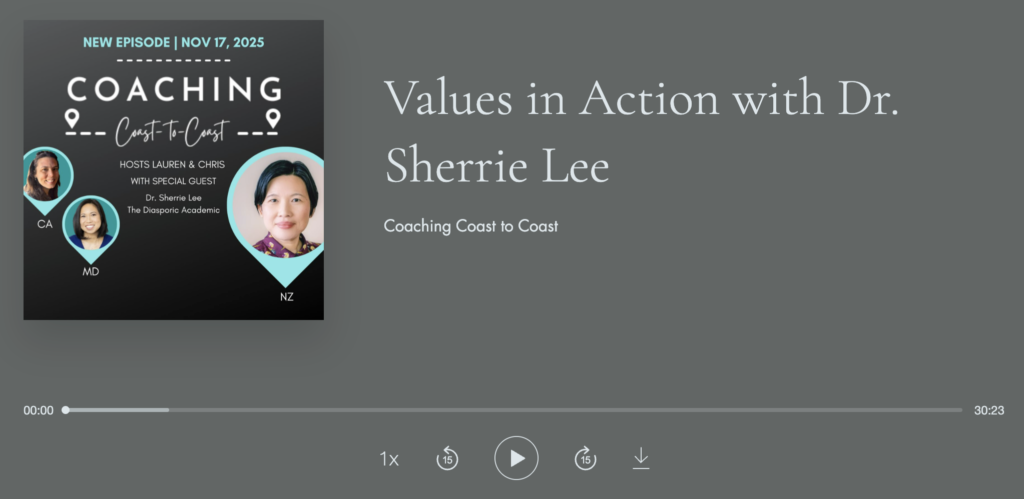
Listen to the latest podcast Values in Action with Dr Sherrie Lee where I was guest on the Coaching Coast to Coast program

Continue reading the article ⬇️

What Are Character Strengths?

Character strengths are the positive traits of your personality that influence how you think, feel, and behave. Picture this: when you’re browsing the latest books at the library or showing genuine interest during networking conversations, you’re seeing your strength of Curiosity in action.

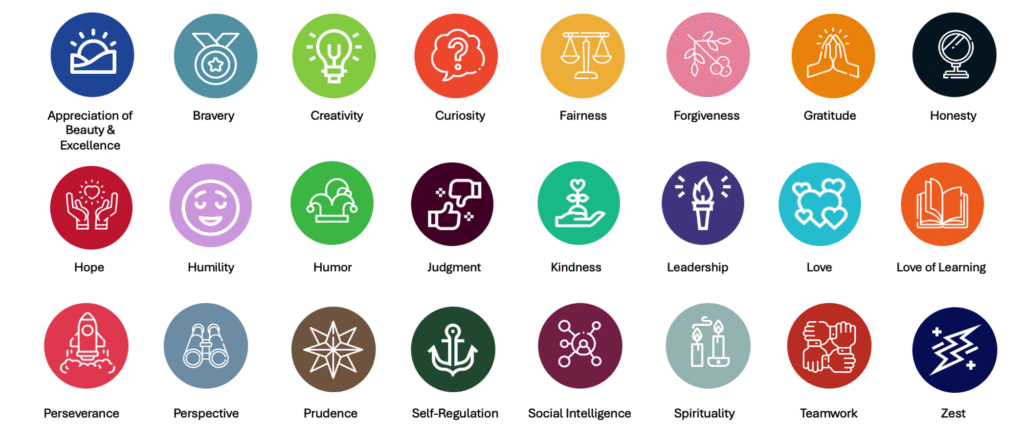
The research on character strengths began in the early 2000s during the rise of positive psychology. Led by Christopher Peterson and Martin Seligman (known as the father of Positive Psychology), this groundbreaking work resulted in the landmark textbook Character Strengths and Virtues: A Handbook and Classification and the VIA Survey which measures 24 character strengths.

These 24 strengths fall under six universal virtue categories that transcend cultures and nations:

  • Wisdom (Creativity, Curiosity, Judgment, Love of Learning, Perspective)
  • Courage (Bravery, Perseverance, Honesty, Zest)
  • Humanity (Kindness, Love, Social intelligence)
  • Justice (Fairness, Leadership, Teamwork)
  • Temperance (Forgiveness, Humility, Prudence, Self-Regulation)
  • Transcendence (Appreciation of Beauty & Excellence, Gratitude, Hope, Humor, Spirituality)
© 2025 Dr Sherrie Lee

Why Understanding Your Strengths Matters for Your Career

Let me share a personal story. When my job was made redundant and I had to consider opportunities outside the industry I’d worked in for five years, I felt like I’d been knocked off a spinning top with no way to get back on. In my search for clarity, I discovered the VIA Survey.

While I wasn’t surprised by my results—I’d done plenty of personality assessments before—something was different this time. The simple but thought-provoking descriptions of each strength gave me a fresh perspective on who I was at my core. It validated thoughts I’d had about alternative career paths and even provided language I could use in cover letters and interviews.

Today, I work as a career consultant, and I can tell you firsthand that understanding and applying your character strengths is transformative for career development.

Here’s why it matters:

  • Self-awareness is the foundation of career planning. Understanding your career direction, what you want to study, and how you want to develop professionally all starts with knowing yourself. Those are exactly the questions employers have about candidates: Who are you? Why do you want to work here?
  • It helps you align career decisions with your values. A keen awareness of what makes you YOU helps align your career choices with your personal values and motivations, allowing you to shape a meaningful career narrative.
  • It provides concrete material for job applications and interviews. Your character strengths give you specific, authentic language to use in cover letters and interview responses.

How to Discover Your Character Strengths

The most direct way to understand your character strengths is through the VIA Survey. What makes this assessment particularly valuable compared to other popular tools like the Gallup CliftonStrengths or MBTI assessment?

The VIA Survey is completely free. Unlike many career assessment tools that require payment upfront, the VIA Survey provides you with a comprehensive ranked list of all 24 character strengths at no cost. This makes it accessible to students and job seekers who might be managing tight budgets.

You get your complete strengths profile. Rather than focusing on just your top strengths (like some assessments do), the VIA Survey ranks all 24 strengths from highest to lowest. This gives you a fuller picture of your character profile and helps you understand not just what you’re strongest in, but also areas where you might want to develop.

It’s rooted in rigorous research. The VIA Survey is based on extensive scientific research in positive psychology, with validation across cultures and populations. The 24 character strengths framework has been tested and refined over two decades.

Extensive free resources available. The VIA Institute website offers a wealth of free resources that both individuals and career practitioners can use, including:

  • Detailed descriptions of each character strength
  • Research summaries and articles
  • Practical exercises for applying your strengths
  • Resources for educators and coaches
  • Workplace applications and team activities

The basic survey takes just 10-15 minutes to complete and immediately provides your personalised character strengths profile. If you want deeper insights, you can choose to purchase more detailed reports, but the free version gives you everything you need to get started on your strength-based career journey.

In my coaching practice, I also recommend reflection exercises that help you understand your values, skills, and working style. The key is to approach this as an ongoing process of self-discovery, not a one-time assessment.

Character Strengths for Career Clarity

Knowing your signature strengths can help you clarify your career path and ideas. I recently worked with a student pursuing a Bachelor of Arts in Psychology and Criminology. They knew they didn’t want to be a psychologist but weren’t sure what else was possible. 

When we reviewed their VIA results, we discovered that Love and Kindness were among their top strengths—qualities that were important to them in all aspects of life, including their future work. This insight sparked a conversation about potential roles in community services and various positions focused on helping people navigate difficult situations, including mental health challenges.

By connecting their natural strengths to career possibilities, this student found direction and purpose they hadn’t realised before with such clarity.

How Strengths Complement Your Technical Skills

Character strengths are also an important complement to your knowledge and skills. Your qualifications give you the knowledge and technical skills in your field. Your character strengths help you apply them effectively in the workplace.

For example, you might understand project management in terms of using spreadsheets, organising meetings, and tracking progress. But it’s your Social Intelligence that helps you communicate effectively with different stakeholders, your Love of Learning that helps you adapt and grow on the job, and your Perseverance that keeps you going when projects get challenging.

What Employers Are Looking For

Different roles and industries will emphasise some strengths over others. Here are some patterns I’ve observed:

  • Innovation and business development roles value cognitive strengths like Creativity and Curiosity
  • Customer-facing positions prioritise social strengths like Kindness and Teamwork
  • Analytical and detail-oriented roles benefit from Perseverance, Prudence, and Self-Regulation

But here’s the important part: your particular top strengths shouldn’t dictate what roles you pursue. You have the capacity for all 24 strengths. A good fit between your signature strengths and your work environment enhances satisfaction and performance, but it’s not the only factor for success. Your knowledge, skills, interests, and the broader job market all play important roles.

This is especially relevant given the World Economic Forum’s Future of Jobs Report prediction that we’ll have multiple careers in our lifetime. With 92 million roles being displaced and 170 million new jobs created this decade due to technological development and economic shifts, understanding and applying your strengths becomes even more crucial for navigating this dynamic and ever-changing job market.

Key Takeaway and Next Steps

As Aristotle said, “Knowing yourself is the beginning of all wisdom.”

Your top five signature strengths represent who you are at your core. Applying these strengths more often will not only help you feel better and become more resilient—it will lead you to discover more meaningful and satisfying work.

Ready to Discover Your Strengths?

If you’re curious about your character strengths, here’s how to get started:

1. Take the VIA Survey to get a ranked list of your 24 character strengths.

2. Note your top five strengths which are your signature strengths.

3. Discuss your results with trusted friends. What resonates, what surprises you, and where have you seen each other demonstrate these strengths?

4. Download my character strengths reflection worksheet to support your reflection.

5. Consider professional support. Find a career coach or attend workshops to explore how to apply your strengths in your career journey.

Remember, career development isn’t just about finding any job—it’s about finding work that aligns with who you are and allows you to contribute your unique gifts to the world. Your character strengths are your roadmap to getting there.

About the author

Dr Sherrie Lee is a career coach who specialises in helping tertiary students and international professionals discover and apply their character strengths for meaningful career development. She runs workshops and provides one-on-one coaching to support individuals in their career journeys. Sherrie is a Professional Member of the Career Development Association of New Zealand (CDANZ) and leads the CDANZ Special Interest Group on Character Strengths.

Nurturing career hope in challenging times

Rose blooming against the odds”, photograph by Sherrie Lee

It is tough out there for job seekers.

Headlines shout bad news almost daily: “Young people struggle to find work” and “Unemployment rate soars”. It’s no wonder our minds get into a tailspin and our anxiety levels rise.

I experienced it during my job search following job redundancy, and I sense it now among graduating students, as well as their parents who have started posting on LinkedIn about their young people in need of a lucky job break.

As a career consultant, and a former international student graduate who struggled to find work in New Zealand, I share how you can become “career-hopeful” in very trying times.

First, it’s worth noting that bad news stays in our minds longer than good news. It also takes 3-5 positive events or interactions to counter a negative one. It’s not about denying the facts of the job market or the state of the economy, but it’s about focusing on things we can control and engaging in activities that help us improve our mood, practice skills or learn new ones, and ultimately provide hope that we can look forward to our future.

The STAR mnemonic is often used as an interview technique for demonstrating your competencies: Situation, Task, Action, Result: Describe the Situation and explain the Task with details about the Action you took, concluding with the Result of your action. We also use the STAR approach to develop our CV and cover letter. Because STAR is used to help articulate your abilities and values, it can also be used to help create positive events and interactions in your job search journey.

S for Situation and Success. Instead of describing a situation, you are creating one. Think about another S word – success. What is one thing you would like to be successful at? One common challenge for jobseekers is networking. Even for an extrovert like me, and particularly in a time when there are few relevant jobs to apply for, the last thing I wanted to do was to dress up, go someplace, and meet people in the hope of finding work. Yet, research tells us time and time again that our networks are an important factor in finding work opportunities and potential intel. The act of networking also provides an opportunity for us to let others know about who we are and contribute something valuable to a conversation. If you’re not naturally sociable or are feeling sceptical about networking, perhaps set yourself a challenge – attend one networking event with the goal of meeting and talking to at least two new people. If you make it to the networking event and chat with a few people, congrats! You’ve overcome fear or inertia and have learned to make new connections.

Find opportunities to take control of the situation and set yourself some achievable goals – the feeling of success should not be underestimated. For me, networking was a dopamine boost for my job search journey. It helped me get out of comfy clothes and remind myself that I was – and still am – a professional with something valuable to share and a curiosity to learn.

T for Task and Test. Set yourself some tasks to do towards a specific purpose. And here’s another T word to consider – test. Use these tasks to test your ideas and thinking and help you make decisions. For example, you might be thinking of switching industries or getting a new qualification. Talk to people in the industry or those who have made the switch or talk to the course provider about the entry requirements and career prospects. Make time to explore a question you have, a ‘what if’ scenario, and seek out others to help you find answers. Setting up smaller tasks and testing things helps to break down major decision-making into doable steps.

I often set up informational interviews with people when I want to find out more about moving to a different field or area of work.  For example, I connected with people working in the training and coaching industry when I was considering becoming a career coach. These were a mix of coffee chats and short video calls that helped me understand what people did, and what they enjoyed about it, testing my own career ideas.

A for Action and Active. What actions could you take to engage in sharing or improving your skills and knowledge? You could volunteer your time and services in the local community or learn something new through a free online course on platforms like Coursera. Or give yourself permission to take a break from job searching and pick up a new hobby. Making a conscious decision to do something else that is meaningful will help you be refreshed and encouraged in your job search journey.

I enrolled in a micro-credential course in disruptive technologies which entailed weekly online guest lectures and working on assignments. This not only helped me gain new knowledge about an area I was interested in, but the structure also provided me with a routine and something to look forward to apart from just job hunting.

R for Result and Resilience. The result of all the above is Resilience. Identifying what you would like to be successful at, setting yourself doable tasks, testing ideas, and staying actively engaged in endeavours other than job hunting, will all help to improve your career resilience. We can’t deny the bumps we are experiencing, but we can learn to face up to them bravely and confidently.

It wasn’t always easy for me to wake up each day to bad news streaming on social media about not finding jobs. However, I found that by focusing my energy on things I could do, people I wanted to meet, and things I wanted to learn, I was in a much better frame of mind to look for work that resonated with my aspirations and values.

I hope the STAR approach provides a way for you to find career hope just as it has done for me.

This article was written for the Careers Newsletter produced by the Careers and Employment Team at Te Herenga Waka — Victoria University of Wellington

Image by Jeon Sang-O from Pixabay

Planned Happenstance – How to Make your Own Career Luck

Image by PIRO from Pixabay

We’re constantly bombarded by ‘get-rich-quick’ schemes – 5-day weight loss program, 3 days to a better you, be an overnight millionaire in a never-to-be-repeated 1-day course. I’ll admit I’ve been seduced by these promises of a sure-fire way to get what you want, only to find shortcuts end up as short circuits. There’s a power surge and the lights go off – and my enthusiasm goes *poof*

To be clear, if you’re attracted to a piece of advice and a pathway to success, by all means check it out and see if it makes sense and works for you. My own experience is that any change I want to see in myself or my circumstances depends on three things: motivation, habits, and accountability. For example, I had a repeated sprain in my arm for the past 6 months and this was related to a mixture of stress, body posture and working from home too much. I was motivated to fix this problem, so I signed up for a weekly Qigong class, and I had a physiotherapist friend check in to see if I was putting stretching and breathing lessons into practice. 4 weeks into the classes, I’m no Zen master but I certainly feel lighter and my arm looks to be sprain free – touch wood!

My experience with fixing my sprained arm parallels another real life issue – finding out about job opportunities. In this very tough employment environment, networking and uncovering the hidden job market becomes so important that I find myself prioritising this over refreshing the Seek job listings. Motivation – big fat check. As for habits – I needed to get myself out of this abyss of gloom and out into the real world of people and conversations.

Photo by Brooke Cagle on Unsplash

Networking and Weak Ties

Networking is not just a buzzword for me. Networking is a concept built on the idea that networks are many connections (of people) linked on the basis of family, friendship, personal interests, employment, industry, business, and so on and so forth. My own PhD research utilised the principles of social networks and relationships to understand how first year international students sought out help for their assignments.

One of the most important ideas about networking pioneered by Stanford professor Mark G. Granovetter is that weak ties (eg, acquaintances, former colleagues) give you relatively more useful information than strong ties (eg, family, friends). Family and friends in your existing social circle hold information that you are already privy to, while acquaintances, former schoolmates and colleagues whom you don’t interact with on a regular basis are more likely to have information about jobs or leads that are unknown to you. (I highly recommend reading Granovetter’s seminal article “The Strength of Weak Ties”.)

Planned Happenstance

While the idea and evidence of the strength of weak ties is compelling, the actual reaching out to weak ties is another thing altogether. Here is where Planned Happenstance, a theory developed by another Stanford luminary the late John D. Krumboltz, comes into play (Mitchell, Levin, & Krumboltz, 1999; Krumboltz, 2009). Planned happenstance is about creating and transforming unplanned events into opportunities for learning and action. Yes, the term ‘planned happenstance’ is a deliberate oxymoron: ‘planned’ suggests being deliberate, while ‘happenstance’ appears to be fate or pure luck. Planned happenstance is not about relying on a lucky break or a knock on the door (and then never have it happen). Rather, it is about taking action to generate and find opportunities.

To illustrate, imagine that all day long you keep thinking you’re going to strike it rich by winning the lottery. You pray to the gods that you’ll be given lucky numbers. But nothing happens – because you haven’t even bought a ticket. So imagine you’re hoping that someone will shoulder tap you for your dream job. You pray to the gods you’ll be given the job you’ve been waiting for all your life. But nothing happens – because you haven’t left the house in the past 2 weeks.

In their book “Luck is No Accident”, Krumboltz and Levin sum it up like this:

“You have control over your own actions and how you think about the events that impact on your life. None of us can control the outcomes, but your actions can increase the probability that desired outcomes will occur. There are no guarantees in life. The only guarantee in life is that doing nothing will get you nowhere.” (Krumboltz & Levin, 2010, p. 9)

So what next? What are the habits we can cultivate to get us into action?

Make Your Own Luck

Prepare for action – Take small steps, do something different, say”yes,” and then work out how you’re going to do it. Your mind can limit what you believe you can do. So train your mind to say yes, rather than no, and develop a bias for action. One way that works for me is to consciously sign up for a networking event or say yes to a social function. It puts something in my calendar and gives me a runway of a few weeks to think through how I might prepare myself. One recent example is how I said yes to be a discussant for an international education research forum. There was one empty slot taking place in about a month, and when I was asked if I wanted to lead the session I said yes – not having a clearly defined topic in mind, or worrying too much about what others might think of me. I work best with deadlines, and as the date in June drew closer, I got my mind attuned to my research and developing key messages for the audience.

Overcome barriers to action – Realise that if your action fails, you are no worse off than if
you did nothing. Don’t forget to celebrate your small successes. Participate in confidence-building exercises, such as accepting compliments gracefully. I’ve sat in front of the laptop for many days on end, doom-scrolling through the jobs that either didn’t interest me or were jobs that I could certainly do – and so could hundreds more. I did have a job interview a few weeks ago which I thought went very well, but in the end they found someone else – and there were many great candidates to choose from. I was disappointed but nonetheless encouraged by the hiring manager’s feedback that they enjoyed interviewing me (which tells me it wasn’t just me thinking I had a great interview). I accepted that feedback and considered it a successful outcome – that I prepared well and the interview panel were impressed with my answers. This helps me be confident for the next interview opportunity.

Take action! Network, socialise and build relationships. At the next networking event or social function, aim to speak to three new people. Share your interests and experiences with people that you meet. You may find leads in the least expected spaces. I recently attended a networking session in Wellington organised by Yes for Success (formerly known as Dress for Success). I spoke to a few people and found out about contract marking which I’ve never considered. I also found out that Yes for Success had just launched a mentoring programme. I subsequently emailed them about it and spoke with the coordinator. I’m now looking forward to a possible mentor match who could also be an accountability partner in my foray into a new career reality.

Choose Your Own Adventure

Taken from Choose Your Own Adventure website

When I was growing up in the 80s, I read Choose Your Own Adventure books. I was hooked from the beginning with some trouble brewing head, a catastrophe to prevent, or a monster to fight. I loved it because I could play the hero and explore the different decision options, and hoped my choices didn’t lead to an ending that got me trapped under the quicksand forever.

Career transitions are becoming my new Choose Your Own Adventure books. With nothing much to lose, I’m been experimenting with different ideas and career options. Unlike the books I read, I can’t go back to page 75 and try a different course of action, but I can create many more pages of possibilities and endings. Plus I know I won’t get trapped under the quicksand forever. But not doing anything will.

References

Granovetter, M. S. (1973). The Strength of Weak Ties. American Journal of Sociology78(6), 1360–1380. http://www.jstor.org/stable/2776392

Krumboltz, J. D. (2009). The Happenstance Learning Theory. Journal of Career Assessment17(2), 135-154. https://doi.org/10.1177/1069072708328861

Krumboltz, J. D., & Levin, A. S. (2010). Luck is no accident: Making the most of happenstance in your life and career (2nd ed.). Atascadero, CA: Impact Publishers.

Mitchell, K. E., Levin, A. S., & Krumboltz, J. D. (1999). Planned happenstance: Constructing unexpected career opportunities. Journal of Counseling & Development, 77(2), 115–124. https://doi.org/10.1002/j.1556-6676.1999.tb02431.x

How NOT to be a Migrant

Image by Jan from Pixabay

In the past few years, I’ve written about my journey with labels: Living and Thriving with Labels and Don’t call me Migrant or Asian but who do you say I am? In a generous reading of a label like ‘migrant’, you could say it is a convenient shorthand that points people to specific information and services, and allows people to quickly adjust how they engage with the subject matter or people who identify as migrant. You might even say ‘migrant’ encourages feelings of empathy and curiosity. In a less sanguine light, ‘migrant’ perpetuates the tropes in our public consciousness – the yellow/brown/black skinned person who is struggling in a white world, who overcomes the odds to be one of them, overachieves but stays humble and grateful.

Continue reading “How NOT to be a Migrant”
Don`t copy text!