Close

Final Destination: I’ve Found What I’m Looking For

Image by Jan Vašek from Pixabay

Seven years ago I made the most significant life decision to date – uprooting my family from Singapore and moving to New Zealand for what many would regard as ‘a better life’. I felt my family was complete with three young children, had an epiphany about doing research and preparing for an academic career in international education, and wanted to start fresh in a new place that would welcome us wholeheartedly, a place we could grow to love, a place we trusted to provide a more equitable future for our family.

Today, seven years after making that decision, I have finally found what I’ve been looking for. 2021 has become the year of the ‘final destination’ not because there’s nowhere else to go from now on, but the culmination of residency, house ownership, established relationships and meaningful employment has marked the end of a seven year journey towards being and feeling settled.

I never thought it would have taken seven years when the typical time was 24 months, at least according to well-meaning advice from the New Zealand government in the form of a settlement curve (Note: While they say it is different for everyone, there’s no other example given). But perhaps those seven years were necessary to build up resilience through struggles of varying depth and emotion, and to fully appreciate the complex feelings and mental state around migration and settlement.

The journey started on shaky ground. 

We arrived in Hamilton in late November 2014 close to the start of the summer holidays and were left wondering if we had chosen a ghost town to reside in in the first couple of months. That meant having to do a whole lot of DIY in finding familiar people and networks, much like how we had to figure out how to DIY around the house. You might consider this just an initial blip of an otherwise upward trending settlement experience (again, according to the settlement curve theory). But the experience was more like ‘peaks and troughs’ unevenly spread out, interspersed with flatline day-to-day routine living of school drop-offs and pick-ups, supermarket runs and going to church.

Peaks were often associated with feeling part of the community (whether this was school, work or church) where we could express ourselves without fear of ridicule or suspicion. These were positive outcomes of coming to New Zealand. But the most significant peak was securing sufficiently paid employment that was considered relevant for a residency application. That was the biggest deciding factor for our future in the country after I completed my PhD study. This meant moving from Hamilton to Wellington, and changing my life and career trajectory altogether.

The troughs, in contrast, can be characterised by feelings of rejection by the host country. Rather than singular events, it was the reminders of how Kiwis were largely ‘friendly but not friend making’; efforts to establish personal relationships were either misplaced or flat out unreciprocated. But then again, new friendships in my stage of life – middle-aged with three children turning into teenagers – were going to be far and few between. And so I quietly resigned myself to the temporary friendships with fellow international PhD students for several years. When I started working, navigating collegial relationships in the New Zealand workplace was another new experience to grapple with. I remember having coffee with a new team and feeling like a foreigner all over again with jokes and cultural and sports references zipping past over my head. And during times like these, I would hear the soundtrack playing the song of whether the strange would ever truly become familiar. 

Through the seven years of peaks and troughs and flatlines in between, as well as pandemic induced lockdowns and border restrictions, I have learnt how to do more of ‘living in the moment’ – a challenge for someone who thrives on order and being organised. Carpe diem – seize the day – as my 20 year old self would remind me.

I’ve also realised that the initial dream of ‘a better life’ in New Zealand has changed into something else. It has been muted by the reality of creeping housing prices and inflation, petty politics and shortsighted planning. But the desire for a more equitable future for the family is playing out in different ways and unfolding over time. The grass is always greener on the other side, and to New Zealand’s credit, the air is fresher and personal freedoms are greater on this side of the world. Particularly with greater personal freedom, I’ve experienced and achieved a number of things which would have been difficult or impossible if I had remained in Singapore.

Part of the dream of ‘a better life’ was about creating an environment where we could appreciate different worldviews and other cultures while being comfortable with ourselves and others. Today we have the permission to call New Zealand home, a house we own, a community we belong to, new and meaningful friendships, and most recently, landing a job that meets my pragmatic, professional, intellectual and aspirational needs. So in some ways, I’ve fulfilled my dream, but it’s really a dream in progress, working at embracing all of the good, and overcoming the struggles and setbacks.

P.S. The title of this blog post is a response to U2’s song. It has a catchy tune but I’m glad I’m not singing this in my head anymore.

Overture to Life of a Complex Woman

Image by Gerd Altmann from Pixabay

The theme for this year’s International Women’s Day is ‘Choose to Challenge’ with the goal of forging a ‘gender equal world’. One expression of forging that equality is to celebrate women’s achievements.

Being a complex woman – is that an ‘achievement’ worth celebrating? Is it noteworthy enough to be female, married, have kids, and be living out a migrant life? Was my desire to move to a foriegn land on the premise that the ‘foreign’ is inherently better, only to realise that it was a mirage from one angle, and a scam in the harshest of lights, a disappointment felt more acutely because of my intersecting ‘woman’ roles and experiences?

If we are celebrating the complexity, are we giving recognition to the ‘seen but unheard’ struggles that we attempt to overcome, whether successfully or not? And if so, what can we hope to achieve from this celebration of complexity and struggle? Are we lauded as being resilient and given a badge of courage that can’t be exchanged for much apart from more well-meaning acclamations? Or do we stand proud and say, see, I am so much more than you make me out to be, and I don’t feel I have to be ashamed of my complexity and struggles. Is that reward enough?

I ask these questions not for rhetorical effect, but for response and dialogue. It’s not something you bring up in everyday conversation or a casual chat with colleagues. In fact, these experiences are so personal and revealing that it’s hard to have a conversation about it with others. I’ve found myself having conversations with myself (as inspired by Bill Evans) – I cry out in my mind the what ifs and rant about my tiredness and frustrations – all this running counterpoint to the roles and responsibilities my physical body carries out.

My work life is playing out a melody with a more or less predictable rhythm, while home life features greater dynamics with solo passages that seem to have a mind of its own. These two scores can play separately but refrains of one will echo in the other. And creeping in between and around the physical locations of work and home is a song I am writing and singing, often using familiar notes and phrases, wishing I could experiment with new chords, and when I try, enter into bars of silence.

Song of Restlessness

The Mother in me is tired
The one who needs to care for her chicks
Who sees the mess to be made right
That food and drink are prepared
To make the path smooth and straight
So her offspring can walk with ease
Releasing versions of independence
Only to be out of sync with actual demands
And outraged by their sheer disregard
Desperate tears sting with shame
The compass needle spinning
With no way to point home

Mother! Why are you so foolish?
Your generosity is such a mistake
Your love misplaced
Unreciprocity is what you deserve
For trying too hard too much
Haven’t you learnt the lessons from your own mother?
Haven’t you figured out how freedom works?

I want to ask Mother to leave me
Or be some other kind of Mother
But kicking her out is impossible
And changing her needs a miracle

So the Mother in me remains in me
The best I can do is ask her to rest
And she will have to however grudgingly
Our energies have limits
And the evening will quieten us down

Good night Mother
Good night
It’s time to say
Good night

So here I am, piecing together this Overture to Life of a Complex Woman, a composer who is working with lietmotifs from the past and present, with the hope of unleashing a triumphant opening for the future.

A Christmas Letter: Messages from a Life in Translation

To my family in Singapore

Firstly, to my sister who celebrates her birthday on Christmas Day, because the celebrations are often conflated and lessened when they ought to be separate like it is for other people whose birthdays are far from Christmas – I wish you first a very Happy Birthday and then I wish you a very Merry Christmas – this is my feeble attempt at separating the two! But more seriously, may all the double feasting give you some temporary relief from your year of adaptations – and maladaptaions – in home and work lives, in personal reckonings and the search for meaning in everything that you do. 

To my ‘Christmas’ sister, my other sister, and my mother, the ones I share a group chat with, every so often we talk about you visiting us, and all of you have, Mother being the most regular visitor who comes for a few weeks leading up to Christmas. And less often, you ask when I am coming home. Last Christmas, I probably said ‘next year’ without commitment and sincerity. But this Christmas, I want to say ‘next year’ – still without commitment but with a lot more sincerity. This year I truly mean it – I do want to go home – next year – when the border re-opens, when I can travel with managed risks, when I can gather the financial and mental resources to arrange travel for my family of five, when I can finally say with conviction it is worth all of it to go home.

To my father, the memory of you sending us off at the airport with cold burgers and fries as we were delayed at customs, your warm wishes of asking us to ‘enjoy the good life’, and your polite promise of visiting us, taunts me now and again. But this Christmas, I will remember the neat Christmas gifts you have given me and my sisters when we were kids, the toys and quirky things you’ve given my children, and the skill of gift wrapping I learnt from you – Merry Christmas Daddy! 

To my family with me in New Zealand

Our Christmases since we have moved to this country have been low key compared to our feasting with family back home. I’ve tried to start some Christmas traditions – remember the mac n cheese for Christmas in the first couple of years? And then the agar agar with condensed milk – an adaptation of my grandma’s recipe – for another couple of years? And the Christmas tree with homemade decorations outshining the store bought ones? And of course the boxing day shopping – often for Christmas gifts! And your grandma visiting us a few weeks before Christmas was the Christmas family cheer (along with suitcases full of prezzies) that we all looked forward to. And then this Christmas – after this year of ‘Sturm und Drang’, with grandma not visiting, with the hopes of settling in Wellington with our own home dashed over and over again, I’m almost out of breath and simply too tired to get into these new traditions. But I’ll summon all my energy and try something new and get all of us into the Christmas spirit – a time when we need to be grateful – and hopeful – to be sure of why Christmas is called Christmas! We remember Jesus Christ, son of God, born of the virgin Mary, sent as a Gift of Redemption.

To my friends and colleagues in New Zealand

Friends from Hamilton – you became friends through our shared circumstances of being ‘international’ PhD students, or you emerged as part of campus life, or were two degrees of connection with my immediate circle – Merry Christmas to you and thank you for the happy memories of Hamilton life. I don’t know if our paths will cross again but if they do, I hope we will easily pick up where we left off a few years ago.

Friends in Wellington – I found you in church and our friendships are still new and growing – may our bonds through faith be strengthened slowly but surely. To friends from elsewhere, some of you may be from the distant future as parents of my children’s friends but I won’t be disappointed if it doesn’t work out (as friendships in Hamilton taught me a few lessons). And some of you may come from unexpected places that God has planned – perhaps to be reported in the next Christmas letter.

Colleagues from the various paid and volunteer work I’ve done, you probably know me the best of this category called ‘friends and colleagues’ – or more precisely, you know the ‘best of me’ since it is work where I have to present the ‘best’ version of myself, the professional persona that justifies my being in this country – it is being employed in work that utilities recognised qualifications and skills that allows me to live here. I hate to be called one but it is true, I am a ‘skilled migrant’.

Before coming to New Zealand, I thought these labels were just administrative and that once I was in the country, I would simply be part of the fabric of a wonderfully accepting and inclusive nation. But that must have been some sort of marketing gimmick that played on the naive desires of a ‘wannabe’. I’ve been living with administrative labels for the past 6 years, and often working hard to justify the label. 

But this Christmas, after several years of working as a professional alongside other professionals, and experiencing a work culture that recognises the individuals for their unique contribution, and having colleagues who value and appreciate each other as individuals, I can start to peel off these labels. No doubt I will be tagged with various descriptors as it suits those who need to, but I am thankful that my colleagues know me for who I am – and spell and say my name correctly!

After reading this Christmas letter, and after you have decided it has been too short, and too long, not enough context or too much information, I look forward to hearing from you – whether as a Christmas letter or message, or some form of communication – in the translation of your choice.

Life is a 9 layered cake

Image by Lydia Bauman from Pixabay

The cake I have in mind is steamed, not baked; made with tapioca and rice flour; and is a sweet treat that is part of the rich food tapestry of Peranakan culture in Singapore and Malaysia (see also the thorough Wikipedia entry). This is my heritage and a culture I am proudly rooted in – although relatives would deride my low level of cultural authenticity!

So it is never quite enough to say I’m Singaporean, or a Chinese Singaporean, and certainly not just ‘‘Chinese’. I am Peranakan, or as a woman, a nonya. And this 9 layered cake is not just a part of my heritage, but my childhood, and also now a precious memory and taste of home while I live in a country that can hardly appreciate the nuances of the Chinese diaspora, let alone have any idea of this uniquely Southeast Asian sub-culture.

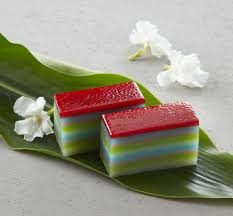
The 9 layered cake is really gao teng kueh in the Chinese dialect called ‘Hokkien’ or  jiu cheng gao (九层糕) in Mandarin. I grew up calling it the ‘rainbow kueh’ – the picture will tell you why.

Taken from mysingaporefood.com

My earliest memory of the rainbow kueh is of my father bringing it home on Saturday morning after his weekly shopping at the wet market, and picking up breakfast from the adjoining hawker centre. Saturday breakfast was a real treat as it took a break from the routine weekday sandwiches and cereal.

The Saturday breakfast options formed a delectable range from springy noodles with thin slices of barbequed pork (kolo mee), peanut pancake (ban jian kueh), rice noodle roll (chee cheong fun), soy bean curd (tau huay) and deep fried dough stick (you cha kueh), or mung bean soup (tau suan) and deep fried dough stick (you cha kueh), and of course, my favourite sweet treat, rainbow kueh. Apart from rainbow kueh, which was a term I coined putting the obvious word that came to mind and the type of food it was (kueh – Hokkien for ‘cake’ or ‘steamed cake’ to be precise), all the other food items I’ve listed here I’ve known them by their Hokkien names (the terms in brackets).

The rainbow kueh comes to mind today in celebration of life – the layers of varying density, the mixed flavours of coconut, pandan and tapioca, and the bright red symbolising happiness – usually the first (and thinnest) layer I peel off to enjoy what I imagine to be sweetest one of them all!.

The rainbow kueh comes to mind as I think of home and what life means to me after being through this year, the year of 9 layers, the layers of: 

Delighting in the now
Chucking out false hopes
Saying yes to opportunities
Loving unwindy sunny days
Pondering over past regrets
Keeping head barely above water
Finding no escape route for shame
Heaving sobs in silent darkness
Riding unfastened in roller coasters

And the sweetest one of them all – delighting in the now – means I am finding the present to be the only thing I have to make or break. At this moment, I am delighting in recollecting my memories, and making sense of who I was and who I am. I used to chant ‘Carpe Diem’ in my teens, after being inspired by Dead Poets Society, so why not again now, after peeling back the 9 layers of life?

Seize the day!
Yesterday is over
Something good is waiting
Wild weather keeps you humble
Disappointment has future lessons
Surviving comes before thriving
The way out of shame is forgiveness
Take time to grief and groan
Cling on tightly to the Immovable Rock

And so life, just like the 9 layered cake – the rainbow kueh – I peel layer by layer, tasting the different textures and flavours of different colours, some more pleasant than others, but savouring each layer and finally completing my quest to consume the rainbow kueh.

A long pause

Hyacinth at the English Wikipedia

Only just last week, life in Aotearoa New Zealand was about being ultra conscious about staying home if sick, washing hands, and being alert to symptoms of COVID-19. From today and moving forward into an indefinite period, it looks like we will have to live in a constant state of heightened awareness and adopt new practices of reduced contact and socialising.

Ordinarily I would be disgruntled at disruptions, upset at being inconvenienced through no fault of mine. But this situation is far from ordinary, in fact, simply extraordinary and unprecedented. It first caused me the typical anxiety about keeping well and protecting myself and my family. But now as the world enters into extreme measures of border control and social directives, my anxiety has turned into more of an uneasy calm. Uneasy because I know the worst thing to do is to be anxious and indulge in panic buying and behaviours; but not ever sure that I am doing enough to do the ‘best’ thing like washing hands and avoiding crowds.

How does one do ‘social distancing’ and keep sane about not being in the company of others? Perhaps my introverted friends welcome the prospect of avoiding the world and all its filth. But for me, I’m trying out alternatives to handshakes and hugs – smiles, awkward gestures and the like. Working from home will be encouraged and while I welcome not having to journey to and fro on the train, I know I will miss the hum of busy minds and bodies about me.

To use a musical term, it feels we have reached a long pause (or a fermata) on a note that was meant to lead on to the next, but holding back for longer than usual. According to the Wikipedia definition, “[e]xactly how much longer it is held is up to the discretion of the performer or conductor, but twice as long is common.” If we are the performers, we take the cue from our country’s leaders, the conductor. Twice as long is probably not long enough, but if we want the music to continue playing, we’ll have to keep on holding the note.

While on this pause, I’ve begun to think about who I want to hang out with, who I could do without, and my obligations to my family if any of us should have to self-isolate. I have learnt to welcome disruption as a way to shine a light on my taken-for-granted values, re-consider knee-jerk reactions, and actually learn how to chill.

For the most part, I would like to be able to meet with people and have conversations. But perhaps they would all soon like to avoid meeting others and making unnecessary contact. And I would probably be persuaded to do so as well. Maybe we do it in the name of self-preservation and keeping the community safe. Maybe we seek solace in avoidance. But we will do what we will be conditioned to do, by political will, by common sense, by social pressure.

May we find the long pause a gift – a gift of restraint to help us become better versions of ourselves when the music resumes.

Don`t copy text!