Close

Book Review – The Anti-Education Era: Creating Smarter Students Through Digital Learning

Book Review - The Anti-Education Era: Creating Smarter Students through Digital Learning

Title: The Anti-Education Era: Creating Smarter Students Through Digital Learning

Author: James Paul Gee

Publisher: Palgrave Macmillan (January 8, 2013)
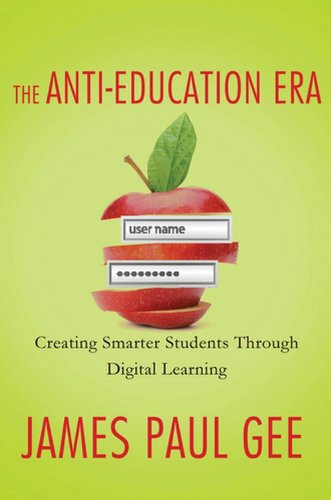
The Anti-Education Era: Creative Smarter Students Through Digital Learning by James Paul Gee

Before we can be convinced of the need to get smart through digital learning, we need to be convinced of our own stupidity.

The title implies that the book will explain how digital leaning will create smarter students in an era the author terms ‘anti-education’. While Gee does explain that and does it well without much reference to buzzwords in educational technology, what the title (as well as the blurb) does not warn us is that there will be a confrontation of the state of the human being and an uncovering of the failings that we are oblivious to. In fact, Part I of the book, which comprises 15 chapters, is plainly titled ‘How To Be Stupid’, while Part II, titled ‘How To Get Smart Before It Gets Too Late’,  has just six chapters.

In other words, before we can be convinced of the need to get smart through digital learning, we need to be convinced of our own stupidity – and Gee does that by exposing mental comfort stories, the dangerous lack of agency or purpose among members of a community (or citizens of a country), and the damaging consequences of our stupidity, e.g. self-deception, inequality and hopelessness.

Unapologetic and deeply convinced for a smarter and more moral world, Gee writes simply and candidly to question our assumptions about education, the economy and society, and calls us to action: to connect, collaborate and create collective intelligence.

I touch on a few of Gee’s arguments that have struck a chord with me.

First, the bad news

HOW SCHOOLS MAKE US STUPID

Humans have the capacity to be reflective and thereafter embark on good actions. Gee calls this the Circuit of Human Reflective Action. The conditions for smart actions to take place are:

1) Initial mentorship so we can learn from people and experience in specific areas/domains;

2) Lots of prior experience;

3) Clear goals;

4) The actions and goals must matter to us emotionally;

5) There is an opportunity to act in a way that elicits a meaningful response from our community (local/global).

Unfortunately, much of formal schooling is highly passive with students imbibing knowledge without much opportunity to take meaningful action based on what they have learned. The lack of a compelling or meaningful goal of studying and attending school is exacerbated by the focus on testing and gate-keeping examinations. Furthermore, some students have initial mentoring (in the form of parents, out-of-school experiences, etc.) and some have not; nonetheless, “we pretend they are on a level-playing field” (p. 16-17).

WHEN STATUS AND SOLIDARITY DIVIDE US

Status and solidarity are powerful cultural forces that shape our identity and influence our everyday actions. We seek status in terms of respect from others. We also seek solidarity with other in order to have a sense of belonging and being accepted.  Such forces, however, may dull our senses and better judgment when status and solidarity become the only end goals of a meaningful life.

As a consequence, we accept and perpetuate particular world views and actions contrary to empirical evidence and facts, common sense and moral standards. For example, aspiring to own a club membership like your peers when your income cannot support it; indulging in bullying tactics along with your buddies when you know the bullied is distressed. These examples may appear trivial but they scratch the surface of a world beset with social ills and inequalities.

In our limited world of people who we want to like us, and people we want to be like, we disregard more rational thought and action, and more sadly, disregard other humans who fall below our flawed standards of human existence.

Now, for some good news

AFFINITY SPACES FOR ALL

In order to engage our students in more critical and reflective thinking, we need to lead them to an affinity space where a community of learners who share common passions and goals. They may come from a variety of backgrounds and have varying levels of experience and expertise, but by exchanging ideas, opinions and thoughts with one another, the group solution to the challenge is going to be superior to an individual’s effort. “[H]umans think and act better when we do so by getting the help of others and giving help to them” (p. 174).

Such affinity spaces would look like discussion boards and interest groups related to the simulation video game The Sims where players find ways to create objects of their desire such as building their dream house and accessories, as well as the various user-generated communities where players interact with one another.

I do believe that affinity spaces are not limited to an online environment and it is important to have real-life face-to-face connections in any affinity space to encourage authentic relationships among learners.

Exactly how affinity spaces are to be constructed is not the focus in Part II of the book but the end is really the beginning of our conversation of how to make use of our 21st century tools to enhance our student’s thinking, reflecting and doing while creating purposeful goals for them in a diverse and global community.


Educating Singapore – Moving Beyond Grades

Educating Singapore - Moving Beyond Grades

The latest PISA (Programme for International Student Assessment) results have placed Singapore among the top performers among 65 countries and economies who took part in the fifth assessment of 15-year-olds’ competencies in Reading, Mathematics and Science. We came in second in Mathematics, and third in both Reading and Science.

Not only are we in good company with our Asian neighbours like Shanghai (top in all three areas) and Hong Kong (third in Math and second in both Reading and Science), we have shown improvement in results in both academically weaker and stronger pupils. Our Education Minister is reported to be very happy and very proud of the results but I hope Singapore’s stellar performance at PISA will not undermine the need to improve areas such as equity and creativity.

S’pore can do better in ensuring educational equity
Singapore can do better in ensuring educational equity

A recent news report gave a more balanced assessment of Singapore’s PISA results, where OECD Deputy Director for Education and Skills Andreas Schleicher noted that Singapore is “a strong performer in (education) quality, but only an average performer in equity.” Educational equity is defined by OECD in terms of fairness and inclusion – providing all students, regardless of gender, socio-economic status or ethnic origin, have similar opportunities to achieving educational potential; and ensuring a basic minimum standard of education for all. By that definition, Singapore has progressed very well over the past few decades (from fishing village to global player) and has been considered the “poster child” for educational development (mirroring its economic success story) – see country report by OECD. We have reduced achievement gaps between genders and races, and have refined the process of teaching students according to their abilities.

Nonetheless, the education culture in Singapore is one driven by results of  high-stakes examinations which are the gatekeepers to the next level of education which in turn determine the type and quality of jobs students eventually land. While this is not a culture unique to Singapore, and certainly not as extreme as compared to South Korea and China, such a culture privileges those who have easier access to educational resources (e.g. private lessons, parental coaching, financial support). Furthermore, innovation and creativity take a back seat while grades get all the glory. Despite government attempts to downplay the importance of grades and asking parents to broaden their perception of their children’s success, parents are too pragmatic to give up the paper chase. Exam results continue to be the determining factor at each turning point of a child’s school life.

The Singapore Ministry of Education hails the latest PISA results as an indication that Singapore students “are ready to thrive in the 21st century.” To me, thriving means growing in a supportive environment where students can realise their potential and nurture their talents. To thrive in the 21st century also means having the capacity to change, innovate and look for new ways of doing things. I’m not sure if we can claim that all Singapore students are ready to thrive. Some have more resources to be able to thrive, some have fewer, and many have discovered the best way to thrive is to go to another country where there’s more to school than just getting good grades.

An education system is a product of philosophy, politics and societal values. I don’t believe there is something inherently right or wrong about using exam results to measure success. Neither do I believe that there is a level playing field for all children. What I hope our education system does not do is to reduce a person’s worth to the degree of educational attainment, and by extension, the financial rewards that come from it.

However the education game is being played, we must be critical of our successes and learn from our failures. Doing that will keep my hope alive.

Adventures of a Note-taking Warrior

Adventures of a Note-taking Warrior

I recently attended the 2013 Joint SELF Biennial International Conference and Educational Research Association of Singapore (ERAS) Conference. I wanted to go more digital in my note-taking so I tool along a Samsung Note 10.1 which includes a stylus. I also had my usual pen and notebook as I wasn’t sure if I would end up going all digital in my notes.

The argument for digital notes is an easy one – more legible, searchable and easily transferred from one digital source to another. But what about writing down notes? Apart from being faster, words stuck on page are just stuck on page.

During the conference, I used Evernote to store my notes. With a premium account, I could work on my notes offline which is important when you may not always have internet access. For me, Evernote has been the best note-taking app/software for desktop, phone and tablet without a doubt. What is not so clear, however, is the best way to make those notes.

Evernote
Evernote (Photo credit: /Sizemore/)

Here are the results of my experiment with different note-taking ways:

1) Using tablet with on-screen keyboard

Two words: hand cramp.

A non-tactile, flat and smooth surface is really not the best input source. As much as predictive text was helpful, I was still typing more slowly than if I had a regular keyboard. Then there were times when I hit other keys instead of space bar, or when serious mistyping led to incorrect suggestions. In addition, not being able to type fast enough also meant missing some info on the slides when the presenter moved on.

Apart from taking notes from the presentation, I also searched for the presenters, found pages related to them and the main theories and ideas they were presenting on, and copied and pasted the links into my notes. If I didn’t have time to do that, I would just bookmark the sites or save the link directly to Evernote.

All in all, while I captured the notes digitally, I’m not convinced the on-screen keyboard is worth the discomfort.

2) Using tablet with stylus

The stylus was a smooth operator, but a bit too smooth.

The S pen was good for some quick scribbling, a few sentences, but certainly not for anything longer or more complex than that. After taking down a few sentences, I switched back to the keyboard.

The stylus, however, was good for making annotations on pdfs or images. I used two apps to try out the stylus for that purpose: iAnnotate and Skitch. I didn’t do a whole lot of annotations during the conference but will be experimenting more with PDF annotation with iAnnotate in the near future.

So the stylus is good for adding details or comments but not for a long stretch of writing.

3) Taking snapshots of slides

If you can’t beat them, join them.

This was actually the most common way of note-taking at the conference, judging by the number of phones and tablets bobbing up and down throughout the presentations. I resisted at first as I was not keen on having a bunch of photos stuck in my phone. Then I discovered Page Camera in Evernote. I could include my photos of slides in my Evernote notes, whether by importing from my phone gallery or taking the photos directly from Evernote. The tablet was not great for taking pictures of slides, so I used my phone for this.

With the slides in my notes, I could also add comments in the notes, or annotate on the picture of the slide using Skitch. The challenge, however, is to multitask between capturing images and taking down notes. Sometimes I found myself taking down notes but missed the chance to capture the slides.

Page Camera is a great addition to Evernote and I’m looking forward to more enhancements.

4) Taking snapshots of handwritten notes

Have pen, will write!

I ended up using my trusty pen and notebook most of the time for quicker note-taking. But not content with the non-digital nature of physical notes, I took photos of my the pages in my notebook and added them to Evernote.

With the premium version of Evernote, the search function includes picking out text from your images. As long as you write legibly, Evernote can highlight words in those pictures. I haven’t tested this fully, but then again, my handwriting is not the most legible to the human or Evernote eye.

Evernote Smart Notebook
Evernote Smart Notebook (Photo credit: AhBook)

In the end, the winner is …

With the limitations of an on-screen keyboard on the tablet, I think the Mac Air would solve that problem. Personally, I would go for the 13 inch version so I can read documents and long stretches of text more comfortably. I did consider a bluetooth keyboard for the tablet but the weight probably adds up to that of the Mac Air. Furthermore, I’m a heavy user of Mendely to organise articles (PDF documents), and so far, both iOS and Android apps do not have full functionality of the desktop version. So for serious note-taking, I’ll be going the way of the Air.

I’ll also be complementing digital note-taking with snapshots of slides and regular handwritten notes. In fact, I don’t ever think I will give up physical notes. Sometimes, you just want to write and doodle or just not have any clunky devices around. I’m going to get the Evernote Smart Notebook by Moleskin which comes with three months subscription to Evernote Premium (brilliant marketing move!). Evernote Premium is valued at US$7 per month (US$21 for three months), almost offsetting the cost of a 3.5 by 5.5 notebook (US$24.95).

Previously, I didn’t think a physical Moleskin notebook would gel with the digital Evernote but it now makes sense to me, wonderful digital sense.

My Last Class – Reflections on the MAT@USC

My Last Class - Reflections on the MAT@USC

“Please hold while I confirm your passcode. Thank you. Your passcode is confirmed.” That’s the automated message to the virtual classroom I’ve attended every week for 6 semesters in the past two years. As I attend my last class today, I know I will miss that familiar buzz through my headphones which welcomed me to a community of learners from various continents including North America, Europe and Asia.

I started the Master of Arts in Teaching (TESOL) with the University of Southern California in May 2011. It is a wholly online course and like many others, I was skeptical of how learning could take place. But as I examined the course program, comparing it to other education-related Master programs I could take in Singapore, I was attracted to the subjects it offered, fieldwork requirements, and the convenience that comes with online learning. I could access the classroom from any computer with camera and mic and for me, that meant not having to travel to and from classes, and being able to go home for dinner, attend to my kids, and settle them down to sleep before I stepped into my study.

Master of Arts in Teaching (TESOL) at USC

The most important part of the program was that it was interactive – real time video conferencing lessons and study group sessions was something that other distance education programs did not offer. (Read more about the Adobe Connect platform that the program used.) While other programs had intensive weekend lessons, the MAT program was paced like a regular program with weekly classes. Like most distance programs, students were required to submit forum postings and term papers, but the MAT program  (as opposed to Master of Education programs) also required students to be involved in fieldwork, observing and video recording classes.

Adobe Connect Meeting Room

As I started virtual classes, there were technical glitches now and then but overall, the learning experience was the best I’ve experienced. Most of my schooling experience in Singapore followed what Paulo Freire calls the banking concept where the teacher deposits information into us to be remembered and regurgitated. In the MAT program, on the other hand, true to the impression many have of American education, learning depended on peer discussion and in the process, respecting and embracing the diversity of opinions and ideas. It was liberating for me and I valued and enjoyed every opportunity I had to engage in discussion with professors and classmates alike.

Apart from attending classes, pouring over readings and honing my teaching skills, I spent time with 3 or 4 classmates in study group sessions. In our cozy groups, we clarified our understanding of the readings and concepts, worked on our group presentations, and had fun bonding with one another. Study group was key in connecting me to fellow classmates on a more personal level. I have made friends with kindred spirits and while it is difficult to maintain long distance friendships, I have great hope that we will all meet one another at some point in the future.

As I complete my MAT journey in the Spring of 2013, I have already begun another journey to be a reflective educator and researcher. (Read about my Teacher Leadership Project.) To my professors and classmates, thank you for these two precious years. No goodbyes, just good memories.

Don`t copy text!