In the past few years, I’ve written about my journey with labels: Living and Thriving with Labels and Don’t call me Migrant or Asian but who do you say I am? In a generous reading of a label like ‘migrant’, you could say it is a convenient shorthand that points people to specific information and services, and allows people to quickly adjust how they engage with the subject matter or people who identify as migrant. You might even say ‘migrant’ encourages feelings of empathy and curiosity. In a less sanguine light, ‘migrant’ perpetuates the tropes in our public consciousness – the yellow/brown/black skinned person who is struggling in a white world, who overcomes the odds to be one of them, overachieves but stays humble and grateful.
In music, counterpoint is the relationship between two or more musical lines (or voices) which are harmonically interdependent yet independent in rhythm and melodic contour. In brief, contrasting yet complementary. I’m starting to see life as counterpoint where different strands of life form an almost impossible fugal work of art.
If I could choose a piece of fugal music as inspiration, it would be Bach’s Prelude and Fugue No.2 Well Tempered Clavier, Book 1.
Work life takes up the most time of one’s 24 hours 7 days a week life, a sure-fire routine of starting up the computer and digital tools, the scrolling and clicking, the joining and leaving meetings, near-novel in-person meetings, the now clichéd Teams-Zoom meetings, the chatter around desks and kitchens, and of course, the actual work of doing-thinking-pausing in various reps and combos.
Work life, for all its transactional, practical and obligatory functions, might as well be the basso ostinato, a fixed bass line or chord progression that is continuously repeated while the melody and harmonies above it vary.
Or is it home life with similar ritualistic routines but with much heavier practical and obligatory functions that becomes the basso ostinato? Without paid work, home life would be untenable. And home life is the life that meets our most basic needs of food, shelter, safety and comfort.
Most of my working life has been as a ‘working mum’ (as opposed to a ‘non-working mum’ or ‘mum’ who are firmly positioned in the home), and as the primary income earner, have developed a no-nonsense almost survivalist mantra of ‘no work, no money, no food, no clothes, no house, so work’.
The work and home life balance is more like a see saw that keeps the momentum going for both lives to thrive. It now becomes evident to me that of course both work life and home life form the basso ostinato, stubbornly persistent and intertwined.
My community life is less about survival and more about serving and lifting others up. I spend this life with my church community – the women’s group, playing the piano, leading church services, praying for others. No doubt, the basso ostinato of work life and home life provides the ballast for me to be able to serve others. You can’t pour from an empty cup, but when you start pouring, your cup overflows.
For whoever has will be given more, and they will have an abundance. Whoever does not have, even what they have will be taken from them. Matthew 25:29
My creative life has only recently resurfaced like a Phoenix rising from the ashes of unfulfilled dreams of being a professional pianist, a composer, a published poet – the things that have been considered fanciful, unrealistic and hobbies at best in my down-to-earth middle class Asian upbringing and a pragmatic, competitive, discouraging Singaporean society. Perhaps it was going through adulthood, motherhood, and if I may coin the term, migrant-hood, in a place like New Zealand, that the creative life could be re-born. And just to be clear, in case you thought I was now a full-fledged musician and published author, I am not.
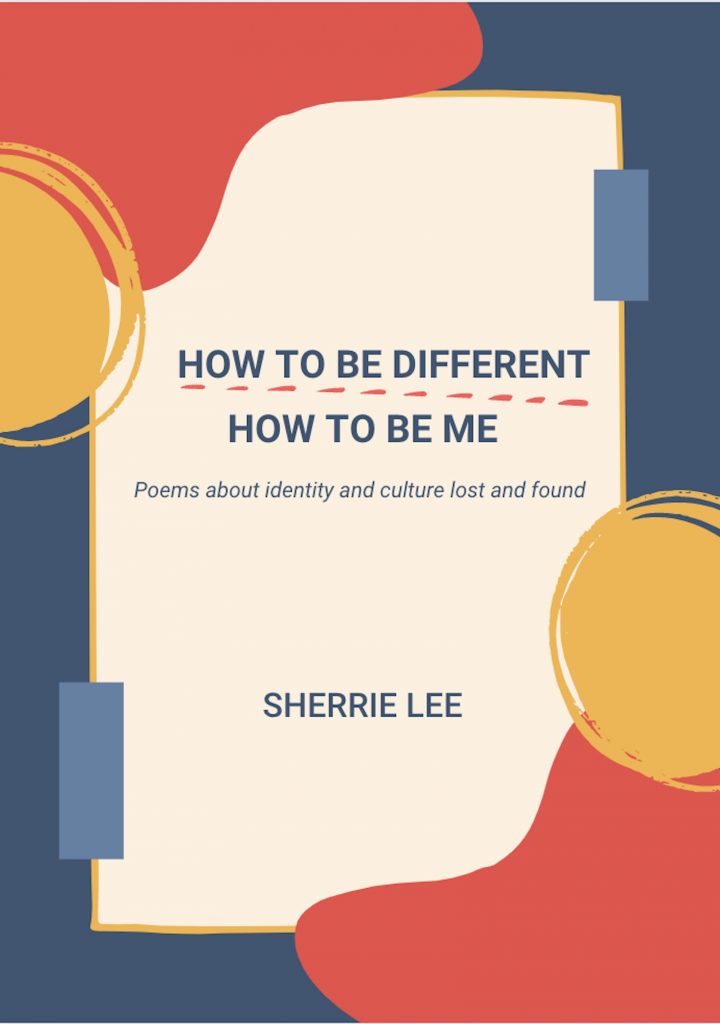
Instead, I have become increasingly comfortable in my own skin, whatever shade it’s purported to be, and feel free and encouraged to write, experiment, create, sing for those who willing to be the audience. Perhaps it is living in Wellington, the creative capital of New Zealand, that is the fertile soil for anyone who is willing to give it a go. Last year, I self-published a poetry book How To Be Different, How To Be Me. And in the past year or so, I’ve tried to make time to write poetry. Poetry is may start with a flash of inspiration that causes words to appear magically on paper, but it is the working through the word choices, sequence, rhythm that makes the scenes and emotions come alive.
This year, my creative life branched out into songwriting. Inspired by a worship leading workshop I attended at The Street Church in a few months ago, I rekindled my desire to write music and wrote two songs. I’ve sung one of them in church, and will sing the second one at the Christmas Eve service. I’ve been encouarged by my church community, and I share these songs with you.
The Offering is a song about what we offer to God as an act of worship, and what God has offered to us – his one and only Son Jesus.
Silent Night Is Calling is a Christmas themed song, inspired by one of my favourite songs, We Are the Reason by singer and songwriter David Meece. In Silent Night Is Calling, I used ‘silent night’ as a motif for the different settings Jesus is present in our lives.
Life’s journey this year (and every year) can feel like it’s been full of routines and activities, and that is why the do-things-for-myself life becomes important. Often overlooked or considered dispensable, this life points to the rests, long pauses and empty bars of my fugal composition. The do-things-for-myself life is unwinding with a book or something on the iPad screen, baking seeded crackers, lying flat on my back in quiet contemplation, walking on my own around the neighbourhood. They are wordless unambitious indulgences.
Time and intention has written this year’s fugual composition, or rather, a movement of a much longer piece of music.
Identities and cultures get lost and found as people traverse land and sea. This a collection of ten poems written by an immigrant in New Zealand, a woman of colour with multiple identities. In some poems, she unpacks the social cues and cultural nuances of the situations she finds herself in. In others, she simply wants to be herself – at least one of the multiple identities she holds.
For best results, perform the poems like a song, a rap or spoken word.
I celebrate the year of 2022 with my first self-published book How To Be Different, How To Be Me: Poems about identity and culture lost and found.
I started writing poetry when I was 15, published poems in local anthologies in Singapore in my early twenties and once entrenched in adulthood and soon after, motherhood, poetry became a distant memory. I started to write again when my children could walk and and run on their own, and as I saw my thirties start to move very quickly into another decade. Where did all that time go? And what did I have to show for it?
Words. I had words to capture the moments when something in me stirred: reacting to an incident, realising some dormant thought, or ranting in style.
By 2022, I had plenty of words for capturing scenes from motherhood, family holidays, coffee conversations, imagined lives of my alter egos, and pointy social commentary dressed up in verse. In 2022, the thirties were well over, and I found myself turning 45 – feeling restless about what I was going to do with my accumulated words, and tired of not having a birthday gift that I really wanted.
The antidote to that was buying myself a New Zealand Society of Authors (NZSA) membership and attending their Wellington Roadshow in July. I was going to be a writer, a poet, a someone who had words worth reading (and performing). I was inspired by the keynote address given by Witi Ihimaera who imparted these lessons: write to impossible deadlines, use writing structures like seasons, and decide what kind of writer you want to be. I re-connected with my element in a poetry masterclass by Siobhan Harvey. And I found like-minded people and discovered networks and events in the amazing literary capital of Wellington I call home.
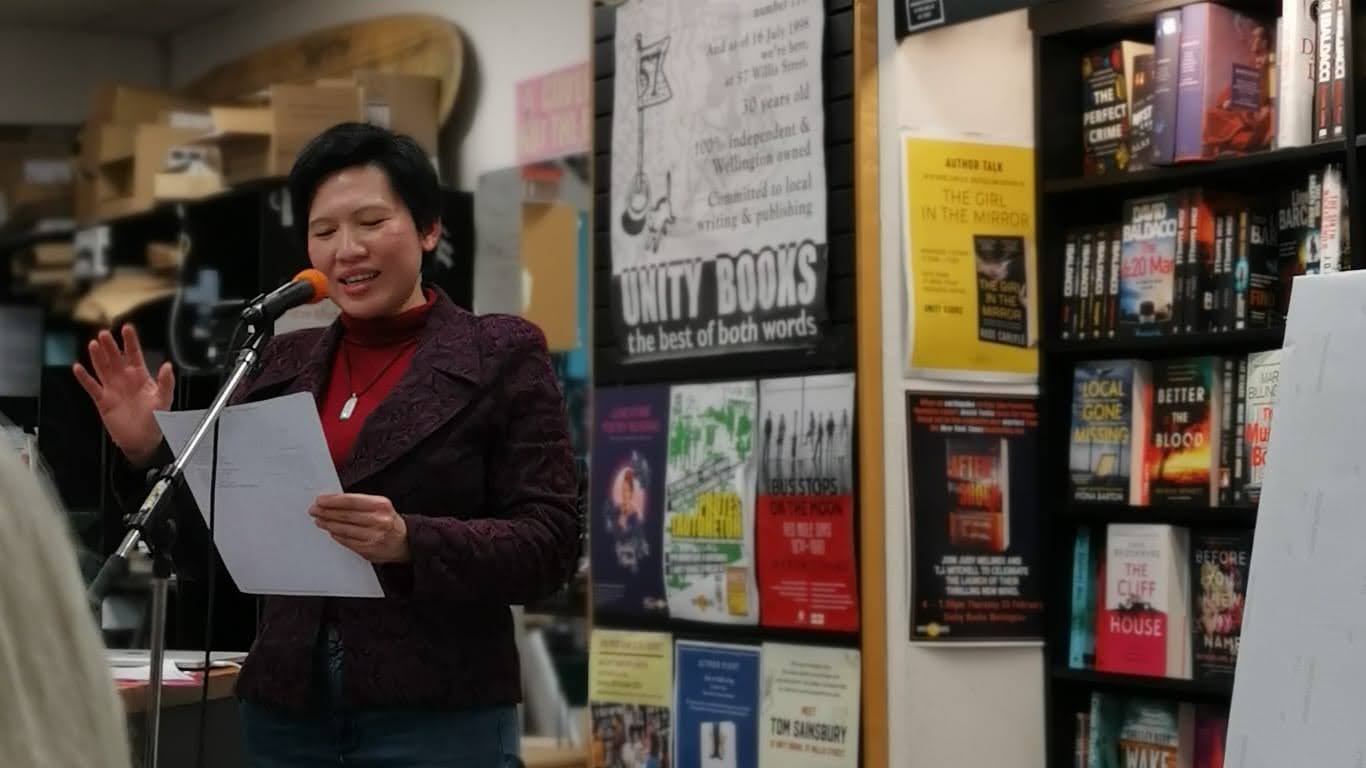
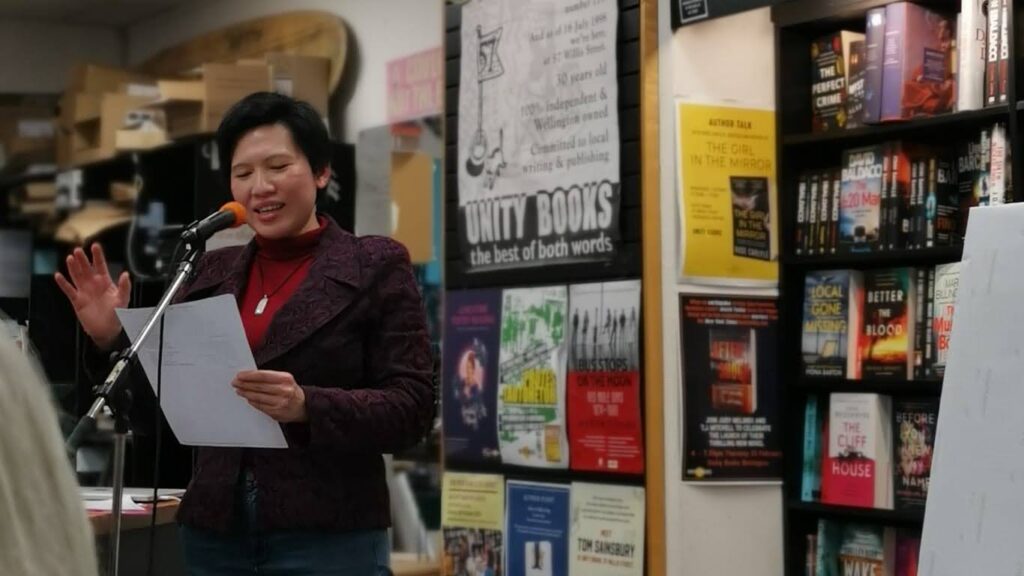
Open mic poetry reading at Unity Books Wellington on National Poetry Day 26 Aug 2022
I took part in an open mic poetry reading organised by the Wellington branch of the NZSA as part of National Poetry Day. I started to write poetry to submit to anthologies, literary journals and any occasion that called for poetry that resonated with my personal and life themes. When my poems were not accepted, I wasn’t disheartened, but was actually motivated to find alternative ways to express myself to the public.
Self-publishing in the age of ‘self’
In the age of the ‘self’, I was starting to think I was missing out on something by merely wishing that someday someone would somehow discover my talent and sign me up as their publisher. I concluded one Sunday afternoon that I could do that for myself – look at the countless other individuals who have released their own music, published their own books, and produced their own apps!
I’ve had already been routinely putting together collections of poetry to share with friends and family, designing book covers and layout using Canva and promoting them on my Facebook page and LinkedIn account. So I was just taking another a few additional steps to getting my work into a more concrete and legitimised format.
With a collection of recent poems already forming in my head, I quickly went into entrepreneurial mode, googling my way through how-to-guides, YouTube videos and learning through trial and error. The result of this self-learnt journey into self-publishing are two products: A Kindle product and a softcover book.
Where to find my book
You can purchase the Kindle book here from anywhere in the world (almost) and you don’t need a Kindle reader – just download the Kindle app on your device. And if you’re in New Zealand, you can place an order for the softcover book here (free shipping). If you’ve read my book, please consider leaving a review on Goodreads.
I also did a poetry reading on Facebook live and this being my first experience hosting a FB live event, I thought it went pretty well!
Facebook live poetry reading from How To Be Different, How To Be Me
My next goals are to get it to local bookstores, events and do more live poetry readings, in-person and online. I also hope to use the book as a springboard for small group discussions, workshops and any kind of event that promotes self-reflection and discovery as it relates to individuals or communities who identify as being ‘different’.
So I bid you adieu 2022, with all the words I’ve written here, and look forward to resting, recovering and re-connecting to prepare for 2023.
ESOL stands for English for Speakers of Other Languages. In New Zealand and other English-speaking countries (eg, Australia, US), the term is used to differentiate the intended audience from mainstream English language instruction.
The article claims that “there is something Anglo-centric and othering about the term”. There’s an argument to be made that someone not born into an English speaking environment and who receives English language training is orienting themselves to an ‘Anglo’ worldview, eg, that English is important for them to want to learn it, that the world they live in or wish to live in operates on an English-speaking basis and all its norms and assumptions. The term is also Anglo-centric in that it is those who provide that type of English language instruction are dominated by the Anglo centres of the world (ie., US, Canada, UK, Australia, New Zealand).
I recognise that Anglo-centricity can give rise to othering, but it is also important to distinguish between the issue of Anglo-centricity – that is, how the English language and associated culture is the dominant and unquestioned way of life, and the issue of othering – marking someone or some group as different with intended or unintended negative connotations.
We can use any number of labels to identify those who are learning the English language, and labels in the English learning and teaching context help to differentiate pedagogical approaches. Whether the label or term becomes ‘othering’ will depend on the context in which it is used.
For the learner, ESOL might be a strange term for them since it’s a given that they speak other languages. Why not simply call it an English language class? Or better yet, describe what they can do with the English, eg, Conversational English, English for Work, Everyday English. And this is probably what happens with naming English classes. So while ESOL is used to refer to the type of English language instruction, learners don’t necessarily use the term to describe their own learning. So whether the term ESOL is ‘othering’ for the learner may be moot as they simply consider themselves English language learners.
So if we hold the teachers of English to speakers of other languages to the principles and intentions of affirming the learners’ home languages and cultures, the term ESOL is far from ‘othering’: it is inclusive, respectful and aspirational.
And to go back to the issue of Anglo-centricity, the underlying ethos of the terms ESOL and TESOL would appear to challenge the status quo of Anglo-centricity in a way that aims to be beneficial for both English language learners and the wider community.
So why this accusation of ‘ESOL’ being guilty of ‘othering’? The ESOL terminology not only serves to make clear the audience of English language instruction, but also aims to affirm learners’ heritage and their linguistic and cultural resources.
It’s encouraging to know that there are advocates for inclusivity and those who call out discriminatory language. But has the word ‘other’ in ESOL tripped people up? There’s nothing othering about the term nor its intended use. And it’s concerning if we start reading ‘othering’ into a term that means no harm.
Sure, re-name course titles and qualifications to signal a wider audience of English language learners. But don’t erase a term or label when there’s a useful function for differentiation, and more importantly, when there’s a specific intention of making learners the centre in language training.
If we want to deal with ‘othering’, let’s look beyond the single word or label. Better yet, let’s welcome the ‘other’ relative to ourselves. If we recognise that those who are learning English speak ‘other’ languages, how about we start to be curious about their languages, and unpack what this ‘other’ means to us, and start to unravel a multitude of languages we can recognise, learn and embrace?
And if you’re ready, you’re in luck. New Zealand Chinese Language Week is coming up and runs from 25 September to 1 October. As a speaker of English, Mandarin and some Hokkien, I’m delighted to share ‘other’ languages with you, and I’m curious about ‘other’ languages different communities around me speak.
Ko taku reo, taku ohooho, ko taku reo taku mapihi mauria.
My language is my awakening, my language is the window to my soul.
Almost 5 years ago, I re-named my blogging website ‘The Diasporic Academic’, inspired by a keynote presentation given by Wendy Larner at a conference on international education held in Wellington. A diasporic academic by her definition was someone with multiple national affiliations, for example, a researcher from one country based in another country working on a project, or travelling between countries for research purposes, and at the same time, having a role as an intermediary between cultures, for example, translating from one language to another, or providing a culturally nuanced interpretation of things. (To dig deeper into the concept of diasporic academics, I highly recommend reading Larner’s 2015 paper on which the keynote presentation was based, as well as a 2020 book chapter I co-authored with a fellow diasporic academic.)
No doubt I’ve long left my academic ambitions at the door of the once enamoured institution called a university, but my academic sense making and inquiry has been put to good use in my public sector career – demanding clarity in policy definitions, looking for evidence to support claims, assessing the value of outputs and interpreting the validity of outcomes. So I’m proud to say that the ‘academic’ part of my identity has taken on a new form, that of a conscientious public servant.
In terms of living out my ‘diasporic’ potential, it has been an interesting journey through the professional and personal contexts of living and working in Aotearoa New Zealand. Being visibly and audibly different from the ‘European norm’ of everyday affairs, I’ve gone through various degrees of identity crises or conscious raising moments. It has made me become more sensitive to social and cultural assumptions, both my own and those around me, and often wonder about what actually goes on in people’s heads when they have an intercultural interaction. We probably assume ‘nothing’ until a word or gesture prompts an ‘aha’ response. Or we might be deliberate about discovering differences and similarities if we actually talk about cultural differences with genuine interest and respect – and how rare is that!
Let’s talk about names – a diasporic reflection
One of the common assumptions we make is people’s names.
Your name is something you take for granted. You know what it is, the variations in different contexts, how you like to be addressed, how you don’t like to be addressed, what is acceptable and welcomed banter, and what is offensive or inappropriate. To illustrate, I’ll start with the ‘Western’ name, that is, one with a first name, middle name, and a family name: Elizabeth Bennett Brown, an officially recorded name.
If we know or assume that the person is single, officially we would address the person as ‘Miss Brown’. Friends might call the person ‘Liz’ or ‘Lizzy’ or ‘Beth’. When using the name in a professional context, the name could be written simply as ‘Elizabeth Brown’, and perhaps even ‘Lizzy Brown’ if that has been the version used over time or could even be a personal brand that warrants formal usage. If the person was married, we’d say hello to ‘Mrs Brown’ and perhaps infer that ‘Bennett’ was her maiden family name. Or maybe ‘Bennett’ was her actual middle name and her maiden family name is buried in school photos and the like. This is how the office, banks, schools, and various institutions would likely respond to the person with the name of ‘Elizabeth Bennett Brown’.
Now compare this with an officially recorded name of a Chinese Singaporean woman: Lim Bee Choo, Maureen. Lim = family name, Bee Choo, Maureen = given names. ‘Lim Bee Choo’ is the the romanised rendition of the Chinese name based on the dialect group of the person (in this case, Hokkien), ie, it is rendered as it is spoken, as opposed to how the Chinese character would be spoken in standard Mandarin (in this case, ‘林’ pronounced ‘Lin’). Maureen is the given English name. It’s quite common for a Chinese Singaporean to have an English name, and by that I mean a name that is given by the parents, recorded at birth, not a name taken at a later age in life. (Something that can be attributed to Singapore being a former British Colony but of course more complex than that, and maybe something to ruminate on later.)
As this is the person’s officially recorded name, we can assume this is the maiden name. If the person were married and wanted her married name officially recorded (eg, on the national identity card), the most common option would be to apply to have the married name added as an alias. This means the person’s maiden name is the principal name, and by default, the official name. Replacing your maiden name with a married name on an official identity document needs to be done by executing a Change of Name Deed Poll. (It’s extra work and costs money so I’ve yet to know of any married female friends who have done so.)
You could use your married name in other contexts (eg, professional name), and be known as Mrs Maureen Goh. Or to just indicate you’re not single (or to be ambiguous about it), Ms Maureen Lim. (In my mother’s generation, it was common to use your married by simply adding ‘Mrs’ in front of their husband’s name. So if Lim Bee Choo, Maureen married Tan Soo Teck, David, her married name could be Mrs Tan Soo Teck, David, or Mrs David Tan.)
To address Lim Bee Choo, Maureen (married or not) in less formal settings, family might call her ‘Bee Choo’ or ‘Choo’, or ‘Ah Choo’; her peers would call her ‘Maureen’, and would be professionally known as ‘Maureen Lim’, although school communications to parents would list her as Mrs Goh. (Note: I found a very helpful resource on Singapore naming conventions and culture, which also has similar entries for other countries and cultures. Absolutely worth reading if you regularly interact with friends or business associates from non-Western backgrounds.)
If Maureen had to list her official name on documents from the ‘Western world’, she would be careful to list ‘Lim’ as her family name, ‘Bee Choo, Maureen’ as given names. If she was forced to choose single names to fit the given categories, her name might be recorded as: Family Name – Lim; Middle Name – Bee; Given Name – Choo; Preferred Name: Maureen. Automated letters drawing from the categories would simply address her as ‘Choo Lim’, and if it were recorded that she was married, ‘Mrs Choo Lim’. ‘Maureen Lim’, as she was commonly addressed and acknowledged in Singapore, would have an automatic identity makeover in New Zealand.
The Inciting Incident
I love the concept of the inciting incident in film and novels: the event that sets the main character on the journey that will occupy them throughout the narrative. Like how Biff calls Marty McFly ‘chicken’ in Back to the Future, triggering Marty to react with determination to put Biff in his place, keenly aware of how his father was a pushover, an easy target for bullies.
Just like how inciting incidents upset the balance within the main character’s world, inciting incidents in my life in New Zealand have made me question why the people around me held the assumptions they did, and why I reacted the way I did. These inciting incidents have touched on deeply personal things such as my name, the colour of my skin and hair, and my customs. And nothing gets me going more than inciting incidents about my name, the most common inciting incidents of them all.
Imagine Elizabeth Bennett Brown, Lim Bee Choo, Maureen, and myself found ourselves in conversation during tea break at a business seminar in Auckland, and our name tags reflected our names as follows: Lizzy Brown; Choo Bee Lim; Sherrie Lee. Our imaginary (and all too real) conversation could go like this:
SHERRIE LEE Hi, (reading name tag) Choo Bee, I’m Sherrie (SHAIR-ree).
CHOO BEE LIM Oh, it’s actually Bee Choo, long story about computer systems, …
SHERRIE LEE No, I get it! Of course, you’re Bee Choo! (laughs). And you’re either from Malaysia or Singapore right?
CHOO BEE LIM Born in Malaysia, but grew up in Singapore. Most people call me Maureen, only my family calls me Bee Choo. But when I came to New Zealand, after filling out a couple of forms, my default name is Choo, and a real struggle to get Bee Choo or Maureen recognised as my proper name. (sigh) So it’s not too bad that I managed to get Bee Choo on my name tag, even though it’s the wrong order! (joint laughter) I’m guessing you’re from Singapore?
SHERRIE LEE Yep, born and bred. Looks like our accents and names give us away. (joint laughter)
LIZZY BROWN joins the conversation.
LIZZY BROWN Hello, I’m Lizzy.
CHOO BEE LIM Hi Lizzy, I’m Bee Choo or just call me Maureen.
LIZZY BROWN Maureen it is, I’m better with English names. Hi (reading name tag) Sherrie (sher-REE).
SHERRIE LEE (cringing inside but smiling outside) Hi Lizzy. It’s Sherrie (SHAIR-ree), like the drink, rhymes with ‘cherry’.
LIZZY BROWN Rhymes with cherry, cute, I can remember that (laughs), so Sherrie (SHAIR-ree).
SHERRIE LEE (more cringing inside but a wider smile outside)
CHOO BEE LIM We’re just talking about our names and the difficulty with Chinese names.
LIZZY BROWN Actually I don’t think your Chinese name is too difficult, they look like English words to me, so ‘Choo Bee’, have I got that right?
CHOO BEE LIM It’s actually Bee Choo, they got the names mixed up. It’s ok, Maureen is fine.
SHERRIE LEE (attempting neutral small talk) Lizzy, is that short for Elizabeth?
LIZZY BROWN Yes, it is. And Sherrie (sher-REE), what’s your real name?
SHERRIE LEE (even more cringing inside) Sherrie (SHAIR-ree) is my real name, my mother gave me that name.
LIZZY BROWN (laughs) I mean, what’s your Chinese name?
SHERRIE LEE (with defiance and a steely look in her eyes) I don’t use it.
LIZZY BROWN I used to have Chinese borders, students studying at uni, and one girl would change her name every semester. First it was Lucy, then it became Anna, not sure what name she does by now (laughs). Maureen, did you have a different name before?
CHOO BEE LIM No, my name is Maureen, always has been.
LIZZY BROWN (laughs) Nice talking to you (walks to another group of people).
CHOO BEE LIM and SHERRIE LEE exchange knowing glances and laugh out loud.
The Diasporic Resident
The inciting incident about names was an imaginary movie scene, created from personal and observed experiences of cultural assumptions and hidden meanings, and snatches of phrases from well-meaning individuals not yet familiar with the Chinese diaspora in Southeast Asia. If this is sounding too academic, it might as well be. After all, it will be a part history part anthropology lesson if I start unpacking Chinese naming conventions, cultural norms and expectations, and colonial influences. (Try Chapter 1 of my 2019 thesis if you’re up for some fairly readable academese.)
Inciting incidents like these that help me appreciate who I am in the world, the world of ‘European norms’ in a settler colony, with the Crown gradually unpacking and honouring Treaty obligations, as well as the wider world of migration and multiculturalism. In the immediate world of my living and working, it can often feel like I’m justifying my existence to others around me – why I should be accepted and feel valued. And when I’m considering my relationship with tangata whenua (the Māori, the peoples of the land), I have questions about what it means to be tauiwi (foreigner/immigrant), especially a non-white immigrant. Whereas if I’m operating in a world where the mobility of people and their culture and languages is welcome, then there’s much more freedom to embrace and celebrate differences.
After finishing my PhD, I truly wanted to be an academic operating in that world of migration and multiculturalism, desiring to be that cultural intermediary or broker who could help explain the unspoken thoughts in people’s heads during the kind of conversation Lizzy, Bee Choo and I had. Although I am not that academic I thought I’d be, I can be a diasporic resident in the world of cultures and clashes.
So here’s a challenge to myself and fellow diasporic residents – the next time an inciting incident about your name occurs, will you be that diasporic resident who explains the story behind your name?