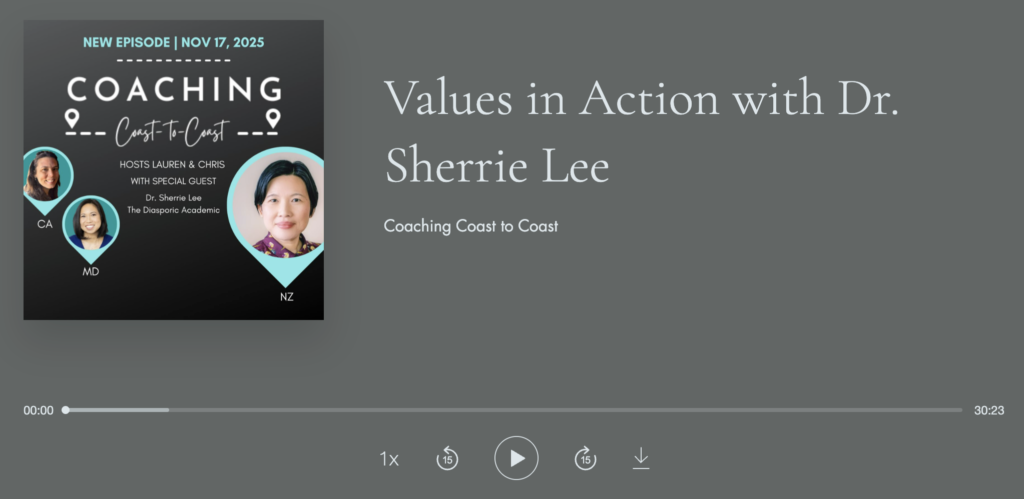
A Year of Professional Development, Character Strengths, and Portfolio Strategy
At the start of 2025, I’d set out to go deep and hone my craft as an international career coach. I committed to professional development, reaching a wider audience with my character strengths workshop. Along that journey, I also experienced planned happenstance – being presented with opportunities when I least expected it, and taking a leap of faith and saying yes.
When I look back at what I’ve done, I find myself taking a pause, a deep breath, and savouring the moment. Imagining I was looking at an art work on the wall, I see Jackson Pollock’s Convergence where “the process of dripping, pouring, and splattering provided him with a combination of chance and control.”

Chance and control. Having a direction of travel but not knowing exactly if it will and how it will work out. Making plans and adjusting them as other things pop up. Keeping my focus on what I want: To make a bigger and deeper impact on international professionals in their career journey.
Professional Development is Non-negotiable
I’ve learnt time and time again that there’s always more to learn, even if you feel you’re at the peak of your career or on top of your game. In fact, if we accept that people and society are dynamic and ever-changing, then it follows that we will need to keep learning, refining, and sharpening our toolkit and skill set.
This year was marked by extensive professional development in career practice. When I get serious about something, I don’t just read a book about it. I could be biased since I have learning as a top strength. And truth be told, sometimes I overuse this strength to my detriment – signing up for way more webinars than I can practically attend or reasonably focus my attention on. But I’m learning the lesson of ‘less is more’ and ‘fewer but deeper’.

For international professionals and migrants navigating career transitions, this commitment to continuous learning becomes even more critical.
New Zealand vs Singapore: Two Approaches to Professional Development
It’s also interesting to note the contrasting attitudes toward professional development between New Zealand (where I live) and Singapore (where I’m from). In New Zealand, professional development is individual-driven, incentivised (or disincentivised) by the organisation’s commitment to it in terms of time and money, as well as the value they perceive it has on the day-to-day operations and organisational needs. In Singapore, at least in the government and education sectors, professional development goes hand in hand with performance evaluation and career advancement. In fact, the Singapore government has a nation-wide blueprint of workforce development for different sectors and career stages, often heavily subsidised, clearly encouraging businesses and organisations to keep their employees up to date and future-ready.
In various New Zealand workplaces, I often find myself the most enthusiastic about professional development among my peers, and also the most disappointed when there is no formal career progression pathway, or when I realise the pathway is part of the ‘hidden curriculum’. Over time, I’ve learnt to be the boss of my own professional development, and in fact, that is often the message I get from managers and HR folk – you decide what you need and ask for it. If the stars (and budget align), you get it!
I believe there is a lot more New Zealand organisations can do to make staff professional development more structured, strategic and a win-win incentive for productivity and innovation. However, I’ve also learnt to embrace an entrepreneurial mindset to designing my professional development and ultimately my career portfolio. And this year was a bumper crop of professional development, more than I actually initially planned for.
Being the Boss of My Own Development
I committed to raising my practice to the highest industry standards. While anyone can call themselves a coach or career advisor, I wanted to provide quality assurance of my work. This year, I completed the 130-hour Facilitating Career Development course, a prerequisite for earning the globally recognised Certified Career Services Provider credential from the National Career Development Association. The programme bridged theory and practice and addressed cultural and ethical dimensions of career practice. Certification required passing an exam and ongoing professional development. To deepen my coaching skills, I’m also close to finishing an ICF-accredited Positive Psychology Coaching programme which has been a truly transformative experience.

Another professional development highlight was an on-demand webinar series called Practice, Practice, Practice co-organised by the Career Development Association of New Zealand (CDANZ) and the Career Development Association of Australia. The series reminded me of the importance of career theory in practice and how ongoing professional development involves the humility of peer supervision and learning from others’ practice. For me, this balance of knowledge acquisition and learning through and from community is the gold standard of professional development. Thinking about the differences between Singapore and New Zealand, Singapore tends to favour knowledge acquisition more than peer learning while New Zealand more readily adopts a community of practice approach. Over and above these two approaches, critical reflection is key to pulling the different threads of professional development into a meaningful learning experience that can have a positive influence on practice. Less is more. Fewer but deeper.
Character Strengths in Career Development
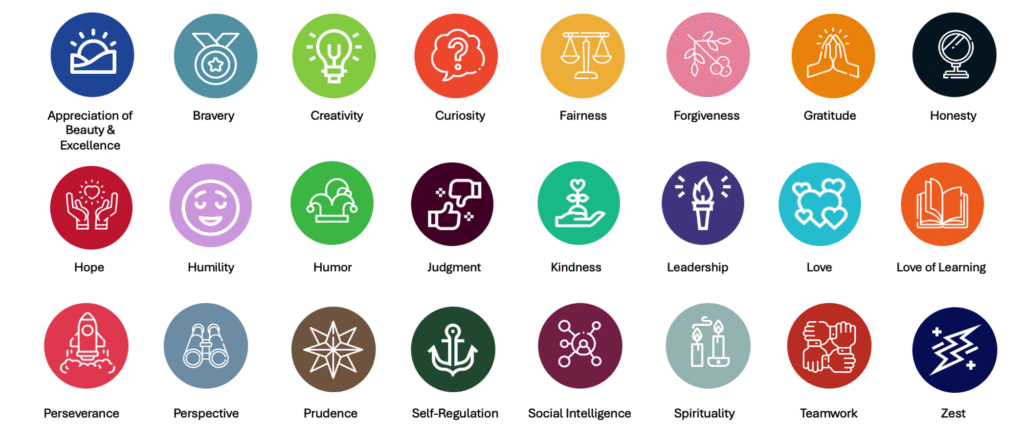
The VIA character strengths framework has become my go-to tool for career coaching and self-awareness development. These 24 character strengths make up the best aspects about our personality.
Developed by researchers in positive psychology, the VIA character strengths framework proposes that everyone possesses all 24 character strengths in varying degrees, so each individual has a unique personal profile. Each character strength falls under one of these six broad virtue categories, which are universal across cultures and nations. The framework uses simple but thoughtful language to describe each strength, applicable across a variety of contexts, and the survey is free to access.
Why VIA Character Strengths?
Because the VIA framework is underpinned by robust research, easy to understand, has wide application and is freely accessible, the VIA survey of character strengths has become my top choice for developing self-awareness – one of the foundations of developing your own career. I’ve written on the topic of character strengths in career development and have spoken about it on two podcasts. One of the podcasts came about in the most serendipitous fashion – I was scrolling through my LinkedIn feed and came across a call for guests on a podcast program to talk about assessments in coaching. The VIA survey immediately came to mind and after a couple of emails and a thoroughly enjoyable recording session, I’m really proud to have shared my heart about character strengths and how doing the survey and pouring over my personal profile has personally transformed my career perspective at a time of job redundancy. For international professionals facing career uncertainty or workplace transitions, understanding your character strengths can provide an anchor of self-knowledge in times of change.
You can’t hide a light under a bowl. Apart from running monthly workshops on character strengths at the university where I work as a career consultant, I’ve run a few webinars on the topic, including a session for the 2025 Higher Education Summit that came about in yet another serendipitous manner. Once again it was my LinkedIn feed that led me to a post on the summit. After reading about the background, the call for contributions and one of the themes of emotions, well-being and inner development, it became clear to me: this was an opportunity to share my character strengths workshop to a global audience! Strength in action: Spirituality.
Taking Character Strengths Global
I took a leap of faith and put together a proposal for the webinar, not knowing much else about the summit or the people who would attend. The proposal was accepted, I prepped for the webinar and up till the last few minutes before the start time, I had no idea how many would turn up. We ended up with a cosy group of eight people from different European countries and backgrounds, and had a precious time of open sharing and discussion of how we can apply character strengths in scary times. Connecting with higher education students and professionals from another continent also helped me to fulfil my dream of expanding my impact on international professionals. Strength in action: Zest.
Building Community: The CDANZ Special Interest Group
However, what I am most proud of is establishing the CDANZ Special Interest Group on Character Strengths. Sharing best practices and learning together with a professional community requires not only time commitment but also active participation. I started with a simple belief that good things cannot be kept hidden and ran a character strengths webinar for CDANZ members with a call for interest in a special interest group (SIG). We had enough numbers to confidently launch the SIG and the three meetings we’ve had to date have helped to create a warm and inclusive group who are generous with sharing and deeply reflective. The smooth running of these online meetings would not have been possible without the assistance of a colleague who helped with refining meeting activities and reflection exercises, as well as providing technical support during meetings. There were times when I wondered if all these hours of prep and admin was going to result in any significant gain. But when I think back to the various aha moments and learning reflections at the SIG meetings, I realise the intrinsic value of talking about strengths in a safe and supportive environment. It is ultimately a service to my professional community in the belief that learning comes through reflection, and transformation through application. Strength in action: Gratitude.
International Career Portfolio Rebalance
An important part of my own international career development this year was reviewing my portfolio career strategy and how I could make a bigger impact. Strategy for me is not a one-day meeting to work out what’s important and what to discard, but more like a meandering experiment until I find my answer. I don’t recommend this approach for everyone but with Spritiuality as my top character strength, followed closely by Creativity and Zest, I knew I couldn’t help but connect with people, try out new ideas, and with a full tank of energy.
Sure I overused these strengths on many occasions, but I also learned to recover in equal measure through silence and rest. There are ways to bring these strengths into optimal use but I honestly much rather overuse them and find ways to compensate at later times. And over time I’m sure I’ll recalibrate the balancing act. But for now, I’m very much driven by the motto: Carpe diem, seize the day, make your lives extraordinary.
Finding My Themes Through Writing
Through the process of more regular blogging and starting a monthly newsletter International Career Journey (on LinkedIn and Substack), I’ve clarified what my portfolio career stands for. I’ve gravitated towards these core themes for international professionals:
- Navigating cross-cultural workplaces and transitions
- Future proofing your career by building portfolio careers
- Self-awareness through character strengths and critical reflection
These themes aren’t just what I write about. They’re the foundation of how I’m building my own portfolio career.
Adding Portfolio Skills through my Instagram Experiment
Part of rebalancing my career portfolio meant adding new skills and experimenting with different mediums. I’ve been experimenting with creating content for my Instagram account. I wanted to learn more about media content creation and how easy – or difficult – it would be to learn and to implement on a regular basis. The learning curve was steep! They say reels are the primary tool to drive engagement, and I’m still learning about what makes a good 3-second hook.
Apart from self-taught lessons on trending audio, reel length and hooks, I also learned about the fleeting nature of attention, how the medium is the message, and admittedly, a personal sense of helplessness in never being able to keep up with the latest trends and algorithms in instagram worthy engagement. But this is part of portfolio career building: trying new things, discovering what fits, and letting go of what doesn’t. I’ve learnt to stop competing and comparing and focus on creating moments of insight with a bit of fun and flair.
From Experiment to Clarity: Portfolio as Process
And where has this meandering experiment taken me?
From working to ‘impossible’ deadlines (and meeting them anyway) to a place of pause and reflection.
From scattered activities to intentional choices.
This year taught me that portfolio career strategy isn’t about having everything figured out. It’s about staying true to your core purpose while remaining open to unexpected opportunities. The professional development courses, character strengths workshops, newsletter writing, Instagram experiments – each was both planned and spontaneous, controlled and chance-driven.
I don’t need to have absolute certainty of what my portfolio looks like. What matters is the clarity of purpose that guides every decision: To expand my influence and impact on helping international professionals thrive on their career journey, whichever stage and place they may be.
The portfolio isn’t fixed. It’s a living, evolving composition, constantly being rebalanced as new opportunities emerge and priorities shift.
As I bring up the image of Jackson Pollock’s Convergence once again, I stand in awe of the masterpiece that is a result of chance and control.
For anyone on their own international career journey, I hope these reflections on professional development, character strengths, and portfolio career building offer both inspiration and practical pathways forward
Carpe diem, seize the day, make your lives extraordinary.
Frequently Asked Questions About International Career Development
Q: What are VIA character strengths and how do they help with career development?
The VIA (Values in Action) character strengths are 24 universal qualities that represent the best aspects of our personality, developed by researchers in positive psychology. They help with career development by providing a foundation of self-awareness. This helps you understand what energises you, how you naturally approach challenges, and where you might be overusing or underusing certain strengths. For international professionals, understanding your character strengths becomes especially valuable during career transitions, as they remain constant even when your environment, role, or workplace culture changes.
Q: How is professional development different between New Zealand and Singapore?
The key difference lies in structure and responsibility. In Singapore, particularly in government and education sectors, professional development is systematically integrated with performance evaluation and career advancement, with nationwide workforce development blueprints and significant subsidies. In New Zealand, professional development tends to be more individual-driven. You’re expected to identify your own needs and advocate for them, with organisational support varying widely. This means international professionals in New Zealand need to adopt an entrepreneurial mindset toward their own development, actively designing their learning pathway rather than following a prescribed route.
Q: What is a portfolio career and is it right for international professionals?
A portfolio career involves combining multiple roles, projects, or income streams rather than relying on a single traditional job. It might include consulting work, part-time employment, freelance projects, and passion ventures all at once. For international professionals, a portfolio career offers flexibility to leverage diverse skills across different contexts, build resilience against job market uncertainty, and create opportunities that traditional employment might not offer. This is especially valuable when navigating visa restrictions, credential recognition challenges, or wanting to maintain connections across multiple countries.
Q: How can character strengths help during workplace transitions?
Character strengths provide an anchor of self-knowledge during times of change. When you’re navigating a new workplace culture, adjusting to different management styles, or facing job uncertainty, your character strengths remain constant. They help you identify what you naturally bring to any situation, recognize when you’re in flow versus when you’re struggling, and make strategic decisions about roles and opportunities that align with your authentic self. This is particularly powerful for international professionals who may be adapting to unfamiliar workplace norms or rebuilding their professional identity in a new country.
Q: What does ‘planned happenstance’ mean in career development?
Planned happenstance is the idea that careers develop through a combination of intentional action and being open to unexpected opportunities. Rather than rigidly following a predetermined career plan, you create possibilities by staying curious, persistent, flexible, optimistic, and willing to take risks. In my own journey this year, planned happenstance showed up when I responded to opportunities I found scrolling through LinkedIn, such as the podcast invitation and the Higher Education Summit, without knowing exactly where they would lead, but trusting they aligned with my broader goal of reaching international professionals. Here’s another article I wrote about planned happenstance: Planned Happenstance – How to Make your Own Career Luck
Q: How do I start building self-awareness for career development?
Start with free, research-backed tools like the VIA character strengths survey (viacharacter.org). Take time to reflect on your results, not just your top strengths, but also your lower-ranked ones and what that pattern tells you about yourself. Combine this with regular critical reflection on your work experiences: What energises you? What drains you? When do you feel most authentic? Consider working with a career coach who can help you explore these patterns and translate self-awareness into actionable career strategies.
Q: What skills are most important for international professionals to develop?
Beyond technical skills in your field, focus on cross-cultural communication and adaptability, the ability to translate your experience across different contexts, resilience and flexibility in the face of uncertainty, networking across cultures and platforms, and continuous learning mindset. These meta-skills help you navigate different workplace cultures, explain your value to employers unfamiliar with your background, and stay agile as workplace expectations evolve.
Q: How can I expand my impact as an international professional?
Consider creating content that shares your unique perspective whether through blogging, newsletters, social media, or speaking opportunities. Join or establish special interest groups in your professional community. Facilitate workshops or webinars on topics you’re passionate about. Look for ways to connect with international audiences through platforms like LinkedIn. The key is finding your authentic voice and the themes that matter most to you, then consistently showing up to share your insights and learn from others’ experiences.
Work With Me
Throughout this post, I’ve shared my journey with professional development, character strengths, and building a portfolio career as an international professional. Now I want to support you in your international career journey.
I’m Dr Sherrie Lee, an international career coach with certifications as a Certified Career Services Provider (CCSP) and ICF-accredited Positive Psychology Coaching. I specialise in helping international professionals, migrants, and academics navigate cross-cultural workplaces, career transitions, and building careers that truly fit.
Based in Wellington, New Zealand, I work with clients globally through one-on-one coaching, workshops, and speaking engagements.
Ready to take the next step in your international career journey?
Whether you’re navigating a career transition, exploring a portfolio career strategy, or seeking clarity on your professional direction, let’s have a conversation.
Book a free 20-minute discovery call to discuss where you are, where you want to go, and how I can help you get there.
Carpe diem, seize the day, make your life extraordinary. And remember, you don’t have to do it alone.