They say this 3-year solo flight of a PhD journey is one fraught with anxiety, self-doubt, and a lot of other negative stereotypical emotive words, whether related to the student, supervisors, and the monster called Thesis. I’m an idealist. When I embarked on my PhD studies, I made up my mind to make it a positive experience, no matter how I felt, with whatever resources I had.
9 months into the journey, flight, any metaphor of your choosing, I’ve had to deal with those stereotyped feelings and emotions, whether it was from me, or proffered by others. Was my candle snuffed out for good? Did my grand ideas and ambitions count for nothing? Had my idealised vision of an emergent scholar come to terms with reality? I was tempted to admit defeat and claim the messiness and roller-coaster emotions as normalcy, but I couldn’t, and didn’t.
A particular incident prompted me to reflect deeply about what I’ve been through. I talked to others, considered my options, and was in between feeling resigned to my fate, and feeling indignant about my situation. Then I took up the advice of a senior PhD student who had gone through a similar situation. One action led to another, and these actions opened up possibilities. Through the process of exploring what I could do, I managed to step away from myself, my situation, and considered things in a less emotional and more critical and objective manner. It helped that I was away for a few days in Wellington for a student conference, and that experience also helped re-framed my outlook on my PhD.
I’ve taken steps to move away from self-pity, and to create a more nurturing environment where I believe my ideals need not be be displaced, but work alongside the twists and turns of PhD life.
I do not discount the effects of academic isolation that a 3-year PhD model brings, but I do not believe the PhD student needs to buy into the narrative of doom and gloom. My PhD studies were motivated by sociopolitical ideals and personal goals. I’m not about to let the dream fade into a distant memory.
I was nominated by the Faculty of Education at the University of Waikato to attend an event organised by Education New Zealand (ENZ). The event is called Student Voice and it provides the opportunity for internationals students to network, and for ENZ to hear from the students themselves about their educational experiences in New Zealand. This year’s Student Voice was named ASEAN Student Voice 2015, in celebration of 40 years of partnership between New Zealand and ASEAN (Association of South East Asian Nations). It was held on 11-12 August, 2015 in Wellington.
I met 29 other international students from Brunei, Cambodia, Indonesia, Laos, Malaysia, Myanmar, Philippines, Thailand, Singapore and Vietnam, as well as 10 Kiwi students who had previously spent some time studying in ASEAN countries. The 40 of us spent two days discussing issues international students face, as well as learning from representatives from government, educational institutions, and private companies.
It was a packed programme, rich with ideas, possibilities, and inspiration. There were practical tips for job search and interview skills, as well as perspectives of what international education means for New Zealand. I was especially inspired by Simon Chu from Otago University, Lester Khoo from AUT, and Jimmy Walsh from Beca. While Simon and Lester shared their personal stories and motivations for building networks with international students, Jimmy spoke about the increasing importance for New Zealand to engage with ASEAN countries.
Despite a full programme, there was time during breaks and meals to interact with the participants. I formed new friendships and also had the opportunity to discuss my PhD research with fellow participants. My research on informal learning practices of international students struck a chord with many and I received insightful comments and encouraging words.
I didn’t have much time for sightseeing but managed to see a good part of the city early Wednesday morning. You can’t beat Wellington on a good day, as the locals say, and I’m blessed to have been in Wellington on a good day. Instead of ducking my head in wild wind, I faced the rising sun along the waterfront, and ambled along the streets as the city came to life.
I left my heart in Wellington. The city reminds me of San Francisco – the waterfront, the hilly landscape, and a vibe that makes the city come alive.Chanced upon a magazine shop tucked behind a coffee place. Apparent, only one of two in New Zealand. The other of its kind is in Auckland. Here, I found serious reads and childhood favs (Beano!). Picked up kids mags that came with freebies.
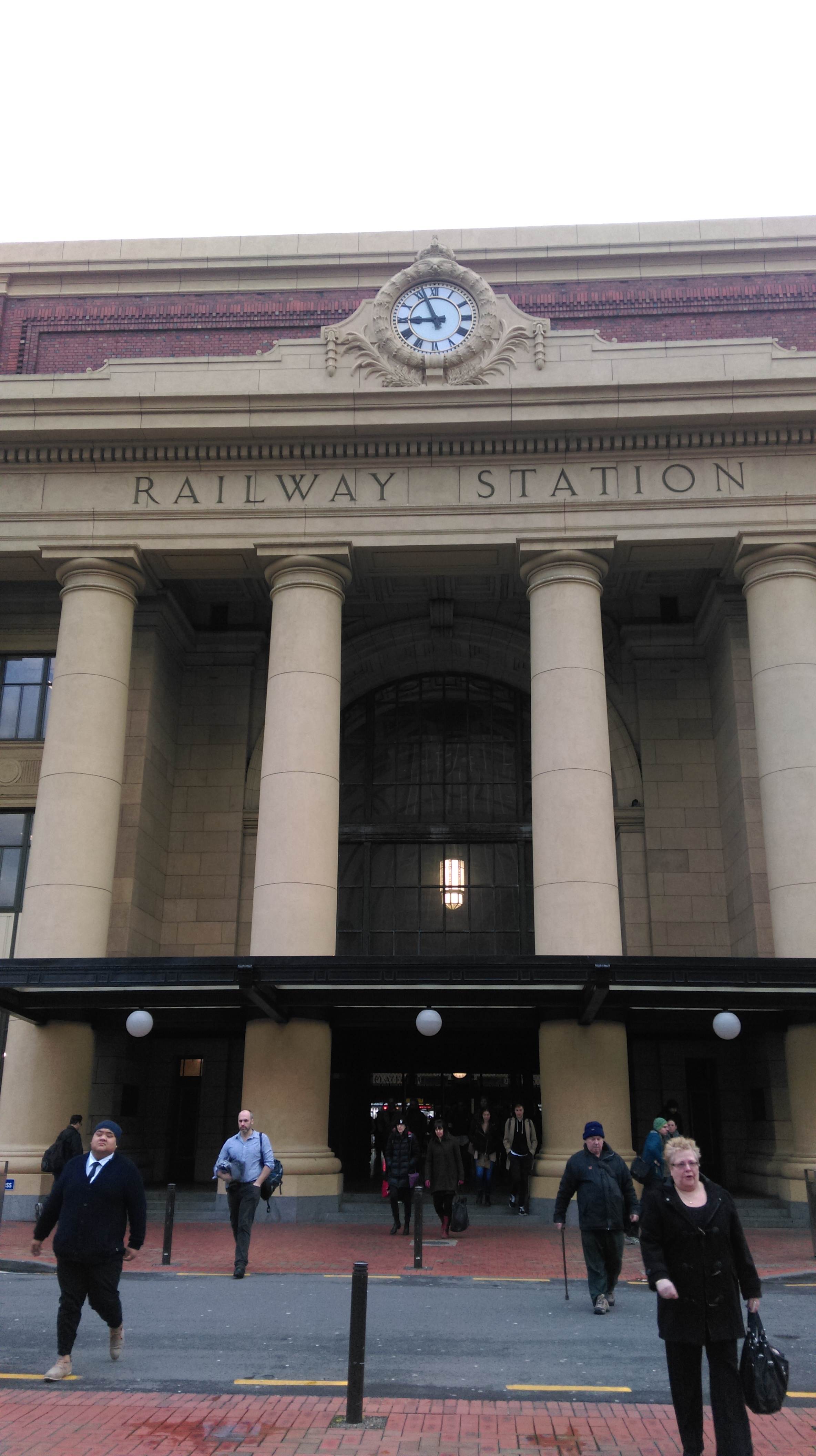
The Railway Station. A regular means of transport between suburbs and city.
The timing of ASEAN Student Voice 2015 was also opportune for personal reasons. I was invited to attend a gala dinner organised by the Singapore High Commission in celebration of Singapore’s 50th National Day. I had never been so excited to be part of a Singapore community since leaving home more than nine months ago.
A cultural performance by a Singaporean arts group flown in for the occasion.A mishmash of Singapore dishes – or rather, a Kiwi version of Singapore dishes. Somewhere in there was Chicken Rice.The final course of our gala dinner – a dessert platter with Kiwi and SG elements. The only recognisable dessert for me were the three chocolates.A spontaneous selfie moment with the Singapore High Commissioner, His Excellency Mr Bernard Baker and his lovely wife, Susan.
Reflecting on ASEAN Student Voice 2015, I am impressed with New Zealand’s commitment to creating a positive international student experience, and even more impressed with the passion and personal convictions of the speakers. Their common message was about relationships – cultivating meaningful and long-lasting relationships between New Zealand and its ASEAN neighbours.
Group photo with Minister for Tertiary Education, Hon Steven JoyceGroup photo from Education New Zealand (taken from FB page – Study in New Zealand)
I now have a renewed vigour for my research, and a clearer vision of how my New Zealand journey can make a difference in the international student experience for my immediate community and beyond. I’m grateful to have had this experience and look forward to many more.
Postscript (19 October 2015): Read the article by Education New Zealand about Student Voice 2015.
I’ve been writing and writing and wondering when it’ll end. It doesn’t, it won’t, but there’s always good reason to pause for thinking, re-reading, and letting go. Just when I thought I was going down the path of one idea (that is, providing an alternative to the deficit discourse on international students), it became apparent that chasing that idea was becoming trite and ultimately, not answering the ‘so what’ question. Lately, I’ve realised that while I’ve spent a considerable amount of effort in pursuing an idea, I have to let it go in favour of a better one.
This whole business of writing and refining your proposal is an exercise in building up stamina, finding new routes, and being persistent in moving forward. A bit like digging a tunnel – you just have to keep on digging until you’ve reached a place where it’s safe to pop your head out into the light!
There have been times when I feel shrouded in the darkness but I always try to avoid being isolated in private intellectual thoughts. There may be some romanticised view of the solitary academic producing voluminous work in a corner of a cafe filled with the aroma of coffee (and in real life, I can actually see this in a professor I know!), but I am no lone ranger and find it dangerous to entertain thoughts of solitary confinement.
The journey may be my own, the destination of my choosing, but my travel companions and pit stops make the journey and bring me to my destination. By companions, I certainly mean more than books and the computer. I do mean people – real human beings who complain about bad weather in the same breath as waxing lyrical about Bourdieu. Sometime more weather, sometime more Bourdieu. (By the way, Bourdieu is not a type of wine.) And those seminars scattered around, social things that happen in between or in sheer serendipity, and whatever you do with people all other times.
I’m a full-time doctoral student but I’m also a full-time person interested in meaningful exchanges and changing the world. (Yes, changing the world, one word at a time, one child at a time, one friend at a time.) I will dig many tunnels yet. And miles to go before I sleep. And miles to go before I sleep.
I can’t write without them. I mean thoughtful, focused writing when your mind could wander off on another theory, another concept, another methodology.
I can’t think without them. I mean fast and furious thinking to complete paragraphs of thought formation, to decide when to review and revise, to decide when to cut it down, throw it out, and move on.
I can’t relax without them. I mean truly be at ease and appreciate other things (like blogging) – after the deadline. What is rest if there is no stress?
Today marks the start of Month 5. I have exactly two months before my application for confirmed enrolment is due. This is a crucial point in the phd journey here at Waikato. Once I’m confirmed, I move from being a student to a candidate, and work on the phd research can start proper.
I’m not sure if I can meet this all important deadline. I know there’s the option to extend the deadline but I’d rather not if I can help it. Unless my supervisors think I need the extension, I’d like to stick to the deadline.
Sure, it’s stressful to have to keep up with revising my work, reading for purpose rather than for intellectual curiosity, and working at every available hour in order to meet deadlines. But in the pain, there is gain. I’m learning how not to waffle through ideas, honing my skills at paraphrasing summarising, critiquing, and developing original thought.
Without deadlines for writing, as it was in the first few months, my time was spent reading and thinking and making notes, but in a rather loose fashion. I felt I had something important to say, but I didn’t have to present these thoughts formally, and so they were left as that – informal, inside, inert.
Writing, not just any kind of writing, but writing for purpose, for someone to read and critique, within a reasonable time frame, shapes thought. The act of writing, entwined with thinking and reading, must be the vessel for those ideas. And those pressing deadlines that create pockets of time when there were none, is the fuel to keep the vessel afloat and moving.
I’ve just met a writing deadline today. It is a feeling of sweet relief. Now, I rest. I thank God, for he arranges the best schedule, that this period of rest is during the Easter weekend. A time with the family away from home. A time to rest from writing (and thinking and reading). A time to count my blessings.
It has become clear to me that pursuing full-time academic or research work revolves around writing. There’s thinking, reading, musing, but writing is the central activity that binds all the activities of scholarship and knowledge finding and creation into a visible, searchable, reflect-able artifact.
To be able to understand my writing and reading patterns, and to track the work I have been doing and need to do in the next steps, I have created a writing/reading log. It is an excel spreadsheet (I use Google Sheets) with columns for date, time, activity and comments. I was skeptical that I could keep up with a mundane task as this but after a few days into logging, I can see the benefits.
First, it helps me to track how long I spend on various tasks. By logging the start and end time of a particular activity, I can see how long I have taken to write a few paragraphs, or clarify a thought. With this log, I realise that it can take all of two hours to write three paragraphs, and part of me wants to shorten that time, but the other part of me is thinking that I need to allocate that time in order to think and write.
Second, with the comments column, I write down what follow-up work I need to do, for example, extend the argument or find more references. These comments are important so that I don’t forget what I need to do when I start the next writing activity. Previously, I used to spend time figuring out what I had thought about the previous night before I could carry on.
Thirdly, this log helps me track my overall progress and serves as an encouragement to keep on writing and reading! It also helps with planning what to do and when do do it in order to meet deadlines.
With a busy household of three school going children, I welcome tools to increase my productivity but more importantly, to help me improve my writing habits. This blog post, for example, will be logged as an activity so that I can track how often I blog and how long it takes me to write.
Seize the day! Tomorrow may throw you a curve ball but take each available moment and make it count. Having a log will help you count that moment!