Close

Book Review – The Anti-Education Era: Creating Smarter Students Through Digital Learning

Book Review - The Anti-Education Era: Creating Smarter Students through Digital Learning

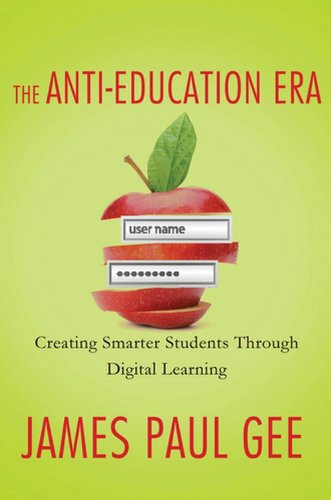
Title: The Anti-Education Era: Creating Smarter Students Through Digital Learning

Author: James Paul Gee

Publisher: Palgrave Macmillan (January 8, 2013)

The Anti-Education Era: Creative Smarter Students Through Digital Learning by James Paul Gee

Before we can be convinced of the need to get smart through digital learning, we need to be convinced of our own stupidity.

The title implies that the book will explain how digital leaning will create smarter students in an era the author terms ‘anti-education’. While Gee does explain that and does it well without much reference to buzzwords in educational technology, what the title (as well as the blurb) does not warn us is that there will be a confrontation of the state of the human being and an uncovering of the failings that we are oblivious to. In fact, Part I of the book, which comprises 15 chapters, is plainly titled ‘How To Be Stupid’, while Part II, titled ‘How To Get Smart Before It Gets Too Late’,  has just six chapters.

In other words, before we can be convinced of the need to get smart through digital learning, we need to be convinced of our own stupidity – and Gee does that by exposing mental comfort stories, the dangerous lack of agency or purpose among members of a community (or citizens of a country), and the damaging consequences of our stupidity, e.g. self-deception, inequality and hopelessness.

Unapologetic and deeply convinced for a smarter and more moral world, Gee writes simply and candidly to question our assumptions about education, the economy and society, and calls us to action: to connect, collaborate and create collective intelligence.

I touch on a few of Gee’s arguments that have struck a chord with me.

First, the bad news

HOW SCHOOLS MAKE US STUPID

Humans have the capacity to be reflective and thereafter embark on good actions. Gee calls this the Circuit of Human Reflective Action. The conditions for smart actions to take place are:

1) Initial mentorship so we can learn from people and experience in specific areas/domains;

2) Lots of prior experience;

3) Clear goals;

4) The actions and goals must matter to us emotionally;

5) There is an opportunity to act in a way that elicits a meaningful response from our community (local/global).

Unfortunately, much of formal schooling is highly passive with students imbibing knowledge without much opportunity to take meaningful action based on what they have learned. The lack of a compelling or meaningful goal of studying and attending school is exacerbated by the focus on testing and gate-keeping examinations. Furthermore, some students have initial mentoring (in the form of parents, out-of-school experiences, etc.) and some have not; nonetheless, “we pretend they are on a level-playing field” (p. 16-17).

WHEN STATUS AND SOLIDARITY DIVIDE US

Status and solidarity are powerful cultural forces that shape our identity and influence our everyday actions. We seek status in terms of respect from others. We also seek solidarity with other in order to have a sense of belonging and being accepted.  Such forces, however, may dull our senses and better judgment when status and solidarity become the only end goals of a meaningful life.

As a consequence, we accept and perpetuate particular world views and actions contrary to empirical evidence and facts, common sense and moral standards. For example, aspiring to own a club membership like your peers when your income cannot support it; indulging in bullying tactics along with your buddies when you know the bullied is distressed. These examples may appear trivial but they scratch the surface of a world beset with social ills and inequalities.

In our limited world of people who we want to like us, and people we want to be like, we disregard more rational thought and action, and more sadly, disregard other humans who fall below our flawed standards of human existence.

Now, for some good news

AFFINITY SPACES FOR ALL

In order to engage our students in more critical and reflective thinking, we need to lead them to an affinity space where a community of learners who share common passions and goals. They may come from a variety of backgrounds and have varying levels of experience and expertise, but by exchanging ideas, opinions and thoughts with one another, the group solution to the challenge is going to be superior to an individual’s effort. “[H]umans think and act better when we do so by getting the help of others and giving help to them” (p. 174).

Such affinity spaces would look like discussion boards and interest groups related to the simulation video game The Sims where players find ways to create objects of their desire such as building their dream house and accessories, as well as the various user-generated communities where players interact with one another.

I do believe that affinity spaces are not limited to an online environment and it is important to have real-life face-to-face connections in any affinity space to encourage authentic relationships among learners.

Exactly how affinity spaces are to be constructed is not the focus in Part II of the book but the end is really the beginning of our conversation of how to make use of our 21st century tools to enhance our student’s thinking, reflecting and doing while creating purposeful goals for them in a diverse and global community.


How I Use Open Educational Resources (OER)

How I Use Open Educational Resources

Open Educational Resources (OER) are increasingly important when we consider the breadth and depth of material that are being produced by educational institutions, media production companies,  and even individuals. Equipping my students with web-based resources allows both my students and I to have access to high-quality and up-to-date information, whenever we need it, wherever we are. This frees me from creating teaching material from scratch and enables me to focus on teaching in class.

Watch a brief interview I did with Learning Academy , Temasek Polytechnic, Singapore:

http://www.youtube.com/watch?v=LTiCr2dw0JM

Let me share some of the OERs I have used :

1. The Purdue Online Writing Lab (OWL) OER: Purdue OWL


For me, the most useful resource on this site is the section on APA Style. It contains sections on how to cite and reference for different reference materials, including print, web and recorded material. The information is presented in an easy-to-read format with clear examples for readers to follow. The information is also easily searchable which makes navigating a content-heavy website less onerous on the user. The Purdue OWL is a great example of how one educational institution creates and maintains educational resources and makes it available for free for educational use.

Terms of use of Purdue OWL materials in the classroom: https://owl.english.purdue.edu/owl/resource/551/01


2. Howcast Media, Inc

OER: Howcast Media, Inc.


Howcast is a media production company that specialises in high-quality and entertaining instructional videos. The videos are usually no more than 5 minutes long but contains enough information to keep the audience engaged. I have used their videos on presentations, writing and questionnaires in my classes. My students usually perk up when the lights dim and the video comes on.

Terms of use of Howcast videos in the classroom: http://www.howcast.com/faq


3.  The YUNiversity

OER: The YUNiversity


The  YUNiversity is a blog (and more) on grammar tips presented in an off-beat, humorous and engaging manner, and is especially suited for the current generation of youths. They post on Tumblr, Twitter, Pinterest, Instagram, Medium and handle Q&As on ask.fm The YUNiversity is managed by an English graduate from the University of California at Berkeley and his wife. I share their posts on grammar tips with my students on social media platforms like Facebook and Twitter.

Terms of use of The YUNiversity materials in the classroom: Not obvious but here’s the link to their FAQs: http://www.theyuniversity.net/FAQ


OERs are indispensable in any classroom. I hope this post has got you thinking about exploring the world wide web of wonderful educational resources!


The Science of Character – Thinking About Grit

The Science of Character - Thinking About Grit

It was Character Day on March 20, 2014. In celebration of, and also to facilitate discussion on character strengths, there was the global cloud film premiere of The Science of Character, “an 8-minute film that explores fascinating new research on character development and our ability to shape who we are” (Let It Ripple website).

The Science of Character – an 8 min film directed by Tiffany Shlain (Twitter: @tiffanyshlain)

Directed by Tiffany Shlain, the film promotes the idea that we can cultivate character by building on our strengths, instead of focusing on our deficits. The central organising structure of character is what has been coined a periodic table of character strengths, which is, in fact, fashioned from the VIA Classification of Character Strengths. The classification itself comes out of a landmark publication, Character Strengths and Virtues written by the late Christopher Peterson, one of the founders of positive psychology, and Martin Seligman,  Director of the Center and a Professor of Psychology at the University of Pennsylvania.


Periodic Table of Character Strengths

Periodic Table of Character Strengths from The Science of Character

While the table is a neat way of categorising 24 virtues common across cultures and time, the VIA Institute on Character reminds us that character strengths were conceived as “dimensions and not as categories” and that “[p]eople have more-or-less of all the strengths and not simply a set of discrete strengths versus weaknesses” (VIA Institute on Character, para 7). This is an important point to note as the periodic table may lead to an inventory list ticking exercise, thus reinforcing a false dichotomy between what we are and what we’re not.

To begin to understand the complexity of the character traits, I started with Grit, a trait I see in myself developing over the years. As part of the film’s premiere, there was a series of Q&A sessions with the experts and I  joined a Google Hangouts session featuring Angela Lee Duckworth, the expert on grit and how it contributes to student success.

Angela Lee Duckworth speaks on Grit

I first came across Angela’s work on TED. Today’s expert chat session on Grit brought up discussions on whether there could be too much virtue, and whether grit could be instilled on demand or something that simply needed time to be developed.

To help explain Grit, Angela provided a metaphor of the Christmas Tree where the various levels of goals are hierarchically organised, with the shining star as the highest and unchanging goal underlying Grit. For example, if my highest level goal is providing free education to poor children, my lower level goals could range from studying for a Masters or PhD, setting up projects, and networking. I should be adaptable and flexible with these lower level goals, for example, if I don’t succeed in one project, I can look at starting a new one. However, the overarching goal of free education to the poor does not change. If it did, I wouldn’t be displaying Grit toward my final destination.

The Christmas Tree metaphor is helpful in understanding why sudden bursts of energy for short periods of time does not really count toward Grit, but rather, a deep interest that you hold over a period of time does. The fact that Grit requires stamina and patience also means that older people will exhibit Grit more often than younger people.

I look back on my twenty-something self and see several bursts of energy and nothing close to Grit. Comfortably into my thirties, I have discovered what I’m passionate about and Grit will serve me for the long run.

Character Day may have come and gone but let the Character Conversation continue, with experts, with each other, with yourself.

Sources

Peterson, Christopher, and Martin E. P. Seligman. Character Strengths and Virtues: A Handbook and Classification. Washington, DC: American Psychological Association, 2004. Print.

Shlain, Tiffany & The Moxie Institute Films. “The Science of Character (a New 8 Min “Cloud Film”).” YouTube. YouTube, 20 Mar 2014. Web. 20 Mar. 2014.

TED. “Angela Lee Duckworth: The Key to Success? Grit.” YouTube. YouTube, 09 May 2013. Web. 20 Mar. 2014.

VIA Institute on Character. “Guidelines on Use and Interpretation.” VIA Character Use and Interpretation. N.p., 2014. Web. 20 Mar. 2014. http://www.viacharacter.org/www/en-us/viainstitute/useandinterpretation.aspx.

Are MOOCs the future of learning?

Are MOOCs the future of learning?

With the ongoing discussion of whether MOOCs (Massive Online Open Courses) is the next revolution in education, I decided to embark on a MOOC myself. My first experience with online courses was not Massive nor Open. It was with the Master of Arts in Teaching program with USC. It was a full-fledged master program conducted via video conferencing which meant real-time interaction with professors and classmates. Having thrived in such an environment, I look to MOOCs with great expectations of lifelong learning without a hefty price tag or any price at all if possible.

My first experience with MOOCs was a shaky one. I can’t really say I fully experienced it since I was never fully engaged with the course. There was one course I did with Open2Study and another with Coursera. Both courses were related to learning and education but somehow there was too much going on in my life in the time I was supposed to complete it. The Open2Study course was conducted at a pace which required almost daily attention that I quickly abandoned it altogether. The pace of the Coursera course was much better but I still couldn’t keep up with the myriad of activities that were going on and felt pretty much a non-student. Without a concerted effort and a “studying” frame of mind, those two MOOCs amounted to a faint memory of videos and catchphrases.

Still hoping for a better outcome with MOOC, I recently enrolled for a Coursera course, History and Future of (Mostly) Higher Education, offered by Duke University and am now in the fourth week of the six-week course. This time I was more prepared to set aside some time to do the course. The first week, however, went by in the flash and I only caught up with the video lectures in the second week.

What got me hooked was the high quality video production with a friendly and engaging presenter  (Professor Cathy N. Davidson) and useful presentation pointers appearing from the side. It a short period of 10 to 15 minutes, I learned important concepts and got thinking about the implication of technology in education. The videos were stimulating enough for me to anticipate the following week’s materials.

One of the tools used in the course is forums which drive a socially-connected and engaging form of learning. I was not, however, particularly drawn to the forums because I am inundated enough with articles, debates and discussion on Twitter (my daily feed of news and trends). Furthermore, as a non-fee-paying student, I am just not as motivated to devote time and energy to share and exchange ideas with strangers, even if it means learning new things.

Professor Cathy Davidson reviewing guiding principles of the course

To me, the outcome of watching the videos was immediate knowledge. I could watch the videos anytime and in between tasks and gained a lot from a relative short span of focused attention. Forums, on the other hand, required more thoughtful and time-consuming contribution which had a less obvious reward. There was no tangible carrot nor stick to motivate the more socially engaging aspect of the course. I am a full-time working mother with three young children, and this makes me evaluate how worthwhile any pursuit is on an ongoing basis.

 Modes of learning aside, let me move on to what I have been learning so far: 1) We’re teaching like it’s 1992; 2) We need to teach for the future; and 3) Our conception of reality is created through the filter of our own mind and perception.
Pen & paper | Flickr: Loops San

Technology and communication practices have evolved since 1993 but education seems to be largely stuck in the days of pen and paper, individual summative assessments and the like.

1) We’re teaching like it’s 1992.

The significance of 1992 was lost on me until I learnt that the Internet was opened to the world on April 22, 1993. Since then, anyone with an internet connection could communicate with one another, expressing what they wanted, when they wanted, how they wanted. Technology and communication practices have evolved since 1993 but education seems to be largely stuck in the days of pen and paper, individual summative assessments and the like.

Personally, I find this to be true in Singapore. National examinations are in the traditional vein of individual summative assessment of the highest order, to the extent of determining your lot in life (whether perceived or real). In post-secondary institutions, however, coursework is more prevalent, especially at the polytechnic. There is a mix of individual and group assignments, some more collaborative than others, but not quite exploiting the full potential of our current technologies.

One reason behind this phenomenon of teaching like it’s 1992 is the fact that educators have grown up in the world pre-1993 and were schooled through and through in the ways and sensibilities of the time before the Internet. I certainly was. Some are looking forward to the future but many are comfortable and used to the past. Whatever the arguments are for staying put and not rocking the boat, I think there are more compelling reasons to decide that we have to change and act on it.

Digital literacies | Flickr: dougbelshaw

It’s not about getting students through a course on digital literacies, it’s about practising digital literacies in and out of the classroom.

2) We need to teach for the future.

I believe that we need to teach our students digital literacies. The post-1993 generation was born into an Internet world of instant communication and gratification. Having taught such students for the past 5 years, I’m convinced that I am more digitally savvy that most of them. They may have the latest gadgets and apps, but most of the time they are too trusting of the first few Google search results, think that, in fact, Google is the originator of the information, and pay little attention to issues of privacy and ethics.

I don’t think students are mastering how to evaluate internet sources because there is a (wrong) assumption that they are naturally digitally savvy and so teachers pay scant attention to this aspect of learning. To put another perspective on this issue, if there are no grades or tangible rewards attached to being digitally literate, students will not become literate. It’s not about getting students through a course on digital literacies, it’s about practising digital literacies in and out of the classroom.

We can never teach our students enough content for the future, but we ought to teach them how to navigate the future with greater critical analytical skills.

3) Our conception of reality is created through the filter of our own mind and perception.

One major concept I learnt and find so true in all areas of my life is Immanuel Kant’s concept of how our perception of the world is filtered by our own preconceived notions and ideas. If we see our students as well-oiled machines, responsive to instructions and high in productivity, then our approach to teaching and assessment will follow suit. Standardised testing, orderliness and measurable results become drivers of education.

While I believe that such a filter is outdated today and that a new filter of creative and collaborative learners is more appropriate, I feel trapped in a factory of deadlines where incomplete or faulty products or tossed aside. Most of the teaching my own children are experiencing right now is highly segmented, time-bound, and considered a done deal by way of tests. Creativity is relegated to physical activity and art lessons or specific assignments.

True creativity and collaborative practice can only be achieved if they are part and parcel of everyday learning – something I have never experienced in my own schooling experience but a future I hope for my children and their children.

A traditional classroom | Flickr: young shanahan

An online course can run like a factory if that’s the vision of the instructors. A traditional classroom can be turned into a laboratory of inquisitive minds if the teachers so wish.

So what about MOOCs?

Will MOOCs then be one of the solutions to instill creativity and collaborative practice in learning? MOOC is merely a vehicle. An online course can run like a factory if that’s the vision of the instructors. A traditional classroom can be turned into a laboratory of inquisitive minds if the teachers so wish. Granted that MOOCs has the potential of reaching out to more by using technologies that are innately collaborative in nature (e.g. forum posting, wikis, etc.), the challenge is to make use of that potential in a sustainable manner for a meaningful learning experience.

My own interaction with the current MOOC has been limited to watching video lectures so far. I have not set my mind on anything collaborative but I may if I find like-minded friends or colleagues who believe that it is a meaningful endeavour for their work or personal growth.

MOOCs can roll out its bells and whistles, but the choice is up to us to ride along with the revolution.

Educating Singapore – Moving Beyond Grades

Educating Singapore - Moving Beyond Grades

The latest PISA (Programme for International Student Assessment) results have placed Singapore among the top performers among 65 countries and economies who took part in the fifth assessment of 15-year-olds’ competencies in Reading, Mathematics and Science. We came in second in Mathematics, and third in both Reading and Science.

Not only are we in good company with our Asian neighbours like Shanghai (top in all three areas) and Hong Kong (third in Math and second in both Reading and Science), we have shown improvement in results in both academically weaker and stronger pupils. Our Education Minister is reported to be very happy and very proud of the results but I hope Singapore’s stellar performance at PISA will not undermine the need to improve areas such as equity and creativity.

S’pore can do better in ensuring educational equity
Singapore can do better in ensuring educational equity

A recent news report gave a more balanced assessment of Singapore’s PISA results, where OECD Deputy Director for Education and Skills Andreas Schleicher noted that Singapore is “a strong performer in (education) quality, but only an average performer in equity.” Educational equity is defined by OECD in terms of fairness and inclusion – providing all students, regardless of gender, socio-economic status or ethnic origin, have similar opportunities to achieving educational potential; and ensuring a basic minimum standard of education for all. By that definition, Singapore has progressed very well over the past few decades (from fishing village to global player) and has been considered the “poster child” for educational development (mirroring its economic success story) – see country report by OECD. We have reduced achievement gaps between genders and races, and have refined the process of teaching students according to their abilities.

Nonetheless, the education culture in Singapore is one driven by results of  high-stakes examinations which are the gatekeepers to the next level of education which in turn determine the type and quality of jobs students eventually land. While this is not a culture unique to Singapore, and certainly not as extreme as compared to South Korea and China, such a culture privileges those who have easier access to educational resources (e.g. private lessons, parental coaching, financial support). Furthermore, innovation and creativity take a back seat while grades get all the glory. Despite government attempts to downplay the importance of grades and asking parents to broaden their perception of their children’s success, parents are too pragmatic to give up the paper chase. Exam results continue to be the determining factor at each turning point of a child’s school life.

The Singapore Ministry of Education hails the latest PISA results as an indication that Singapore students “are ready to thrive in the 21st century.” To me, thriving means growing in a supportive environment where students can realise their potential and nurture their talents. To thrive in the 21st century also means having the capacity to change, innovate and look for new ways of doing things. I’m not sure if we can claim that all Singapore students are ready to thrive. Some have more resources to be able to thrive, some have fewer, and many have discovered the best way to thrive is to go to another country where there’s more to school than just getting good grades.

An education system is a product of philosophy, politics and societal values. I don’t believe there is something inherently right or wrong about using exam results to measure success. Neither do I believe that there is a level playing field for all children. What I hope our education system does not do is to reduce a person’s worth to the degree of educational attainment, and by extension, the financial rewards that come from it.

However the education game is being played, we must be critical of our successes and learn from our failures. Doing that will keep my hope alive.

Don`t copy text!